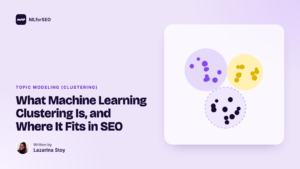
Customer segmentation divides a customer base into groups that behave or look alike. Done with machine learning, it uses clustering algorithms to find those groups in the data, instead of relying on segments someone guessed in advance. It is one of the most common and valuable marketing uses of unsupervised learning.
How it works
- Collect numeric data per customer, typically from a CRM, e-commerce platform or GA4: purchase frequency, average order value, recency, categories bought, engagement.
- Clean and scale the data so that one large-valued column (such as lifetime revenue) does not dominate the distance calculations.
- Run a clustering algorithm. K-means is the usual starting point; Gaussian Mixture Models allow softer, overlapping segments; density-based methods such as DBSCAN can flag outliers.
- Choose the number of segments with the elbow method, the silhouette score and, above all, business sense.
- Profile each segment (for example, high-value regulars, occasional discount buyers, new customers) and give it a name the team will use.
How it’s used in SEO and marketing
- Personalised landing pages and content for different user types.
- Targeted email and paid campaigns per segment.
- Content strategy: matching topics and formats to the questions each segment actually has, which supports conversions and engagement.
- Spotting high-value or at-risk groups early, feeding work such as churn prediction and lead scoring.
Example
In the Introduction to Machine Learning for SEO practical, an online shop clusters customers on purchase frequency, average order value and behaviour, then compares three clustering approaches. One segment buys often with small baskets; another buys rarely but spends a lot. The first gets replenishment reminders and loyalty content; the second gets premium product launches and detailed buying guides.
Limitations and things to watch
- Clustering always returns clusters, even when the data has no real structure. Read and test the segments before acting on them; the silhouette score and business review both matter.
- Results depend heavily on the features you include and how you scale them.
- Segments drift as behaviour changes, so re-run the analysis on a schedule.
- Customer data is personal data: follow GDPR or your local rules, minimise what you collect and avoid sensitive attributes.
- Too many segments are hard to act on. Ask whether the team can build a distinct strategy for each one.
Learn it on MLforSEO