 By Lazarina Stoy· August 1, 2026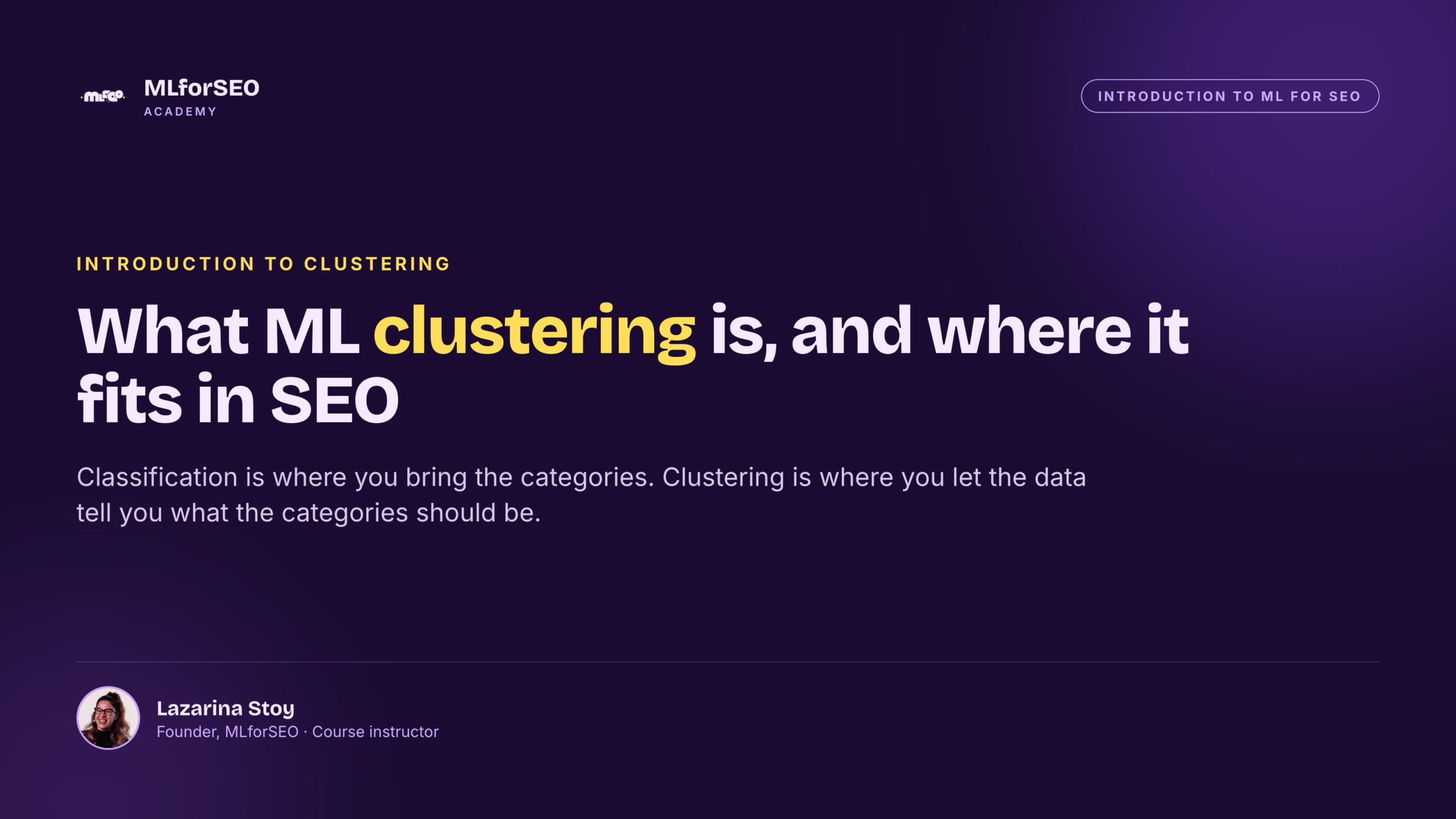
If classification is the task where you bring the categories, clustering is the one where you let the data tell you what the categories should be. That single difference makes it one of the most useful and most underused techniques in SEO, because so much of our work starts with a pile of unlabelled text, pages, keywords, reviews, transcripts, and the question “what is actually in here?” Clustering answers that question at a scale no human could, and it is increasingly the same question AI search systems ask when they fan a query out into sub-topics and decide which cluster of content best serves each one.
This post covers what clustering is, the families of clustering algorithms and the specific ones you will meet, why text clustering is its own beast, and a proper tour of the SEO and marketing projects where it pays off. It is the conceptual grounding for the practicals in the Introduction to Machine Learning for SEO course, where we actually cluster content with KeyBERT, LDA and BERTopic.
What clustering is
Clustering is partitioning an unlabelled dataset into groups of similar objects. It is an unsupervised approach whose whole goal is to gain insight from data that has no labels, by grouping data points that share characteristics. You can cluster documents, pages, keywords, images or numeric data, with a little transformation.
Mechanically, it forms groups of homogeneous data points out of a heterogeneous dataset: you start with points that are all different from one another, and the algorithm finds the similarities and combines them into smaller groups whose members share something in common. It measures that similarity with metrics like Euclidean distance, cosine similarity or Manhattan distance for numeric data, then groups the most similar points together. One detail that matters more than it sounds: the clusters it finds can be any shape, not just neat circles, so when you visualise your data the groupings can look genuinely organic, which is exactly what you want when your data is messy and real.
Hard versus soft clustering
The first way clustering splits is by how membership is assigned.
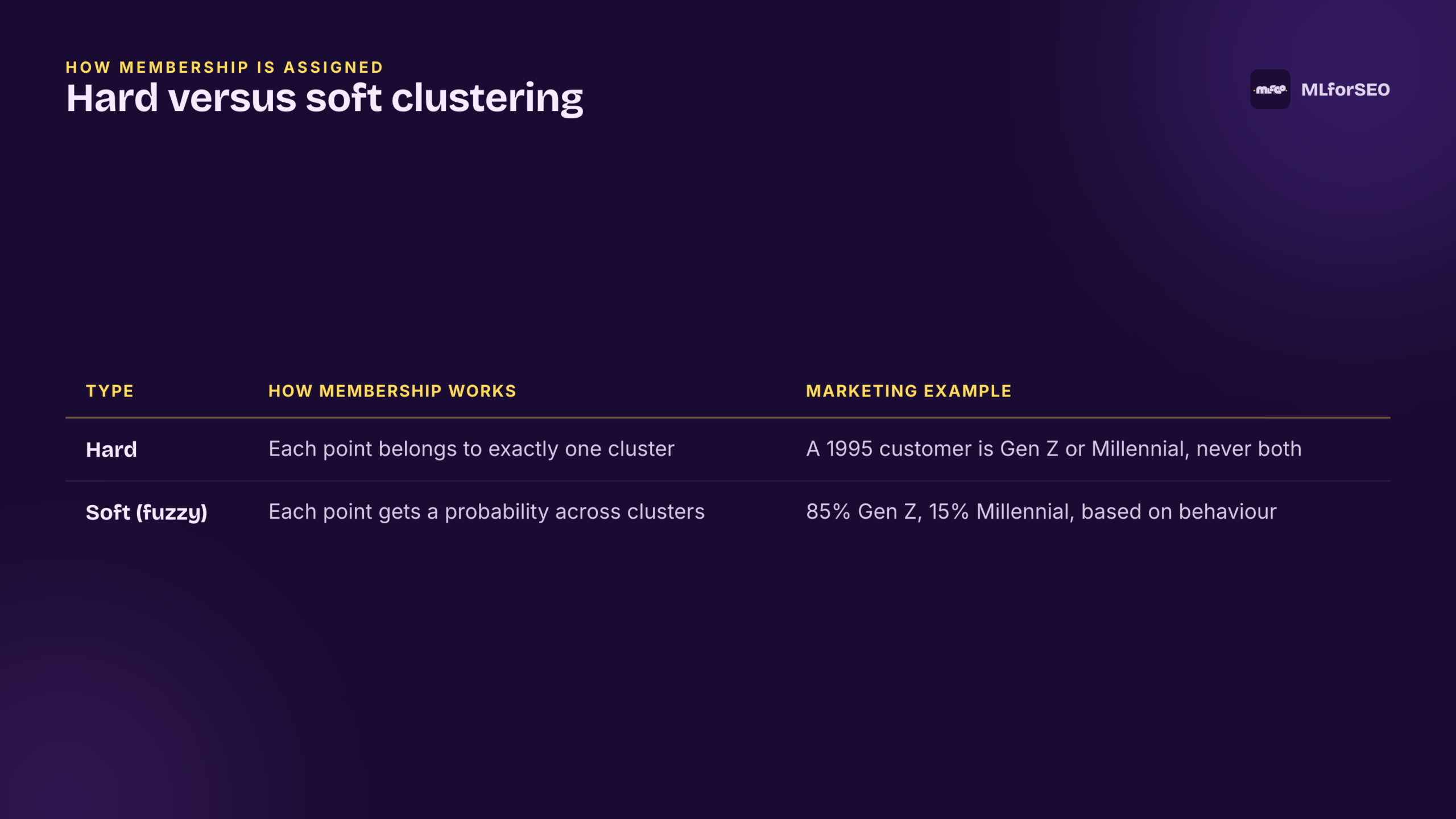
In hard clustering, every point belongs to exactly one cluster. Segment your customers this way and a person born in 1995 is either Gen Z or Millennial, never both, because the cutoff is fixed, so you can only ever target them with one strategy. In soft (or fuzzy) clustering, each point gets a probability of belonging to several clusters. That same 1995 customer might come out 85% Gen Z and 15% Millennial based on their actual behaviour, letting you detect the nuance and target them correctly. Soft clustering is exactly what you want when segments overlap or when a document genuinely covers multiple topics, which, in content, it almost always does.
The families of clustering algorithms
The second split is by method, and knowing these five families helps you pick sensibly.
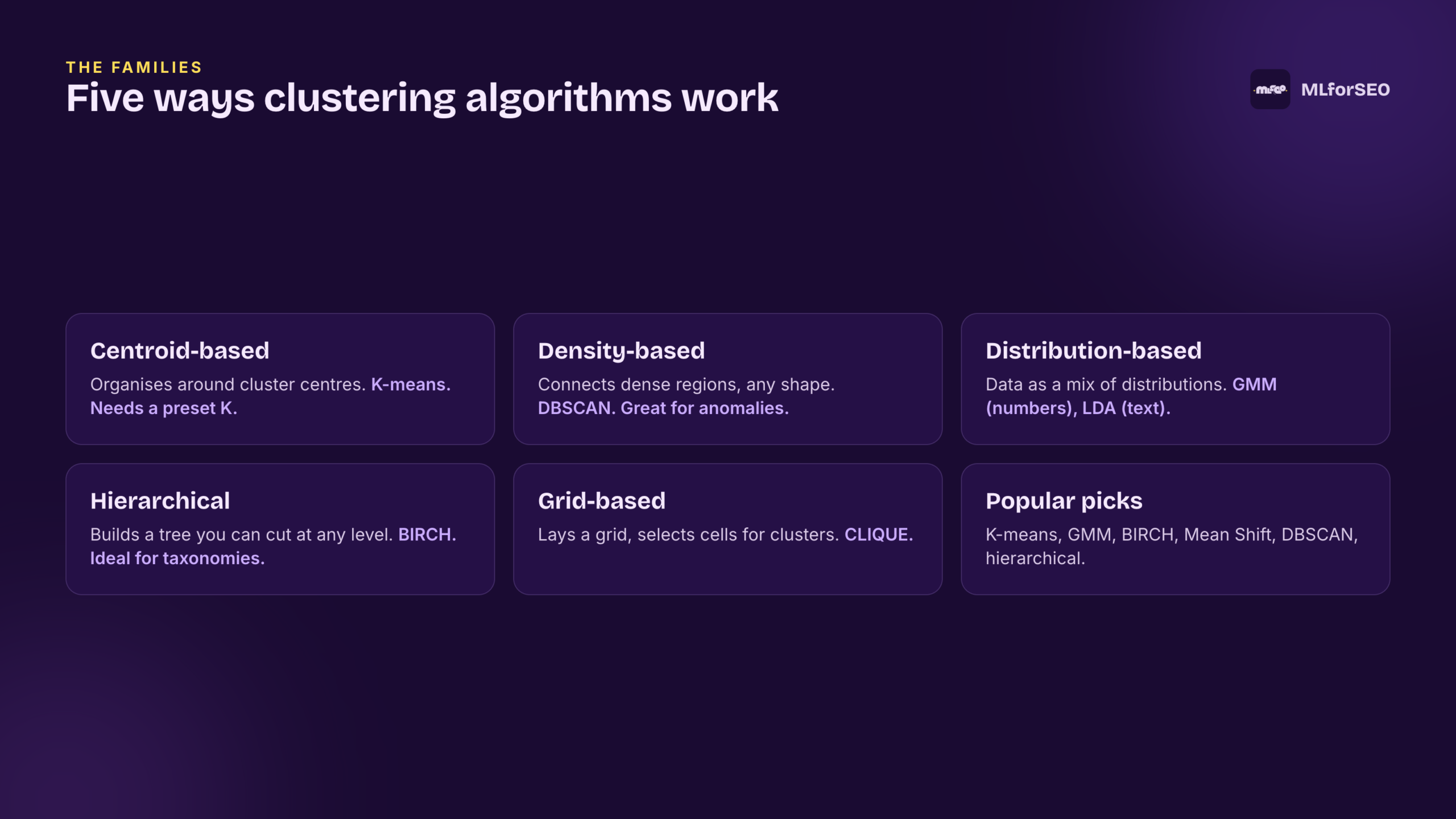
Centroid-based clustering organises data around cluster centres (a centroid is the arithmetic mean of all points in a cluster) into non-hierarchical groups; it is efficient and the most beginner-friendly, but you must predefine the number of clusters and it is sensitive to outliers and initial conditions. K-means is the flagship. Density-based clustering connects contiguous areas of high density into clusters of any shape, works out the number of clusters itself, and leaves outliers unassigned, which makes it excellent for anomaly detection; DBSCAN, Mean Shift and OPTICS live here. Distribution-based clustering assumes the data is a mix of probability distributions (like Gaussians), with the probability a point belongs to a cluster falling as it moves from the distribution’s centre; Gaussian Mixture Models handle numbers and LDA handles text. Hierarchical clustering builds a tree (a dendrogram) you can cut at any level, ideal for taxonomies; BIRCH is a common example. And grid-based clustering lays a grid of cells over the data and selects cells for inclusion; CLIQUE is the classic.
The popular algorithms you will actually meet
Within those families, a handful of algorithms come up again and again. Recognising how each behaves saves you a lot of trial and error.
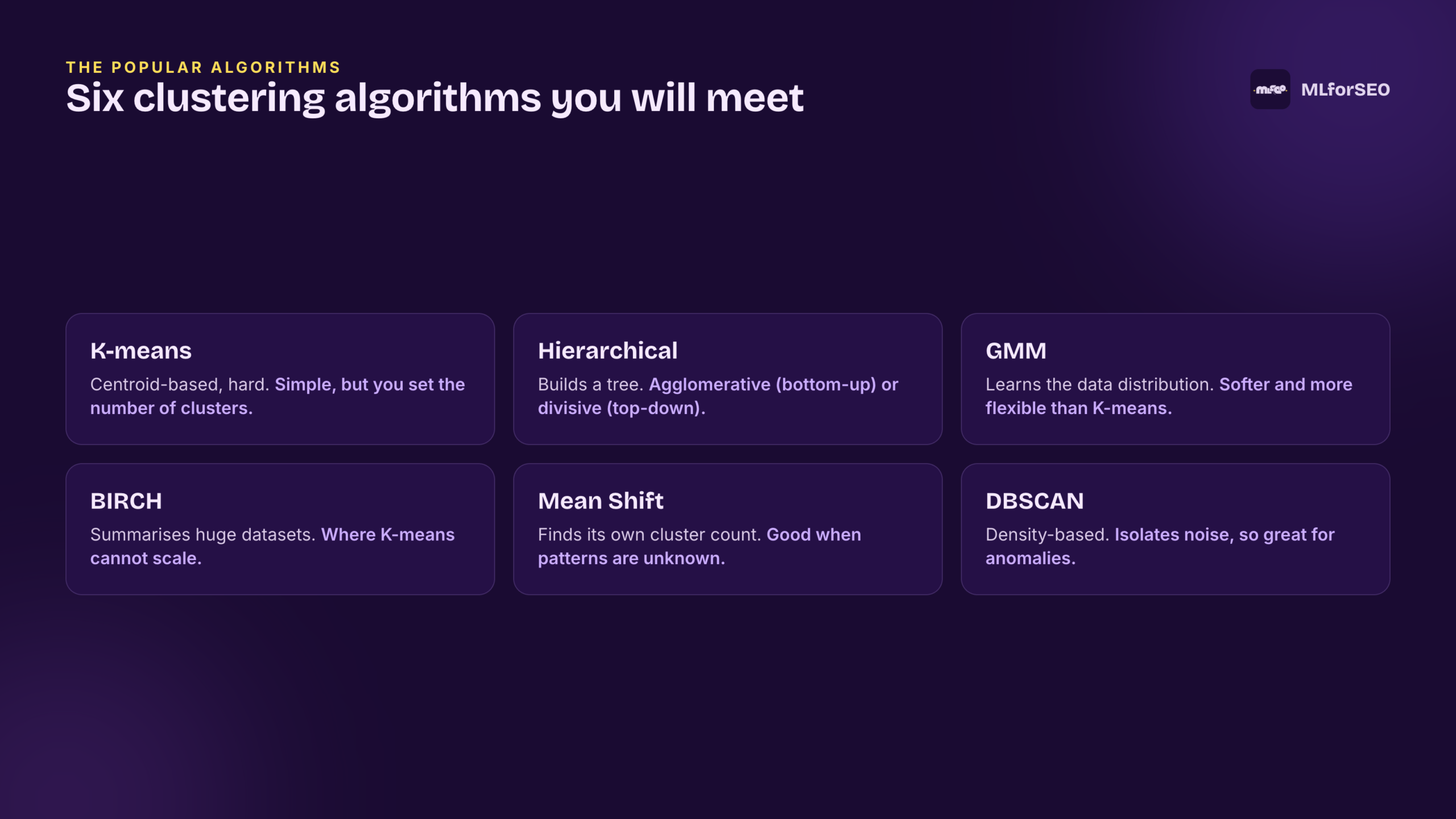
K-means is the most widely used, simple and beginner-friendly, but it is hard clustering, iterative, and you must define the number of clusters, usually by trial and error then validation. Hierarchical clustering builds a hierarchy either agglomerative (bottom-up, every point starts as its own cluster and merges upward) or divisive (top-down, everything starts as one cluster and splits). Gaussian Mixture Models are softer and more flexible than K-means because they learn the actual distribution of the data and can form clusters of different shapes. BIRCH (Balanced Iterative Reducing and Clustering using Hierarchies) handles very large datasets where K-means cannot practically scale, often as a first summarising pass that other algorithms then build on. Mean Shift automatically determines the number of clusters, great when you have no idea of the patterns in your data. And DBSCAN (density-based spatial clustering of applications with noise) treats clusters as dense regions separated by sparser ones and, crucially, isolates noise points instead of forcing them into a cluster, which is why it is so good at anomaly detection and non-linear datasets.
Why text clustering is different
Here is the part that matters most for us, because we live in text. Most classic clustering assumes numeric data. When your input is text, it first has to become numbers, and that changes the whole pipeline.
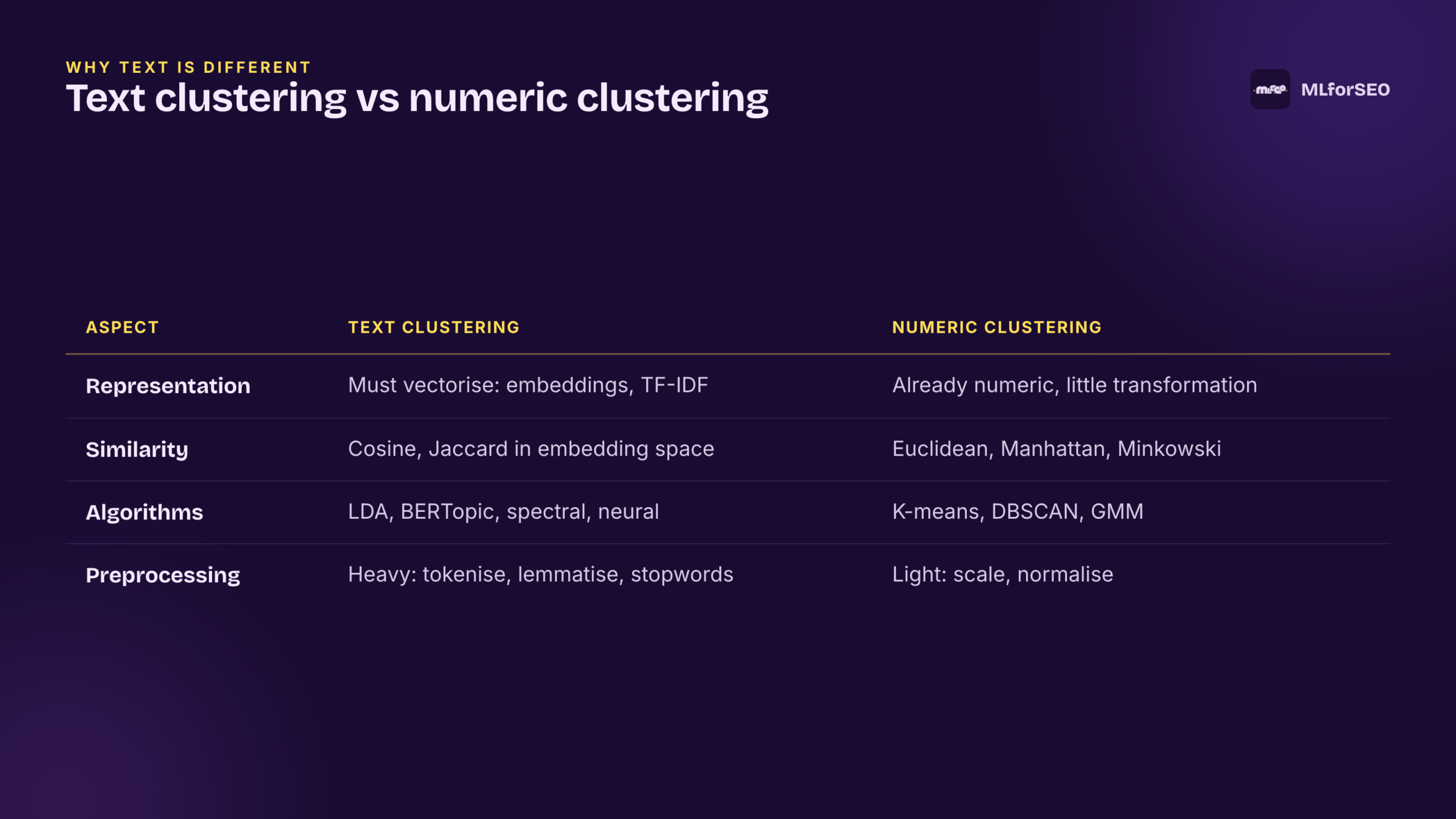
With numeric data, values are directly comparable and preprocessing is light, scaling and normalising. With text, you have unstructured input that must be vectorised, through TF-IDF, word embeddings or transformer embeddings, before any clustering can happen, and embeddings are what make modern approaches work. Text is also extremely high-dimensional (vocabulary size or embedding dimensions), needs heavy preprocessing (tokenisation, stopword removal, stemming, lemmatisation), and carries ambiguity, synonymy and polysemy that can wreck cluster quality if you do not capture semantic meaning. This is why the algorithms you reach for on text, spectral clustering, hierarchical clustering, LDA, and neural or transformer-based approaches, differ from the K-means and DBSCAN you would use on numbers.
Transformer-based clustering deserves a special mention because it is so useful to us. It uses models like BERT to generate contextual embeddings and then applies a clustering algorithm on top of those embeddings. Because it is context-aware and captures semantics, it is robust for both short and long text, exactly the natural-language work search marketers do constantly. And yes, you can also cluster images, usually with K-means or BIRCH, by transforming them into numeric vectors in a vector space first.
The full comparison is worth holding in your head, because it shapes every decision you make on a text project. Text carries very high dimensionality (vocabulary size or embedding dimensions) where numeric data is usually low-dimensional; text similarity is measured with cosine or Jaccard distance in embedding space rather than plain Euclidean distance; text needs extensive preprocessing (tokenisation, stemming, lemmatisation, stopword removal) where numbers just need scaling; and text carries ambiguity, synonymy and polysemy that will quietly wreck cluster quality unless your embeddings capture semantic meaning properly. Neural networks (BERT, and increasingly LLMs) do the heavy lifting of turning words into vectors that respect meaning, which is why modern text clustering leans on them so heavily.
Judging whether your clusters are any good
Because clustering is unsupervised, there is no label to grade against, so evaluating quality relies on interpretability and external evaluation rather than a single accuracy number. In practice that means reading the clusters and asking whether they make sense to a human, using metrics like the silhouette score to gauge how well-separated they are, and iterating on both the number of clusters and the features you cluster on. This is a fundamental difference from classification: topic modelling and segmentation are exploratory exercises, so expect to run them several times, tuning as you learn what the data is actually telling you, rather than treating the first output as the answer.
Where clustering fits in SEO
This is where it gets practical, and clustering shows up in far more places than most people expect. Here is the tour.
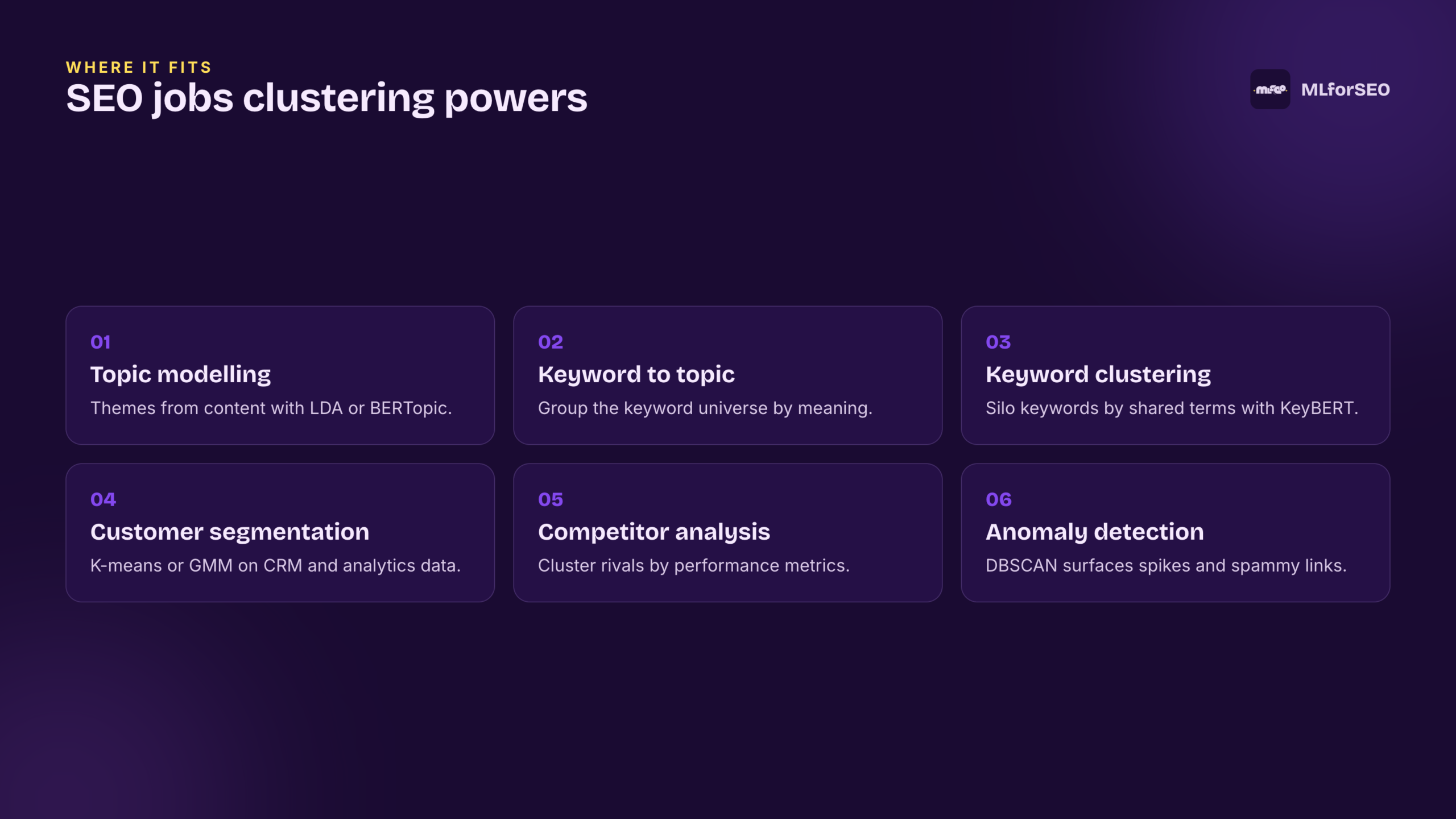
Topic modelling is the flagship use: uncovering themes from large sets of unstructured text (blogs, product descriptions, reviews) with LDA or BERTopic. The models pull out the core terms that describe each topic, and the topics can be as granular as you like. Run it on your own site and you can improve internal linking, sanity-check whether your content still aligns with your positioning and business objectives, and spot gaps against competitors; run it on YouTube titles or transcripts, or Reddit posts, and you can read a new platform’s competitive landscape fast. It works best paired with sentiment and entity analysis on first-party data.
Keyword-to-topic mapping is topic modelling on short text: use BERT embeddings to group your keyword universe by semantic similarity into clusters like “summer clothes”, “maternity” or “festival wear”. BERTopic works well here, and I love the example from Ryan Jones, who used a topic-modelling approach to cluster keywords and lay them out as a treemap sized by search volume, an instantly readable map of a market. Keyword clustering with KeyBERT takes a related angle, grouping keywords by shared terms and n-grams (unigram, bigram or trigram depending on your configuration), which is perfect for building silos. Both have full walkthroughs you can start with today: keyword clustering with KeyBERT and mapping keywords to topics.
Customer segmentation moves to numeric data: cluster customers by purchasing frequency, average order value and behaviour with K-means or GMM, pulling data from your CRM and GA4, then profile each resulting segment (parents, income group, family size, high-value versus occasional shoppers) for targeted email and marketing campaigns. Image clustering is a niche but lovely one for ecommerce: group product images by colour or style with K-means (via the Google Vision API or Amazon Rekognition, both easy out of the box) to improve categorisation, recommendations and internal linking on product pages; there are even beginner-friendly tutorials on extracting image colour with K-means first. Competitor analysis clusters competitor domains by performance metrics, build a dataframe where each row is a competitor with columns like domain authority, organic traffic, keywords ranked, backlinks and social engagement, then apply K-means, DBSCAN or hierarchical clustering (with pandas and scikit-learn) to see who is genuinely in your topical space versus who just looks big from a distance. And anomaly detection uses density-based algorithms, the PyOD library is purpose-built for outlier detection, to flag unusual traffic spikes, spammy backlinks or irregular customer behaviour as the points that fit no cluster.
The thread running through all of these: start small. Pick one specific project, try an algorithm, see what works, then scale as you see the value, into new data types, new algorithms and new Python libraries. Momentum, not perfection, is what builds a clustering habit.
The Role of Clustering in AI Search and Query Fan-Out
Clustering is quietly everywhere in modern search. When an AI system runs a query fan-out, breaking one question into many concurrent sub-queries, it is effectively clustering the information space into sub-topics and deciding which cluster of content best answers each facet before synthesising a response. The better your content maps onto coherent, well-covered topic clusters, the easier it is for these systems to recognise you as the right source for a given sub-topic. Running topic modelling on your own site is, in a real sense, seeing your content the way an AI answer engine groups it, and fixing the thin spots and overlaps before they cost you a citation. The same unsupervised grouping that helps you organise a content library is the mechanism deciding whether you surface in an AI Overview.
Going deeper
If clustering becomes a regular part of your work, it is worth reading into the nuances of the different algorithm families, running the beginner-friendly Python tutorials for each, and, because most of our work is text, digging into topic modelling specifically: how LDA, hybrid-LDA and non-LDA approaches compare, and the particular challenge of modelling short-form text (a keyword or a tweet) versus long-form (a paragraph or a full page), where coherence is far harder to achieve. Those distinctions are exactly what decide which tool actually works on your dataset, and they are the reason we teach several approaches rather than crowning a single winner.
Resources
The free BERTopic: Benefits and Limitations guide helps you weigh up modern topic modelling, and the deeper Complete Guide to ML Clustering for Marketing & SEO maps every algorithm to its use cases and is included with the course.
Where to Take Clustering Next
This post covers what clustering is and where it fits. The Introduction to Clustering module inside Introduction to Machine Learning for SEO then takes you into the hands-on practicals: keyword clustering with KeyBERT, and clustering page content with both LDA and BERTopic, including how to evaluate topic quality and choose between the approaches. Read the companion posts on topic modelling with LDA and with BERTopic next, and if you are still deciding between labelled and unlabelled approaches, what ML classification is is the natural companion.
Related glossary terms
MLforSEO Academy
Take your skills further — pick your path
Introduction to Machine Learning for SEO
by Lazarina Stoy
Ship practical ML workflows — classification, clustering, entity extraction — no CS degree required.
View course →AI Search Optimisation & Agentic SEO
by Beatrice Gamba
How agentic systems retrieve, evaluate and select — and how to become the source they cite.
View course →AI Search, LLMs, Entity SEO & Knowledge Graph Strategies
by Beatrice Gamba
Build the entity authority and knowledge-graph presence that makes AI recognise and trust your brand.
View course →Semantic ML-enabled Keyword Research
by Lazarina Stoy
Query understanding, search intent and semantic clustering for how people and AI really search.
View course →