 By Beatrice Gamba· May 13, 2026
The most common failure mode in entity SEO is not poor implementation. It is trying to optimise too many entities at once. A typical mid-size brand has 50-200 distinct entities once you start counting properly — organisation, founders, leadership team, every product, every feature, every methodology, every location, every event. Most of those should not be priority work right now, and trying to treat them all equally is the fastest way to do none of them well.
The three-tier prioritisation framework is the part of the BRIDGE methodology that handles this problem. It gives you a defensible way to decide which entities to invest in first, which to defer, and which to leave alone for the time being.
This post covers the framework itself, the decision criteria that place entities into tiers, and the practical implications of the prioritisation for content, schema, and external distribution work.
The three tiers
The framework places every entity into one of three tiers based on a small number of decisive criteria.
Tier 1: Core entities. The entities essential to your brand identity. Without strong recognition of these entities, AI systems cannot confidently understand or cite your brand. Tier 1 is small — typically five to ten entities for most brands.
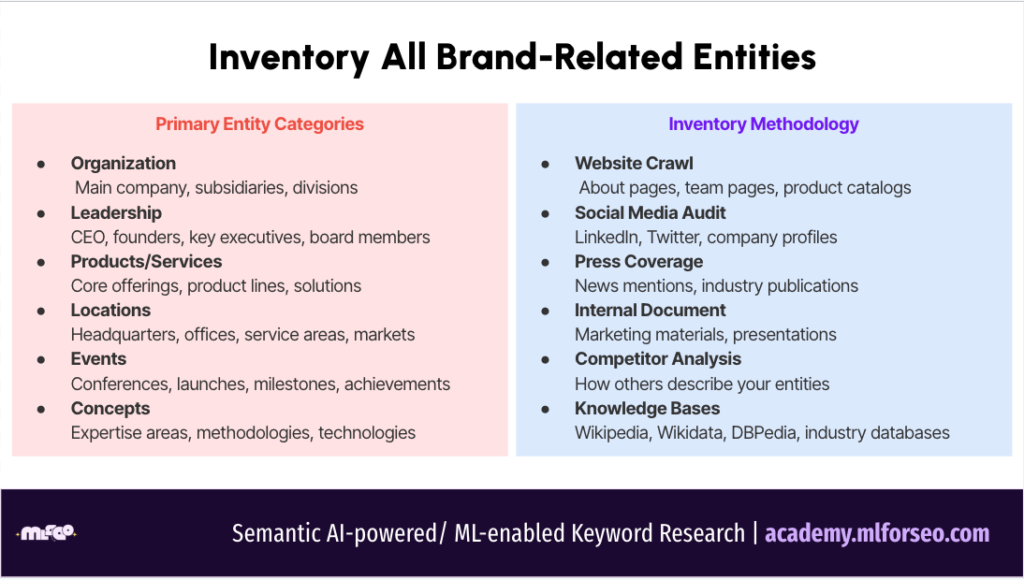
Tier 1 always includes:
- Your primary Organisation entity
- Your founder(s) and current CEO as Person entities
- Your headquarters or primary location as a Location entity
- Your flagship product or service as a Product entity (one to three of them, not all)
- Your most defining proprietary Concept entity if you have one — a named methodology, framework, or technology
These entities get the most attention. Comprehensive schema, dedicated entity hub pages, full cross-platform distribution, active Wikidata representation where possible, structured relationships connecting them to each other. Every piece of content on your site should reinforce one or more of these entities.
Tier 2: Authority signal entities. The entities that demonstrate depth of expertise and contribute to citation-worthy content. These reinforce Tier 1 but do not stand alone as defining the brand. Tier 2 typically contains 15-30 entities.
Tier 2 usually includes:
- Senior team members beyond the CEO and founders
- Core product features (significant ones, not every minor feature)
- Secondary methodologies and frameworks
- Major partnership and integration entities
- Industry concept entities you have genuine authority on
These entities get proper schema, internal linking to their hubs, and inclusion in cross-platform profiles where appropriate. They do not all need dedicated external presence on Wikidata or major directories — that work is reserved for Tier 1.
Tier 3: Extended network entities. Everything else of strategic relevance. All other team members, every product feature, minor concepts, secondary locations, individual events, lesser methodologies. Tier 3 can contain dozens or hundreds of entities depending on the size of the organisation.
Tier 3 entities are tracked in the blueprint but do not get active optimisation work. They are mentioned where relevant, referenced through structured data where it does not add maintenance burden, but they do not get dedicated hubs, dedicated external profiles, or active distribution work. They expand the discoverability surface gradually as the foundation strengthens, rather than being targets for direct effort.
The decision criteria
A specific decision framework for placing an entity into a tier:
- Is it brand critical? Would the brand be unrecognisable or fundamentally misrepresented if this entity were missing from your communication? CEO, flagship product, primary methodology — yes. Junior team members, minor features — no.
- Does it have external authority? Is there existing recognised presence for this entity outside your own site? Wikipedia article, Wikidata entry, established media coverage, recognised industry presence. The CEO who is regularly quoted in industry press has external authority. The recent hire whose only mention is on your team page does not.
- Does it generate meaningful search demand? Does anyone actually search for this entity or related queries about it? Your flagship product gets searched. The internal codename for a minor feature does not.
A simple scoring rule:
- Yes to all three: Tier 1
- Yes to two of three: Tier 2
- Yes to one or none: Tier 3
This is mechanical enough to be defensible in stakeholder conversations and flexible enough to handle edge cases. The point is not to follow it dogmatically but to have a clear, repeatable basis for prioritisation that survives team disagreements.
What the prioritisation actually changes
The tier assignment translates into specific operational differences.
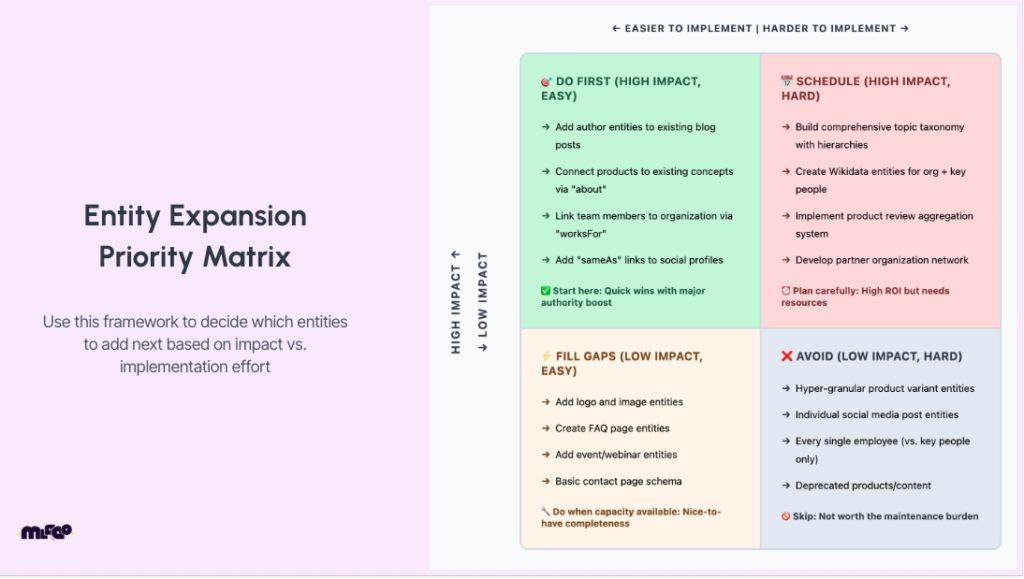
Schema markup investment. Tier 1 entities get the full schema treatment: comprehensive properties, @id URIs, sameAs references to authoritative external profiles, bidirectional relationships to other entities. Tier 2 entities get standard schema with the core properties and key relationships. Tier 3 entities get basic schema where it appears naturally on existing pages, without extra effort to deepen it.
Hub page existence. Tier 1 entities have dedicated, comprehensive entity hub pages. Tier 2 entities have hub pages of more modest depth — covering the entity but not exhaustively. Tier 3 entities do not have dedicated hubs at all; they are mentioned where relevant in other content.
External distribution. Tier 1 entities are distributed across every platform that matters — LinkedIn, Wikidata, Crunchbase, industry directories, press features. Tier 2 entities appear on the platforms where they naturally fit (LinkedIn for people, industry-specific platforms for products). Tier 3 entities receive no active external distribution work.
Maintenance cadence priority. When the maintenance cadence surfaces problems, Tier 1 entities get fixed first. Tier 2 entities get fixed in the next maintenance window. Tier 3 entities get fixed only when convenient or when they become Tier 2 candidates.
Content frequency. Tier 1 entities are reinforced in content regularly — every month at minimum. Tier 2 entities are reinforced when relevant. Tier 3 entities are mentioned occasionally without coordinated reinforcement effort.
The cumulative effect is significant. Tier 1 entities become unambiguously recognised and well-cited over months of consistent investment. Tier 3 entities stay as background presence without consuming attention they would not earn back.
Common prioritisation mistakes
A few patterns that produce prioritisation problems.
Treating every product as Tier 1. Brands with broad product lines often try to make every product a flagship entity. The result is diluted investment across too many entities, with none reaching Tier 1 recognition. The fix is honest assessment: one to three products are flagship; the rest are Tier 2 at most.
Including the founder as Tier 1 even when they are no longer active. A founder who has stepped away from operations may still be technically part of the company, but they are no longer brand-critical in the same way. Demoting them to Tier 2 is often correct even if it feels awkward.
Pushing concept entities into Tier 1 when they have not earned it. A new framework or methodology with limited external recognition is a Tier 2 entity, not a Tier 1 entity. Treating it as Tier 1 means investing in entity work that the framework cannot yet sustain. The fix is realistic assessment: concepts earn Tier 1 status through external recognition over time, not through internal aspiration.
Refusing to demote entities. Brands change. Strategic priorities shift. An entity that was Tier 1 two years ago may rightfully be Tier 2 today. Refusing to demote it produces a Tier 1 list that grows year over year until it is unmanageable. Periodic re-tiering is healthy.
How tier assignments change over time
Tier assignment is not static. Entities move between tiers as their strategic importance and external recognition shift.
Tier 3 → Tier 2. A team member who joins as a junior hire and rises to senior leadership over years of tenure moves from Tier 3 to Tier 2. A feature that grows from a small piece of the product to a defining capability moves from Tier 3 to Tier 2.
Tier 2 → Tier 1. A senior leader who becomes the public face of the brand moves from Tier 2 to Tier 1. A product that becomes the flagship offering moves up.
Tier 1 → Tier 2 or 3. A former CEO. A discontinued flagship product. A methodology that has been superseded. These get demoted as their strategic relevance fades.
A reasonable cadence for re-tiering: annually, as part of the broader entity audit. Major strategic shifts (leadership changes, product line restructuring, brand repositioning) trigger immediate re-tiering rather than waiting for the annual review.
Why the framework is more useful than “optimise everything”
The honest answer to “where should we focus entity SEO work” is that you cannot optimise everything to the same standard. The three-tier framework formalises this reality and gives you a defensible structure for the conversation with stakeholders who want to know why some entities are getting more attention than others.
Without the framework, prioritisation happens implicitly — usually based on whoever spoke up last, whatever launched most recently, or whatever felt urgent. The implicit prioritisation is rarely strategic. The three-tier framework makes prioritisation explicit, repeatable, and aligned with the criteria that actually matter for AI search visibility.
A small number of entities optimised to Tier 1 standard outperforms a larger number of entities optimised to mediocre standard. The framework is how you get there.
Continue your learning (MLforSEO)
This post covered the three-tier prioritisation framework, the decision criteria for placing entities into tiers, and how the prioritisation translates into specific operational differences. The full implementation — including the prioritisation matrix template, the criteria scoring methodology, the workflow for transitioning entities between tiers, and the BRIDGE framework that the tiering sits inside — is in the AI Search & LLMs: Entity SEO and Knowledge Graph Strategies for Brands course on MLforSEO.
Enrolling also gets you into the dedicated course channel inside the MLforSEO Slack community, where Beatrice Gamba and Lazarina Stoy answer course-specific questions and discuss ongoing implementation projects with course-takers.
MLforSEO Academy
Take your skills further — pick your path
AI Search, LLMs, Entity SEO & Knowledge Graph Strategies
by Beatrice Gamba
Build the entity authority and knowledge-graph presence that makes AI recognise and trust your brand.
View course →AI Search Optimisation & Agentic SEO
by Beatrice Gamba
How agentic systems retrieve, evaluate and select — and how to become the source they cite.
View course →Semantic ML-enabled Keyword Research
by Lazarina Stoy
Query understanding, search intent and semantic clustering for how people and AI really search.
View course →Introduction to Machine Learning for SEO
by Lazarina Stoy
Ship practical ML workflows — classification, clustering, entity extraction — no CS degree required.
View course →