 By Beatrice Gamba· May 13, 2026
The most common reason entity SEO programmes underperform is not poor initial implementation. It is the absence of a maintenance cadence. Teams build the entity foundation, deploy the schema, populate the external profiles — and then move on to the next project. Twelve months later, the data has drifted, the external profiles are stale, the schema references are broken, and the entity recognition has quietly weakened.
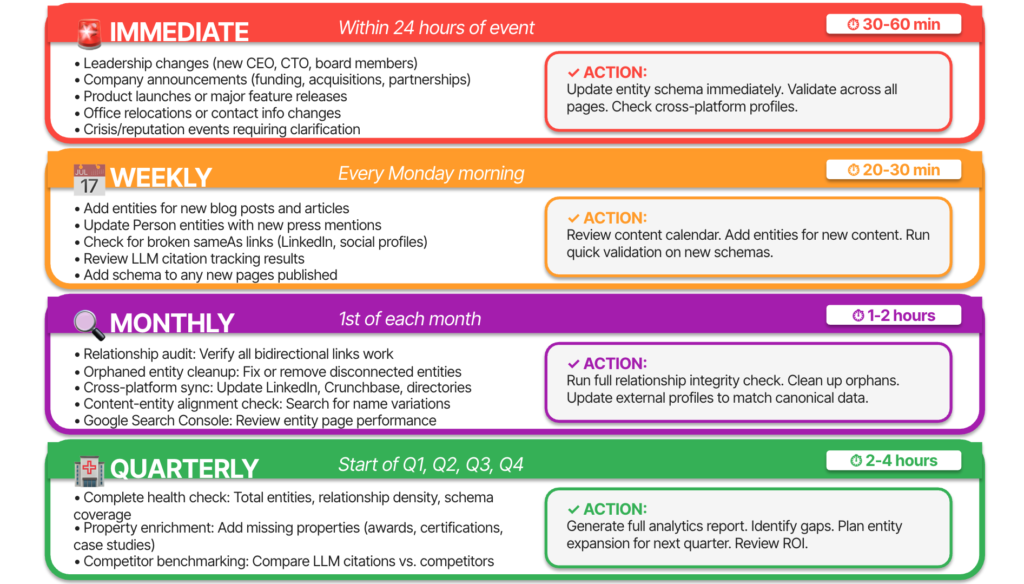
This post covers the cadence-based maintenance schedule that keeps an entity programme healthy: what to check weekly, monthly, quarterly, and on demand. The schedule is designed to keep the workload manageable while preventing the kind of drift that compounds into significant entity decay.
Weekly checks
The weekly cadence is for content-driven entity work. New content, new external mentions, new team activity — anything that needs entity tagging or schema implementation as part of normal operations.
Specifically:
- Tag new content with entities. Any blog post, case study, or article published in the past week should have its core entities identified and marked up in the schema. The author should be tagged with their
@id. The publisher should be tagged. The topic should be declared throughaboutproperties. - Add entities for new mentions or coverage. If your CEO appeared on a podcast, if your product was reviewed in an industry publication, if a team member was quoted in press — these external touchpoints should be reflected. Add the citations to the Person entity. Update the
sameAsreferences where new authoritative profiles have appeared. - Quick check on
sameAslinks. Spot-check that the external profile URLs in your structured data still resolve. BrokensameAslinks are surprisingly common — platforms change URLs, profiles get moved, accounts get renamed. Even one broken link reduces entity confidence. - Glance at LLM citations for the week. Run a few target queries through ChatGPT, Perplexity, or AI Mode. Note any obvious changes — new citations, lost citations, unexpected co-citations. This is monitoring, not full analysis. Five minutes once a week is enough to catch trends.
The weekly cadence is light by design — under an hour if the content volume is moderate. It is what keeps the entity layer from accumulating debt week to week.
Monthly checks
The monthly cadence is for relationship health and structural integrity. Where the weekly work is content-driven, the monthly work is graph-driven.
Specifically:
- Verify bidirectional links. Person
worksForOrganisation should be matched by Organisation listing the Person. Articleauthorshould be matched by Person referencing authored content. Asymmetric relationships weaken over time; a monthly check catches drift before it compounds. - Check for new orphan entities. Any entity that has been mentioned across multiple pages in the past month but does not have its own hub page is an orphan. Either create the hub or remove the mentions. Orphan entities accumulate quickly without a check.
- Run a Google Search Console structured data report. GSC reports on schema validity, eligibility for rich results, and any errors detected. The monthly check catches schema issues that have appeared since the last review.
- Sync cross-platform distribution. Confirm that recent updates on your own site (new leadership, new products, new methodology pages) are reflected on LinkedIn, Wikidata, Crunchbase, and other key platforms. The faster these stay in sync, the less drift you accumulate.
- Review citation patterns. A more thorough version of the weekly citation glance. Run your target query set through multiple AI systems. Document the citations. Compare to the previous month’s record. Identify any trend shifts — gaining authority in a query category, losing in another, being co-cited with new entities.
The monthly cadence is a bigger time investment than weekly — typically half a day to a day for a typical brand. The compounding effect is significant because it catches things that the weekly check would have missed.
Quarterly checks
The quarterly cadence is for the full entity audit. This is where you re-validate the structural integrity of the entire entity network rather than checking individual pieces.
Specifically:
- Complete schema validity audit. Crawl every page with structured data and validate it against Google’s Rich Results Test and the schema.org validator. Zero errors is the target. Resolve any that have appeared.
- Run entity extraction on top pages. Use Google’s Natural Language API on your homepage and top ten most important pages. Confirm that primary entities still appear with appropriate salience and that no new noise has crept in.
- Verify Knowledge Graph recognition. Query your top entities through the Knowledge Graph Search API. Confirm that confidence scores have not declined and that Knowledge Graph IDs are stable.
- Enrich properties with new signals. Look for new external authority signals that have appeared since the last quarterly check — new press features, new podcast appearances, new partnership announcements, new Wikidata edits. Add these as references where appropriate.
- Run competitor benchmarking. Apply entity analysis to three to five competitors. Compare their entity coverage against yours. Identify gaps and differentiation opportunities. The competitive landscape shifts quarterly; the audit captures the shifts.
- Review the entity blueprint. Update the master inventory of entities. Add any new entities that have emerged. Reprioritise the tier system if the balance of importance has shifted. Remove or deprioritise entities that are no longer strategically relevant.
The quarterly cadence is the most time-intensive — one to two days for a mid-size brand, more for larger ones. It is also the one most likely to surface significant findings because it is comprehensive enough to catch patterns that the lighter cadences cannot.
On-demand checks
In addition to the regular cadence, certain events trigger immediate audit work regardless of the calendar.
Leadership changes. New CEO, new founder, departure of a key Person entity. All schema, all external profiles, all sameAs references need to be updated within a few days. Stale leadership information on Wikidata or Crunchbase is one of the fastest ways to confuse AI systems about your entity.
Acquisitions and structural changes. New parent organisation, acquisition of another brand, merger. The Organisation schema, the sameAs references, and the cross-platform profiles all need to reflect the new structure.
Major product launches. New products mean new Product entities, new schema, new internal linking, new external profile updates where applicable.
Office relocations. Address changes propagate across many platforms. The on-demand check catches them all.
Rebranding. A change to the canonical brand name, logo, or positioning is a significant entity event. Every platform that holds your canonical brand information needs to be updated systematically.
These events are infrequent but high-impact. Handling them within a few days of the change prevents the inconsistency window that otherwise produces real entity confusion.
A practical scheduling pattern
A pattern that works for many teams: assign the cadence work to specific days rather than letting it float.
- Weekly checks: 30-60 minutes on Friday afternoon, every Friday
- Monthly checks: half a day on the first Monday of each month
- Quarterly checks: a full day or two at the start of each quarter
- On-demand: handled by whoever owns the entity SEO programme, with a defined process for triggering it
The structure prevents the most common failure mode: knowing the work needs to happen but never having a specific time when it does. Cadence work that lives “whenever we get to it” never gets to.
Why the cadence compounds
Each cadence builds on the others. Weekly checks prevent small problems from accumulating. Monthly checks catch the issues that the weekly cadence is too lightweight to address. Quarterly audits surface patterns that only become visible across longer time spans. On-demand work handles the events that calendar-based cadences cannot anticipate.
Together, the four cadences maintain entity health at a level that is essentially impossible to achieve through ad-hoc effort. Teams that maintain the cadence consistently end the year with stronger entity recognition than they started with. Teams that do not lose ground quietly even if their content production stays steady.
The work is unglamorous. It is also where compounding happens.
Continue your learning (MLforSEO)
This post covered the cadence-based maintenance schedule for entity SEO programmes. The full implementation — including the templates for each cadence checklist, the citation tracking framework, the competitive benchmarking workflow, and the BRIDGE framework that organises the audit-to-action work — is in the AI Search & LLMs: Entity SEO and Knowledge Graph Strategies for Brands course on MLforSEO.
Enrolling also gets you into the dedicated course channel inside the MLforSEO Slack community, where Beatrice Gamba and Lazarina Stoy answer course-specific questions and discuss ongoing implementation projects with course-takers.
MLforSEO Academy
Take your skills further — pick your path
AI Search, LLMs, Entity SEO & Knowledge Graph Strategies
by Beatrice Gamba
Build the entity authority and knowledge-graph presence that makes AI recognise and trust your brand.
View course →AI Search Optimisation & Agentic SEO
by Beatrice Gamba
How agentic systems retrieve, evaluate and select — and how to become the source they cite.
View course →Semantic ML-enabled Keyword Research
by Lazarina Stoy
Query understanding, search intent and semantic clustering for how people and AI really search.
View course →Introduction to Machine Learning for SEO
by Lazarina Stoy
Ship practical ML workflows — classification, clustering, entity extraction — no CS degree required.
View course →