 By Lazarina Stoy· May 11, 2026
Understanding why someone searches shapes everything from keyword selection to page structure to which SERP features your content needs to compete with. In this post, we’ll define search intent, work through the classic categories and where they fall short, look at how engines actually infer intent, map intent to the funnel, and walk through the practical lens for classifying intent at scale in your keyword research.
The aim isn’t to give you a definitions glossary. It’s to give you a working framework — and to flag where the picture changes in AI search, because intent inference is one of the areas where AI systems behave significantly differently from traditional search. The full classification workflow — rule-based classifiers at scale, AutoML approaches to custom intent classifiers, integrating intent labels into a complete semantic keyword universe — is its own substantial body of work covered elsewhere in detail.
This guide covers:
- what search intent is, and the core, hybrid and implicit intent types
- how search engines infer intent, and how intent shows up on the SERP
- how intent works in AI search
- how intent maps to the marketing funnel and to conversion likelihood
- the difference between search intent and keyword intent
- a practical classification workflow and checklist for semantic keyword research
- why intent matters so much for content creation
The core definition of search intent
Search intent is the reason why someone would write a query and submit it to a search engine. Back in the days when there weren’t any search engines or internet, search intent would be the reason why someone would visit the library, or look up a particular shop they wanted to buy from in the Yellow Pages.
Search intent represents an objective that the searcher is trying to accomplish through their online journey.
At its simplest, search intent is the underlying purpose behind a user’s search query — the goal they hope to achieve when they type something into a search bar. It’s the bridge between language and action, shaping how search engines interpret meaning and how content creators should structure information to meet that need.
Academic research shows that around 75% of search queries can be confidently assigned to a single dominant intent. The remaining 25% display overlapping or hybrid motivations. This overlap is important — intent isn’t a rigid category, it’s a spectrum. Users may begin with one purpose and evolve toward another as their search journey unfolds. Recognising that fluidity helps you design content pathways that align with real search behaviour rather than tidy taxonomies.
Explicit (macro) intent
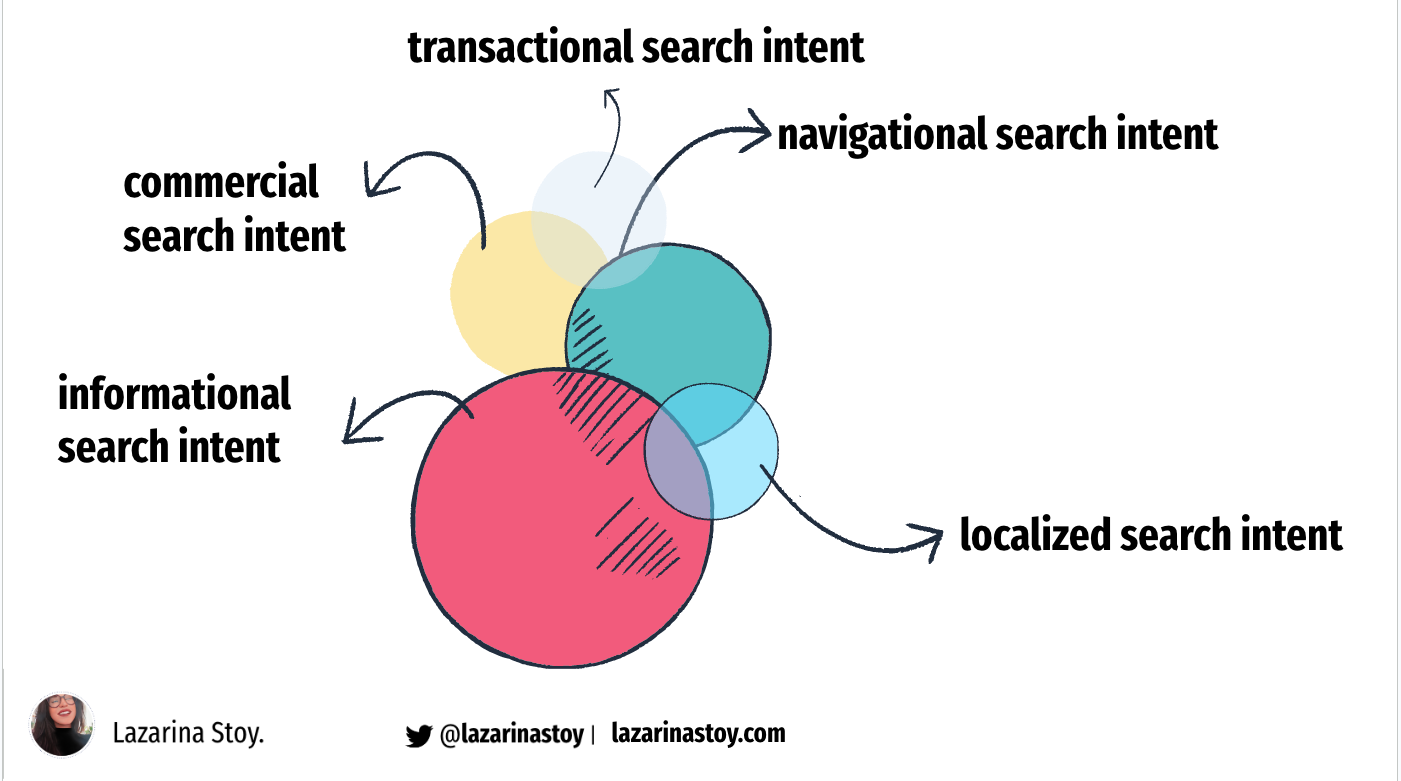
SEO professionals have historically grouped explicit intents into three broad categories — the macro intents that still underpin most search models. They have been sustained since the days of library searches, are reflected in academic research, and are defined in Google’s own guidelines:
- Informational — the user seeks to learn, clarify, or understand something. These queries often start with “how,” “what,” “why,” or “when,” and signal curiosity or problem-solving.
- Navigational — the user is trying to reach a specific digital destination. They already know the brand, product, or platform they want and use search as a shortcut.
- Transactional — the user aims to complete an action. Buying, booking, signing up, downloading. These queries imply readiness to convert.
Each macro intent aligns with different stages of the user journey — awareness, consideration, action — and demands distinct content types, page structures, and SERP expectations. Informational queries are typically satisfied by educational articles or videos. Transactional queries demand optimised product or service pages with clear CTAs.
A useful way to tell the three apart is to ask what the searcher already knows: about their need, about the possible solutions, and about the vendors who provide them.
Informational search intent
Informational queries are by far the biggest group. In Jansen, Booth and Spink’s analysis of web search logs, roughly 80% of queries were informational (with about 10% navigational and 10% transactional). These searchers want to locate a particular snippet of information that satisfies a knowledge need they are struggling with.
There is a recognised need, with no clear solution. The user’s search behaviour is purely information-seeking: they are asking general questions with the intention of learning and understanding the potential pathways to a solution better.
That 80% figure is from search logs analysed in the late 2000s, and newer clickstream datasets put the share lower (SparkToro’s, covered further down, lands at around 52%). The exact proportion depends on the dataset, but informational intent is consistently the largest bucket.
Navigational search intent
Navigational search intent demonstrates a desire to be taken to a specific location of an organisation the searcher is already aware of. This might be finding their Amazon account page, or anything else very specific related to a brand. The user already knows the brand, and they’re trying to locate something related to it on the web.
There is brand awareness. The searcher is solution-aware, but more specifically, in the context of digital marketing, they are brand-aware. They are interested in navigating to a specific destination, e.g. a brand website, a product page or a solutions landing page.
Transactional search intent
Transactional search intent demonstrates a desire to obtain something other than information, which is typically a web-mediated transaction.
For a user to develop and express transactional intent, there is a recognised need, a recognised solution, recognised vendors for providing this solution, and a purchase desire. The searcher at this stage is ready to act on the options they have evaluated.
Hybrid intent categories
As search has matured, hybrid intent categories have emerged that blend aspects of the core three. Users no longer search with purely informational, navigational, or transactional goals in isolation — their queries often express mixed motivations that evolve across a single session or even a single query.
Here’s the interesting part: in that remaining 25% of queries that don’t fit neatly into one category, we can distinguish patterns that form new categories of intent, and they correspond to different stages of the user journey. Each of these hybrid categories carries a certain percentage of one of the main intents, but they are distinct enough to form categories of their own.
Two of the most important hybrid categories:
- Commercial investigation — researching before buying. Reviews, comparisons, “best of” lists. The intent isn’t directly transactional, but it’s directly tied to a transaction the user is considering. Recognising this as a distinct category matters because content that serves commercial investigation looks different from content that serves either informational or transactional intent — and conflating them is a common mistake that produces under-converting content.
- Localised search — combining navigational, informational, and often transactional intent with a geographic component. “Coffee near me,” “best plumber in Sofia,” “Italian restaurants open now.”
Commercial intent has transactional intent within it. The user wants to complete a web-mediated transaction and is already aware of one or two organisations in the space, but they are also seeking information about these brands, so we see a mixture of intent types. There is a recognised need, a recognised solution, and recognised vendors for providing it. The searcher at this stage is in the process of market evaluation, comparative analysis and option consideration.
With localised intent, the user is seeking information about a brand, for instance whether they have a physical shop or how they can contact the team. They’re usually brand-aware, and often interested in completing a transaction too. These are people looking for local business contacts, directions, opening hours, contact information or any other point of contact related to the real world.
Implicit intent: the layer under the query
Explicit categories describe what a user appears to want. They rarely explain why. Implicit intent looks beneath the surface, revealing the underlying — often unspoken — motivations that shape how, when, and why people search.
Unlike explicit intent, which can often be identified from keywords alone, implicit intent depends on contextual and behavioural signals: the device used, the time and place of the search, the user’s emotional state, and the cultural or situational context of the moment.
Every query carries these invisible layers. A search for “best jobs in design” might look informational. For one person, it reflects ambition. For another, it stems from frustration, burnout, or fear of redundancy. Recognising these differences lets SEOs interpret not just the topic behind a query but the human motive driving it.
Emotional and contextual drivers
Implicit intent often shows up through emotional or contextual drivers that shape how users phrase queries and which results they engage with.
- Emotional intent stems from feelings — reassurance, aspiration, pride, fear — none of which need to appear in the literal query text. A user searching “how to recover from website traffic drop” isn’t only seeking data; they’re seeking reassurance that recovery is possible. “Best portfolio website examples” reflects aspirational intent, a desire to improve and belong.
- Contextual intent arises from the situation in which a search occurs. Environmental factors (home, office, commute), device constraints (mobile vs. desktop), urgency cues. “How to remove coffee stains quickly” or “healthy lunch ideas for work” are loaded with contextual signals that influence both content depth and format expectations.
Together, these emotional and contextual dimensions form the texture of a search — the part algorithms try to infer through personalisation and behavioural modelling, and the part SEOs can mirror through empathetic content design.
Implicit intent types worth naming
When I classify keyword sets for clients, a handful of implicit intent types come up again and again. They sit on top of the macro categories, and each calls for a different kind of content:
- Fear-based intent arises when users are seeking information to alleviate their fears, concerns or anxieties about a topic, event or situation. They are motivated by a desire to address potential risks, avoid negative outcomes, or find reassurance and guidance, and search for things like safety measures, prevention methods, or ways to overcome obstacles.
- Comparison intent: users want to evaluate and compare multiple options before making a decision. They search for terms like “X vs. Y,” “best alternative to,” or “pros and cons of.” Content that presents thorough comparisons, highlighting the strengths and weaknesses of each option, serves them well.
- Trending or popularity intent: users want to stay up to date with the latest trends, news or popular topics. They seek current information, viral content, or insight into what’s popular in an industry or niche. Content that explores trends, provides analysis or showcases popular items caters to this intent.
- Problem-solution intent: users are actively seeking solutions to specific issues they are facing, with phrases like “how to fix,” “solve,” or “troubleshoot.” Practical solutions, troubleshooting guides and step-by-step problem-solving content address it.
- Inspirational or motivational intent: users want content that uplifts, inspires or motivates them, searching for “success stories,” “inspirational quotes” or “motivational speeches.” Inspiring stories, motivational advice and strategies for personal growth resonate here.
- Educational intent: users are looking for in-depth knowledge, courses or tutorials on a specific subject. They want comprehensive information that helps them acquire new skills or expand their understanding, so detailed guides, tutorials, educational resources and online courses fit.
- Recreational intent: users seeking entertainment, leisure or recreational content, looking for enjoyment, relaxation, or something that engages their interests. Think entertainment recommendations, events to visit, facts about their hobbies, travel guides, fun facts or celebrity gossip. These searches are performed with a purely relaxing or rewarding purpose.
Common micro-intent patterns
Within implicit intent, smaller and more specific micro-intents emerge. These micro-motivations explain why users perform certain searches even when the explicit goal looks clear. A query for “ergonomic desk chair” can carry a budget micro-intent (find a cheap one), an affluent micro-intent (find a premium one), an obstacle micro-intent (my back hurts), or an expert-validation micro-intent (which one do ergonomists actually recommend). The query text is identical. The content that satisfies each is different.
Each micro-intent adds granularity to the broader categories. Together they explain how emotional, situational, and social dynamics affect the way people search — and how search engines interpret relevance and satisfaction.
Jobs-to-be-done as a way of understanding implicit intent
The Jobs-to-be-Done (JTBD) framework reframes a query as: “When [situation], I want to [motivation/action], so I can [desired outcome].” It distinguishes between functional and emotional jobs and acknowledges related jobs — troubleshooting, deeper learning, confidence-building. JTBD is a useful complement to micro-intent because it forces you to think about the user’s underlying goal rather than the words they typed.
How search engines infer intent
Search engines don’t rely on keywords alone. They combine explicit signals, implicit cues, and behavioural patterns to interpret what a user really means and what kind of result is most likely to satisfy that meaning. The sophistication extends far beyond what SEOs can directly measure — but the patents make clear what’s being measured and how.
What Google looks at
According to multiple Google patents, query intent classification draws on the interaction between query-level data and behavioural data:
- Query patterns — length, syntax, entity or topic clustering
- Interactions — click patterns, dwell time, brand focus
- Refinements — adding, removing, or reordering words within a session
- Contextual factors — device type, location, time of day
- Content-type cues — explicit modifiers like “video,” “pictures,” or “under 10 minutes” that reveal preferred format
A Google patent on query intent inference describes how a consistent concentration of clicks on one domain signals navigational intent, while dispersed clicks across multiple results suggest informational intent. Longer dwell times or repeat interactions with particular pages indicate the document is satisfying the user’s need.
Sessions, sequences, and refinements
A separate patent on query sequence analysis within user sessions explains how Google examines the order and progression of queries to infer evolving intent. The system doesn’t look at a single query in isolation — it looks at the path a user takes across multiple refinements.
If someone searches “home gym equipment,” then “best beginner home gym,” then “buy foldable treadmill,” Google recognises the progression as a refinement chain reflecting transition from informational to transactional intent. These patterns let the system learn not just which pages satisfy a query, but which combinations of searches lead to satisfaction.
The patent describes the system identifying modifications — added or removed terms, reformulation frequency, and which refinements end the session. This data feeds machine learning models that continually update Google’s understanding of intent transitions across the search journey.
Content-type and format hints
Google’s systems also note explicit format indicators within a query. When a user specifies “with pictures,” “under 10 minutes,” or “video tutorial,” that’s a strong signal about content expectations and micro-intent. These cues help the ranking algorithm filter and prioritise content that matches both topic relevance and format relevance.
A “video” query may elevate YouTube results or short-form content. An “image” query may emphasise visual carousels or featured snippets with inline imagery.
How intent shows up on the SERP
The SERP itself is Google’s visible read of intent. It presents different elements depending on what it believes the searcher wants, and learning to read them is one of the most useful habits in keyword research (I go deeper on this in SERP feature analysis for smarter keyword research, and in my older piece on incorporating machine learning into your SERP analysis):
- AI Overviews. Since rolling out from May 2024, AI Overviews appear most often on informational and how-to queries, where Google judges a synthesised answer to be useful. Their presence is now one of the strongest signals that a query is informational.
- Featured snippets. A concise answer or summary extracted directly from a relevant page, commonly shown for informational queries, demonstrating Google’s recognition of the intent to find quick answers.
- Knowledge panels. Structured information about entities such as people, places or organisations, on the right-hand side on desktop and near the top on mobile. A knowledge panel suggests the intent is focused on factual details about, or exploring, a specific entity, and often accompanies navigational queries.
- Image and video results. When intent involves visual content, the SERP includes dedicated image and video sections alongside traditional listings, indicating intent oriented toward visual exploration or consumption.
- Local pack. For location-based queries, or when users seek nearby businesses or services, Google shows a map and a list of local businesses with addresses, ratings and reviews. Its presence suggests the intent revolves around finding local establishments or services.
- Shopping results. When users have transactional intent and are searching for products to buy, Google shows product images, prices and links to online stores, so users can compare products directly on the SERP.
- “People Also Ask” and related searches. These show additional questions and related queries that users commonly search for, indicating Google’s understanding of the underlying intent and offering further avenues for exploration.
By observing these elements, you can gauge how Google interprets intent for a query and what content is most likely to satisfy it. The specific elements displayed vary with the query and the user’s context, so always check from the location and device your audience uses.
Limits and ambiguity
Even with billions of data points, intent classification remains probabilistic, not absolute. The same query can express multiple legitimate intents depending on circumstance. “Apple” could be navigational (the brand), informational (the fruit), or transactional (the store).
Search engines handle this by maintaining multiple intent hypotheses simultaneously and testing which results generate stronger engagement. Ambiguity isn’t a flaw — it’s a fundamental feature of language. For SEOs, this means success often depends on designing content ecosystems that address overlapping intents rather than over-optimising for a single one.
Search intent in the AI search era
Intent inference works fundamentally differently in AI search, and that’s worth flagging directly.
In traditional search, intent shapes which results get ranked. Google retrieves a candidate set based on your query, then re-ranks that set using intent and behavioural signals. The query itself stays stable across users — different users see the same candidates in different orders.
In AI search, intent inference happens upstream of retrieval. When AI Mode or Perplexity expands a user’s query through fan-out, the sub-queries it generates reflect the system’s interpretation of what the user actually wants — and that interpretation is built from the user’s prior behaviour, memory, context, and signals as much as from the words typed. Two users with the same query but different inferred intents will trigger different fan-out queries, retrieve different documents, and get different synthesised answers.
I covered this in detail in How AI Search Personalizes Fan-Out Queries. The short version for SEO: intent matters more than ever, but it now operates at the query-generation level, not just the ranking level. Content that comprehensively covers an entity’s intent space — informational queries about it, transactional queries around it, comparative queries against alternatives — is content that gets retrieved across more user contexts. Content that targets a single narrow intent gets retrieved less.
There’s a related practical implication: AI systems are increasingly inferring persona signals from query phrasing and surrounding context. “Best budget running shoes for marathons” carries persona signal (budget-conscious, marathon-running) that the system can use to shape fan-out. Your content’s clarity about which personas it serves directly affects which fan-outs retrieve it. Persona-tagged content isn’t a nice-to-have anymore — it’s a retrieval signal.
Macro vs. micro intent and the funnel
Macro intent buckets are useful as a starting framework, but they oversimplify. Within each broad category exist countless micro-intents — the specific, contextual needs that actually drive a user to take action.
Olaf Kopp’s framing extends this thinking by emphasising the importance of addressing micro-moments across the entire customer journey, not just the point of purchase. His model includes after-sale and loyalty stages, recognising that intent continues even after a transaction. Users search for support, troubleshooting, ways to maximise value from a purchase — all part of an ongoing, cyclical intent pattern.
SparkToro’s research on how people use Google shows how this plays out in query distribution. Roughly 150 query terms account for about 15% of total search demand — and these are mostly navigational (“YouTube,” “Gmail,” “Amazon”). Single-word queries represent nearly 59% of all unique terms but only about 2.2% of total search demand. Short, generic searches are vastly outnumbered by longer, more specific ones.
Broken down by intent in the same study, the distribution was roughly 52% informational, 32% navigational, and 14% commercial. Exact proportions vary by dataset, but the pattern is clear: most searches begin as information-seeking, while transactional or commercial searches form a smaller, more targeted subset.
The implication for strategy is significant. Long-tail, context-rich queries carry a higher likelihood of conversion despite representing a smaller share of total volume. They reveal user readiness and situational context, giving you the opportunity to craft highly relevant experiences that meet intent at every stage.
Mapping intent to the funnel (and why navigational intent is the hardest to place)
According to resources by Ahrefs and STAT, search intent corresponds to the different parts of the marketing funnel, i.e. the user’s journey to purchase. This means that the lower down the search intent funnel, the higher the likelihood of conversion.
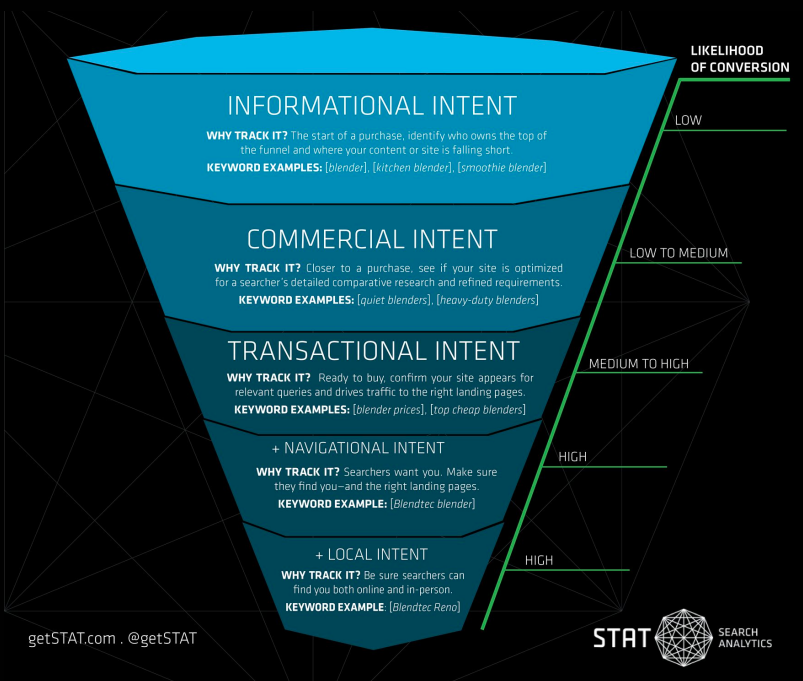
As you will notice, the two sources disagree on where navigational intent sits in the funnel. Navigational intent is the most difficult to map, because a user can become brand-aware at different stages of the buyer journey. As Ahrefs puts it:
Navigational queries are perhaps the most nuanced. Those searching for such queries may be in the “Interest” stage of the funnel and just want to learn more about your products/services. Or they could already be customers and are simply trying to navigate to a specific page on your website.
Ahrefs
For instance, if the searcher is looking for a digital bank, they might already know of Revolut or Monzo. Or they might discover them while researching different options for digital banking. If we illustrate the search intent funnel with this example, the buyer journey, expressed through queries, might look like this:
- How to open a digital banking account (informational)
- Digital banking account guide (informational)
- Best digital banking accounts (commercial)
- Monzo digital banking account (navigational)
- Revolut digital banking account (navigational)
- Open a digital banking account (transactional)
With this example, it’s easy to see that depending on off-page, social or even offline marketing campaigns, and on the user’s existing brand awareness, navigational queries can sit anywhere in the search journey, and this doesn’t really change the end result.
Understanding the intent categories is only the first step. It enables a few (very important) things:
- conversion prediction
- a full-funnel, search-first marketing strategy
- very happy visitors, because a website architecture aligned to intent gets people where they want to go
What this means in practice: we do want lots of organic visitors, and we know we can get them with informational keywords and pages, but it is very unlikely that this traffic will convert at the rate of traffic further down the funnel. Plan and report on informational content accordingly.
Search intent vs. keyword intent
While search intent focuses on the user’s purpose or goal, keyword intent centres on the specific words or phrases used in a query. Keyword intent is about identifying the intent behind the choice of keywords, which can give you insight into the user’s underlying needs.
For example, consider the query “best running shoes.” The search intent behind it could vary. One user may have transactional intent and plan to buy running shoes, while another may have informational intent and want recommendations and reviews. The keyword stays the same (“best running shoes”), but the search intent varies.
Understanding the distinction between search intent and keyword intent is essential for crafting effective SEO strategies. It lets marketers and content creators align their content with the user’s goals and deliver meaningful, relevant information.
If you want to start classifying keyword intent in your own keyword research, these will help:
- Search-intent classification with machine learning: the approaches explained, including a walkthrough of my free Data Studio template
- Search Intent Keyword Classifier Data Studio template (free): categorise keywords by search intent in minutes
- Custom dimension formulas in Data Studio, to build advanced search intent classification into your marketing analytics
- ML-enabled SERP analysis Data Studio template, to classify search intent with the power of machine learning
Practical intent classification for semantic keyword research
The real impact comes from applying intent classification in practice. There are several complementary methods that bridge user psychology, search behaviour, and SERP data into a single structured framework.
1. Query-based, rule-based classification
The most direct way to identify intent is through query text analysis using rule-based classification to detect linguistic patterns.
At the simplest level, certain words reliably correlate with macro intent:
- Informational — “how,” “why,” “what,” “when,” “does,” “can”
- Commercial investigation — “vs,” “review,” “best,” “cheap,” “comparison”
- Transactional — “buy,” “sign up,” “book,” “order,” “request”
To move beyond generic categories, intent analysis needs industry-specific nuance. The way intent is expressed differs dramatically between verticals — a “beginner” modifier in an SEO query signals one thing, in a yoga query another, in a programming query something else again.
Beyond industry, modifiers help identify personas — a layer of micro-intent embedded in the query itself. “Affordable” suggests a budget-conscious user. “Premium” or “luxury” suggests an affluent one. “DIY” suggests a hands-on user; “professional” suggests someone who wants it done by an expert.
These linguistic indicators can scale through automated text parsing or simple rule filters in spreadsheets. Combined with keyword performance data, they let you segment keyword universes by probable user motivation. If you want a starting point, my rule-based search intent classifier in the MLforSEO code hub applies these dictionaries to any keyword export and gives you the matching Google Sheets and Data Studio formulas.
2. SERP features as signals
The second classification method relies on SERP feature analysis — the visible clues search engines display to represent their own understanding of intent. This is a backward-looking approach: it reflects what Google currently believes satisfies a query, not necessarily what users originally meant.
Still, these signals are extremely valuable when triangulated with query data:
- Knowledge cards or one-boxes → navigational or “know simple” informational intent
- Product panels, reviews, shopping modules → commercial investigation or transactional intent
- Featured snippets and PAA boxes → informational intent
- Platform-dominant results (Wikipedia, G2, Amazon, Etsy, Shopify) → clues to content format expectations
- Device variance → certain features (maps, app packs, short videos) appear more often on mobile, hinting at situational micro-intents
Cataloguing SERP features at scale across a keyword list lets you quantify how Google interprets specific themes and validate or refine your rule-based classifications.
3. SERP and landing page analysis
A more advanced layer comes from content-type mapping — analysing the nature of the pages currently ranking. Each page type provides a clue about the intent Google has learned to associate with that query:
- Tutorials, guides, how-to articles → informational intent
- Product or category pages → transactional intent
- Comparisons, reviews, listicles → commercial investigation intent
- Podcasts, case studies, white papers → micro-intents like “expert validation” or “social proof”
Extend the analysis to your own site and competitors by identifying which intent each page currently serves and whether there are mismatches. If a page targets “best marketing automation platforms” but is structured as a company announcement, it’s mismatched against the commercial investigation intent dominating the SERP.
Aligning your content format and page type with the dominant intent signals in the SERP makes sure your pages match user expectations and Google’s learned understanding of satisfaction.
4. Build the dataset from your own and competitors’ queries
Build and iterate your own intent dataset. Pull keyword and query data from your own domain (Google Search Console) and from competitors (Ahrefs, Semrush). Then:
- Apply rule-based classification (macro + micro intent labels)
- Layer in SERP data (features, ranking domains, top page types)
- Cross-check intent assumptions by comparing how competitors satisfy the same query
- Map each intent category to the most appropriate content format on your site — blog, video, product page, guide, landing page
Repeating this across your entire keyword universe builds a living intent taxonomy that can feed content strategy, internal linking, and analytics segmentation. Maintained over time, this dataset becomes the foundation for semantic keyword clustering, content forecasting, and SERP opportunity modelling.
Implementation checklist
A condensed version of the workflow above:
- Define macro + micro taxonomy. Start with informational/navigational/transactional plus commercial investigation and local. Add micro-intents — emotional, contextual, persona-driven, format-driven, depth-driven.
- Create rule-based detectors. Phrase lists for each macro intent; industry-specific modifiers; persona and price/quality signals; troubleshooting and obstacle patterns (“can’t,” “won’t work,” “broken”).
- Mine and label your data. Pull queries from GSC and tools. Auto-label macro/micro intent from text patterns. Flag desired format (“video,” “pictures,” “under 10 minutes”). Capture context hints (device words, temporal cues).
- SERP read-back. For important keywords, capture features, ranking domains, and page types. Use this to validate or adjust your labels and to choose the right content format.
- Map to page types and content. Align intent to the correct page type on your site (resource hub, guide, comparison, product, local). Make sure on-page copy and structure reflect the micro-intent.
- Account for personas. Create variants or sections that speak to affluent vs. budget signals without diluting clarity.
- Close the loop. Monitor engagement (clicks, dwell, next-page paths) to refine labels and formats over time.
Why search intent matters for content creation
Search intent is crucial for content creation because it ensures that what you produce aligns with the needs and goals of your target audience. By understanding the intent behind a query, you can tailor your content to provide relevant, valuable information that satisfies the searcher’s expectations. This improves the user experience, improves your chances of ranking, drives organic traffic and increases engagement. Ultimately, content that matches search intent helps establish authority, credibility and relevance in the eyes of both users and search engines.
Once you have an idea of the search intent, make sure the content you are creating fits it. Are people just looking for an answer to a question or a definition? Are they comparing products before purchase? Or do they intend to buy something right away? This is often reflected in the type of query they make.
Pages can answer more than one intent, but it’s important to know the natural flow of search intent and try not to mix intents from vastly different ends of the spectrum in one piece of content. Or worse, try to satisfy all of them with just one piece of content.
Imagine trying to sell a product or service via an informational blog post. This might not yield great results, as the user is there for the information, not the solution. The goal of such content is to plant the seed for future navigational, commercial or transactional searches, or otherwise to build brand awareness.
Google’s John Mueller has made the same point. When Lily Ray shared an Ahrefs chart showing a single keyword whose searcher intent shifted over time, he replied that it makes sense to create content covering both possible intents (Search Engine Roundtable has the full exchange):
Now say you are selling the same product or service via a white paper or case study that presents cutting-edge research, or compares its performance against industry averages. This is a proven conversion-boosting tactic, and there is a reason for that: the person engaging with this content is likely problem-aware and way past the information-seeking stage. They are now looking for a solution, so product placement is suitable.
Turning search intent insights into action
Search intent isn’t a theoretical exercise. It’s the bridge between how users think and how content performs. Across this post, we’ve covered the full spectrum of intent — explicit (informational, navigational, transactional), hybrid (commercial, local), and implicit (emotional, contextual, persona-driven, environmental). Search engines infer these patterns by analysing queries, sessions, refinements, and behavioural data, building a multidimensional understanding of what users seek. AI search systems take this further, using inferred intent to shape the queries they generate before retrieval even begins.
The teams that operate well in this environment treat intent as a first-class signal — present in keyword research, content briefs, page design, internal linking, and analytics. The teams that don’t tend to over-target a single intent per page and underperform in feature-heavy SERPs where multiple intents overlap.
And remember the distinction between search intent and keyword intent: keyword intent focuses on the specific words used, while search intent goes deeper into the searcher’s motivation. Bring search intent into your content planning and information architecture, and your content strategy will deliver valuable, relevant information that aligns with what people are actually trying to do.
Continue your learning (MLforSEO)
This post covered what search intent is, the methods to classify it, and how AI search changes the calculation. Every classification method here has a free Colab notebook in the search intent classification folder of the MLforSEO code hub: rule-based, SERP-feature, transformer and semantic entity-based. The full walkthrough — including rule-based classifiers in Google Sheets, SERP-feature-driven intent classification at scale, AutoML approaches to building a custom intent classifier on your own data, persona-aware intent modelling, and integrating intent labels into your semantic keyword universe — is in the search intent classification module of the Semantic AI-Powered SEO Keyword Research course on MLforSEO.
Build intent into your keyword research
The Semantic AI-Powered SEO Keyword Research course takes you from intent definitions to a working classification workflow: rule-based classifiers, SERP-feature signals, custom intent models and a semantic keyword universe you can act on.
Frequently asked questions
What is search intent?
Search intent is the reason why someone writes a query and submits it to a search engine. It represents the objective the searcher is trying to accomplish through their online journey.
What are the four main types of search intent?
Informational, navigational, commercial and transactional. Informational, navigational and transactional are the three classic macro intents; commercial investigation is a hybrid that most SEO tools now treat as a fourth main type. There are also sub-types, such as localised intent, and implicit intents like fear-based, comparison or problem-solution intent.
What is the difference between search intent and keyword intent?
Keyword intent is the intent signalled by the words in the query; search intent is the searcher’s actual goal. The same keyword, such as “best running shoes”, can carry transactional intent for one person and informational intent for another.
How is search intent shown on Google’s search results page?
Through the SERP features Google chooses to show. AI Overviews, featured snippets and People Also Ask point to informational intent; knowledge panels to entity or navigational intent; local packs to local intent; shopping results to transactional intent; and image and video sections to visual intent. What appears varies with the query and the user’s context.
Does search intent work differently in AI search?
Yes. In traditional search, intent mainly shapes how results are ranked. In AI search, the system infers intent before retrieval and uses it to generate fan-out sub-queries, so two users with the same query can get different sources and answers. Content that covers an entity’s full intent space gets retrieved in more contexts.
Related glossary terms
MLforSEO Academy
Take your skills further — pick your path
Semantic ML-enabled Keyword Research
by Lazarina Stoy
Query understanding, search intent and semantic clustering for how people and AI really search.
View course →AI Search Optimisation & Agentic SEO
by Beatrice Gamba
How agentic systems retrieve, evaluate and select — and how to become the source they cite.
View course →AI Search, LLMs, Entity SEO & Knowledge Graph Strategies
by Beatrice Gamba
Build the entity authority and knowledge-graph presence that makes AI recognise and trust your brand.
View course →Introduction to Machine Learning for SEO
by Lazarina Stoy
Ship practical ML workflows — classification, clustering, entity extraction — no CS degree required.
View course →