
 By Lazarina Stoy· July 31, 2026
If you are going to lean on one machine learning task more than any other in SEO, it is classification. It is the quiet workhorse behind sorting content into topics, tagging pages, scoring intent, flagging risky content, predicting whether a page will rank, and a dozen other jobs you probably still do by hand. And here is what makes it worth understanding properly in 2026: classification is essentially how you teach a machine to understand what a piece of content is about at scale, which is exactly the question every AI search system, from Google’s AI Overviews to ChatGPT, is asking about your site right now.
This is the theory-heavy heart of the classification module of the Introduction to Machine Learning for SEO course, and I am going to do it justice rather than skim it. We will cover what classification really is, the two different ways it splits into types, how it differs from clustering, the algorithms you will actually meet and how each behaves, the extra theory worth knowing, and then a proper tour of the SEO and marketing projects where it earns its keep. It stops short of the full hands-on practicals, those live in the course, but you will leave understanding the concepts well enough to know exactly what to reach for and why.
What classification actually is
Classification, as a task, means sorting data into specific categories using a labelled dataset. The textbook example is email: an inbound message gets scored and dropped into one of two buckets, spam or genuine (often called “ham”). The model is trained on labelled examples, then tested, then shown validation data and tested again, and once it is built, every new message that arrives gets a predicted label along with a score reflecting how confident the model is. Visually, you can picture messages flowing in and being sorted into their buckets, and you can apply that exact same principle to page content, keywords, documents or reviews.
Classification is a predictive-modelling approach: it assigns a predefined class label to input examples. It is supervised, so it needs labelled data to learn from, and it can be applied to almost any data type, sometimes with a transformation first. That last point is the entire personality of classification. You bring the categories; the model learns to sort into them. If you do not have categories in mind, and instead want the data to reveal its own structure, you are looking at clustering, which we will get to.
Classification versus regression: the target-type split
The first way classification splits is by what you are predicting, the target type. Both classification and regression are supervised, but they are not the same.
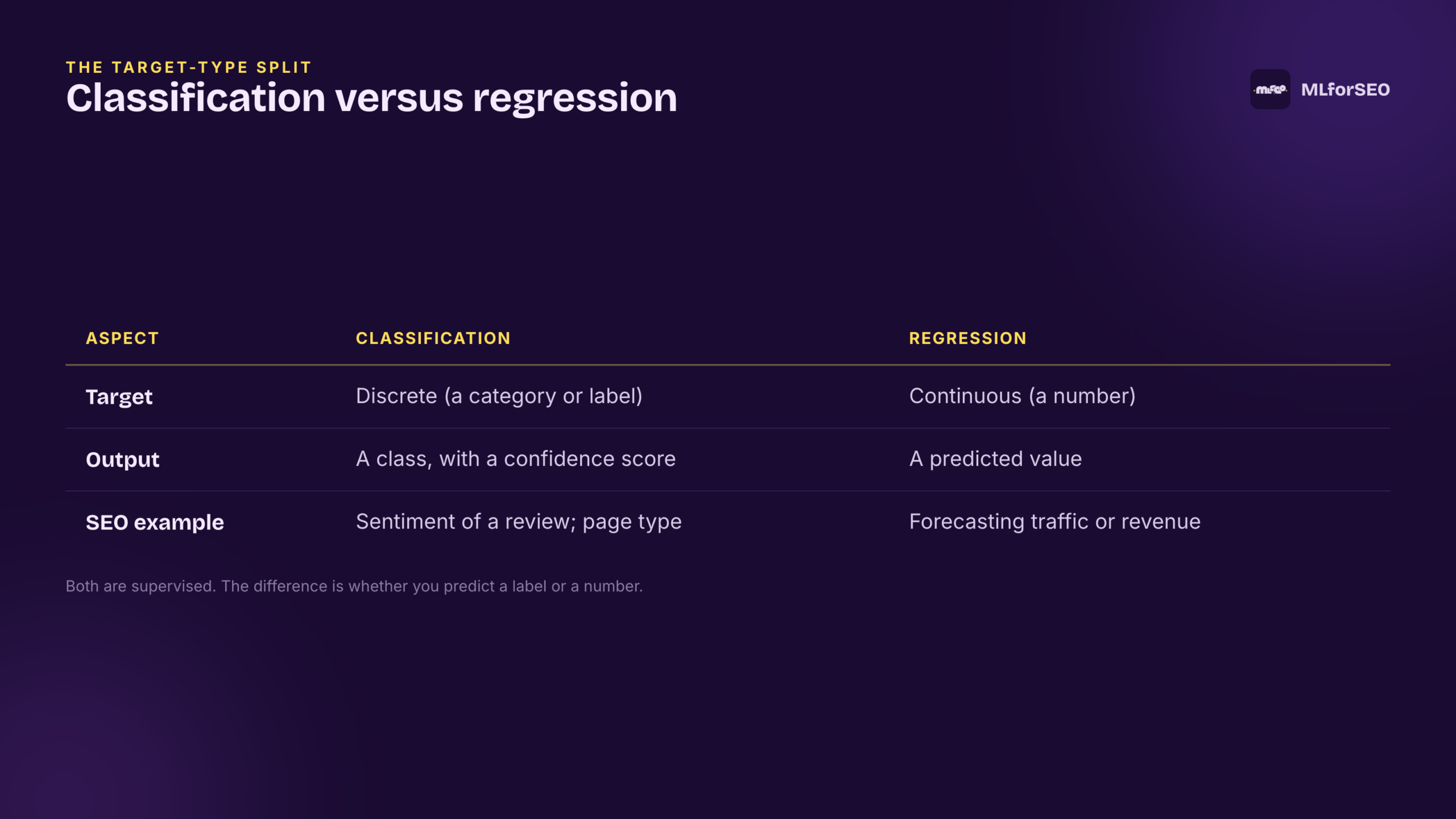
The prediction is a classification when the target is discrete, a category or label, like identifying the underlying sentiment of a piece of text. It is a regression when the target is continuous, a number, like predicting someone’s salary from their education, experience, location and seniority. A clean way to hold it: discrete predictions definitively sort data into distinct categories, while continuous classifiers assign a class as a probability. A healthcare model might classify a patient as diabetic or non-diabetic (discrete), or it might say the patient has an 82% probability of being diabetic, a continuous confidence score between 0 and 1. In classification you will constantly see those confidence scores, and they matter enormously. A low confidence score is the model quietly telling you it is guessing, and that is your cue to check the output, retrain, or fine-tune.
The four types of classification task
The second way classification splits is by the shape of the task itself. These four categories cover almost everything you will do in SEO.
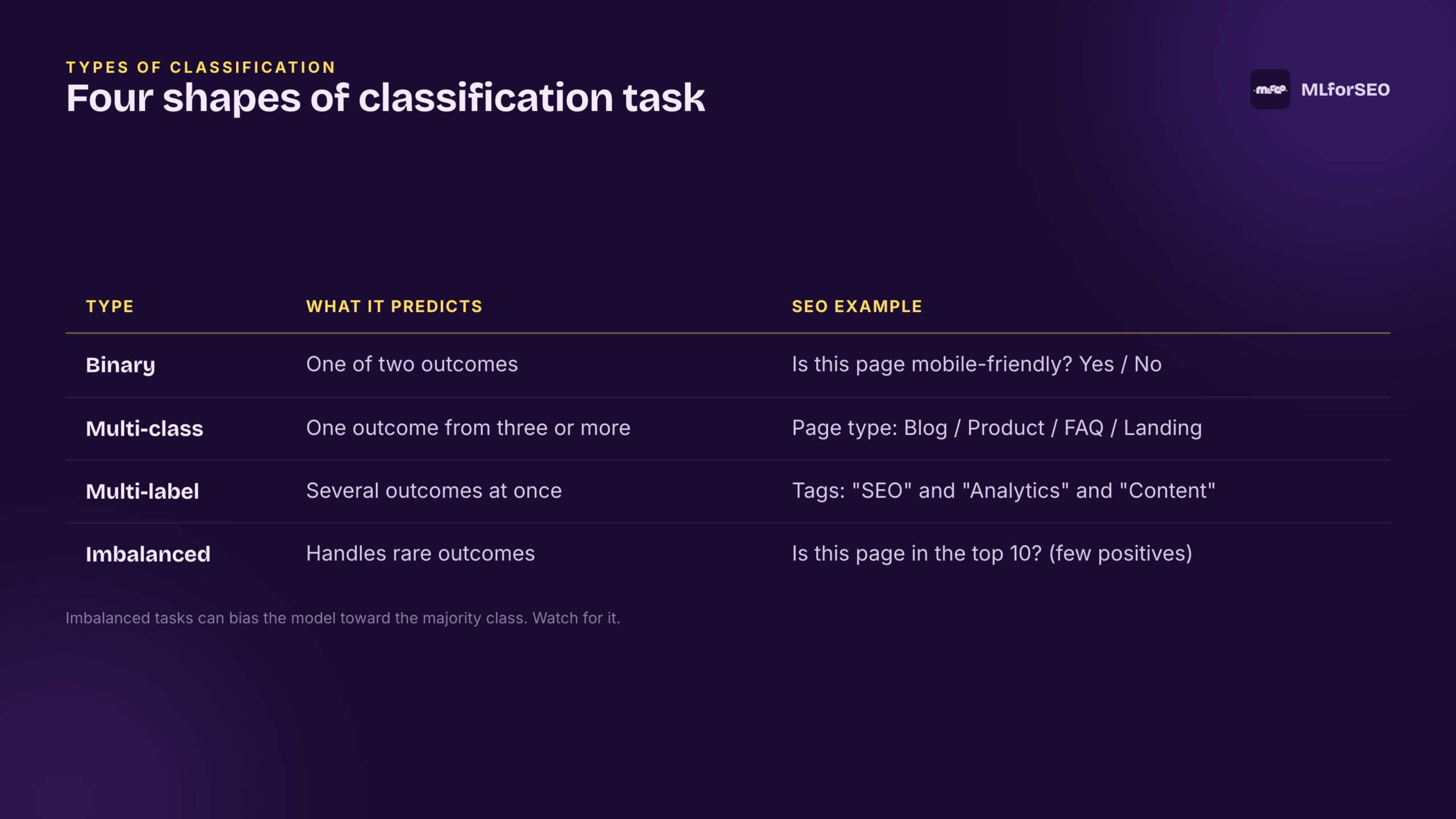
Binary classification predicts one of two outcomes, is this page mobile-friendly, yes or no. Multi-class classification predicts one outcome from three or more options, what type of page is this: blog, product, FAQ, landing page or case study. Multi-label classification predicts several outcomes at once, which is how you apply topical tags at different levels of granularity to the same piece of content: does it fit Arts and Entertainment, and if so, Museums, Galleries or News? And imbalanced classification handles situations where some outcomes are much rarer than others, like whether a page ranks in the top 10, where you only have a few positive cases.
That last one carries a warning worth internalising. When one group dominates the data, the model can develop a bias toward it and over-predict that majority class relative to what actually happens in reality, so your “will it rank” model quietly learns to say “no” to everything because “no” is usually right. It is a known limitation of imbalanced classification, not a reason to avoid it, but something to watch and correct for with resampling or weighting.
One-vs-one and one-vs-rest
A quick but important nuance on multi-class problems, because it comes up the moment you move past toy examples. Most binary classification algorithms can be pressed into multi-class service, with two notable exceptions: support vector machines and logistic regression do not support multi-class classification natively, only binary. To get around that, you apply a transformation strategy. One-vs-one trains a separate classifier for every pair of labels, so a three-class problem means three pairs and three classifiers. One-vs-rest (or one-vs-all) treats each label as an independent yes/no problem against all the others, much like a native multi-class algorithm would. Knowing these two strategies exist saves you a lot of confusion when a tutorial or a library’s documentation casually mentions them.
Classification versus clustering
People constantly confuse these two, so let’s settle it properly. Classification assigns predefined labels that you supply. Clustering partitions an unlabelled dataset into groups of similar objects, with no labels at all. Think of one as top-down, starting from your categories, and the other as bottom-up, starting from the data and letting the patterns emerge.
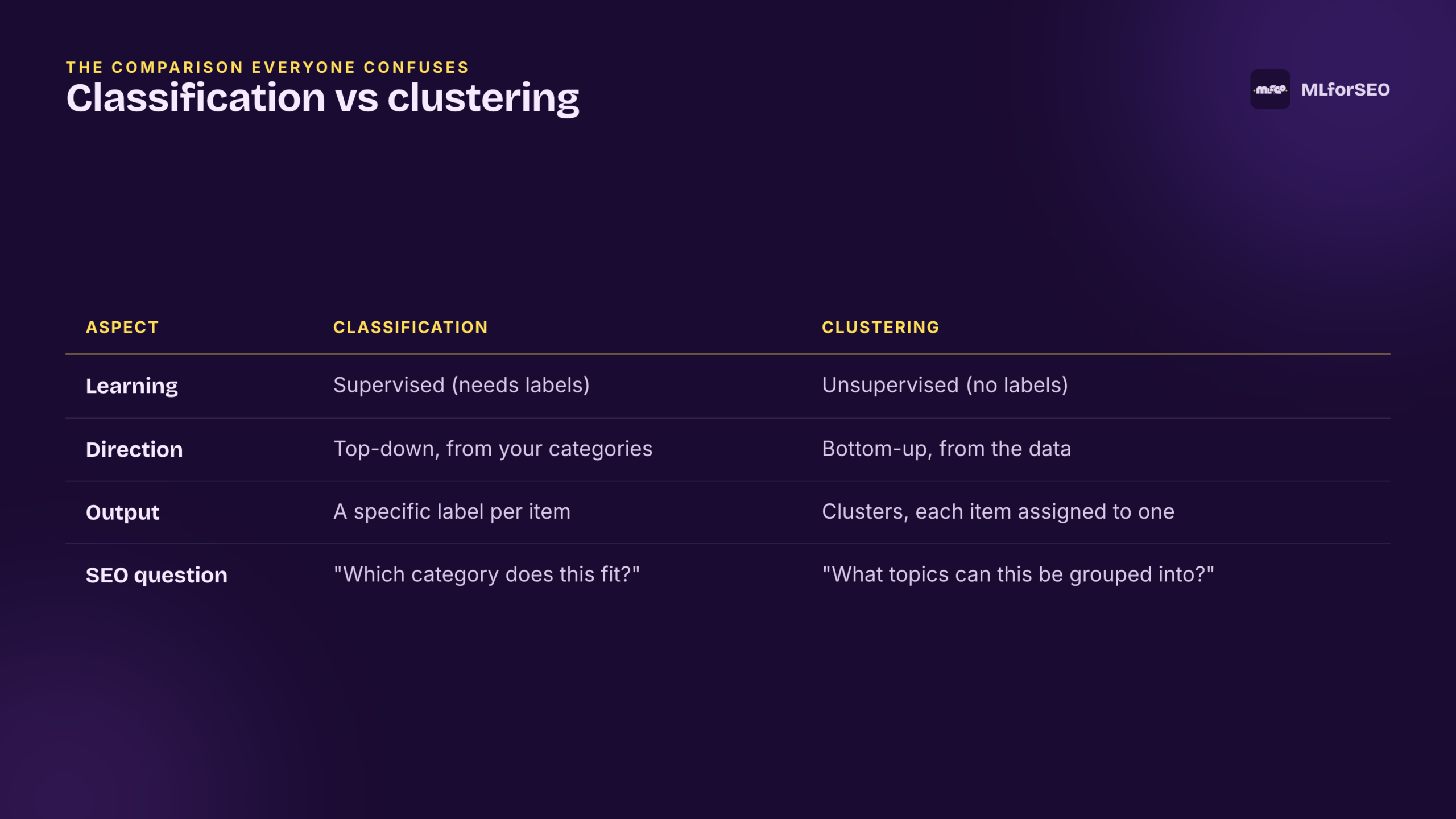
The goal of classification is to predict which known category a data point belongs to, and its output is a specific label per item; it is supervised, so it needs labelled training data. The goal of clustering is to find natural groupings without any predefined labels, and its output is clusters, with each point assigned to one; it is unsupervised, so the algorithm discovers the structure on its own. Framed as SEO questions: classification answers “which of my categories does this post fit into?” while clustering answers the far more exploratory “what topics can this content be grouped into?” Clustering gets its own dedicated treatment, so I will leave the deep dive there.
The algorithms you will encounter
You do not need to memorise the maths, but recognising these names and roughly how they behave helps you read tutorials and choose sensibly.
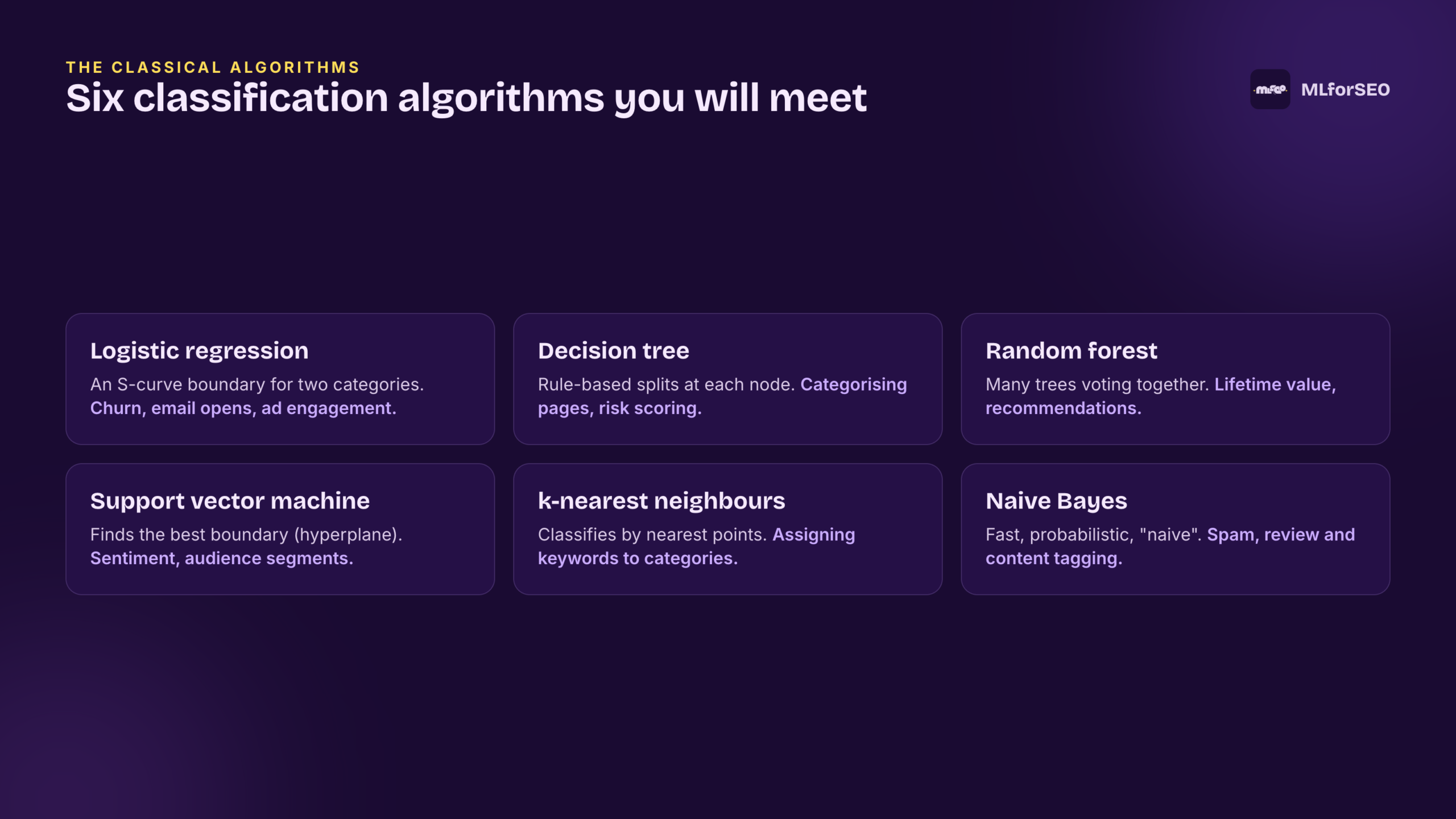
Logistic regression predicts probabilities to classify data into two categories, drawing an S-shaped curve between 0 and 1 that forms a boundary between your true and false examples; great for churn, email open rates and ad engagement. Decision trees split data into smaller groups based on rule-based decisions at each node, forming a tree; the classic illustration is scoring heart-attack risk by branching on age, weight and whether someone smokes, and in SEO it is great for categorising pages. Random forests combine many decision trees and take the most common answer across the whole forest, which improves accuracy and reduces overfitting, useful for lifetime-value prediction and content recommendations.
Support vector machines separate data by finding the best decision boundary, the hyperplane, which makes them strong for classifying ad-copy sentiment and audience segmentation. k-nearest neighbours classifies a point based on the majority of its nearest neighbours, drawing a decision surface and letting the closest points vote, handy for assigning keywords to categories or tagging social posts. And Naive Bayes uses probabilities while assuming all features are independent (the “naive” part); it is fast and efficient but quite surface-level, because the formula it uses is rudimentary and does not cope well with complex, multifaceted problems. Worth knowing: most of the models we actually use later in the course are transformer or ensemble models, a real step up from these classical approaches.
The theory worth going deeper on
The lesson deliberately flags a set of concepts to explore if you find yourself with a lot of classification work, and I want to name them here because they are where beginner knowledge turns into real competence. If you ever move toward self-training your own models, these stop being optional. Evaluation parameters and metrics, how different algorithms are scored and which metric (precision, recall, F1) is right for each. Eager versus lazy learner models, a distinction in when a model does its “thinking”, up front during training, or at prediction time. Ensemble methods and transformer models, the architectures behind most modern, high-performing classifiers. And bias in classification algorithms, how it forms from both the formula and the training data, and how it quietly skews your results. Every algorithm has its own blind spots baked into its maths; knowing them is how you avoid trusting an output you should not.
Where classification fits in SEO
Concepts are the foundation, but you are here for application. Here is where I actually reach for classification, and why it pays off.
Content classification into topics
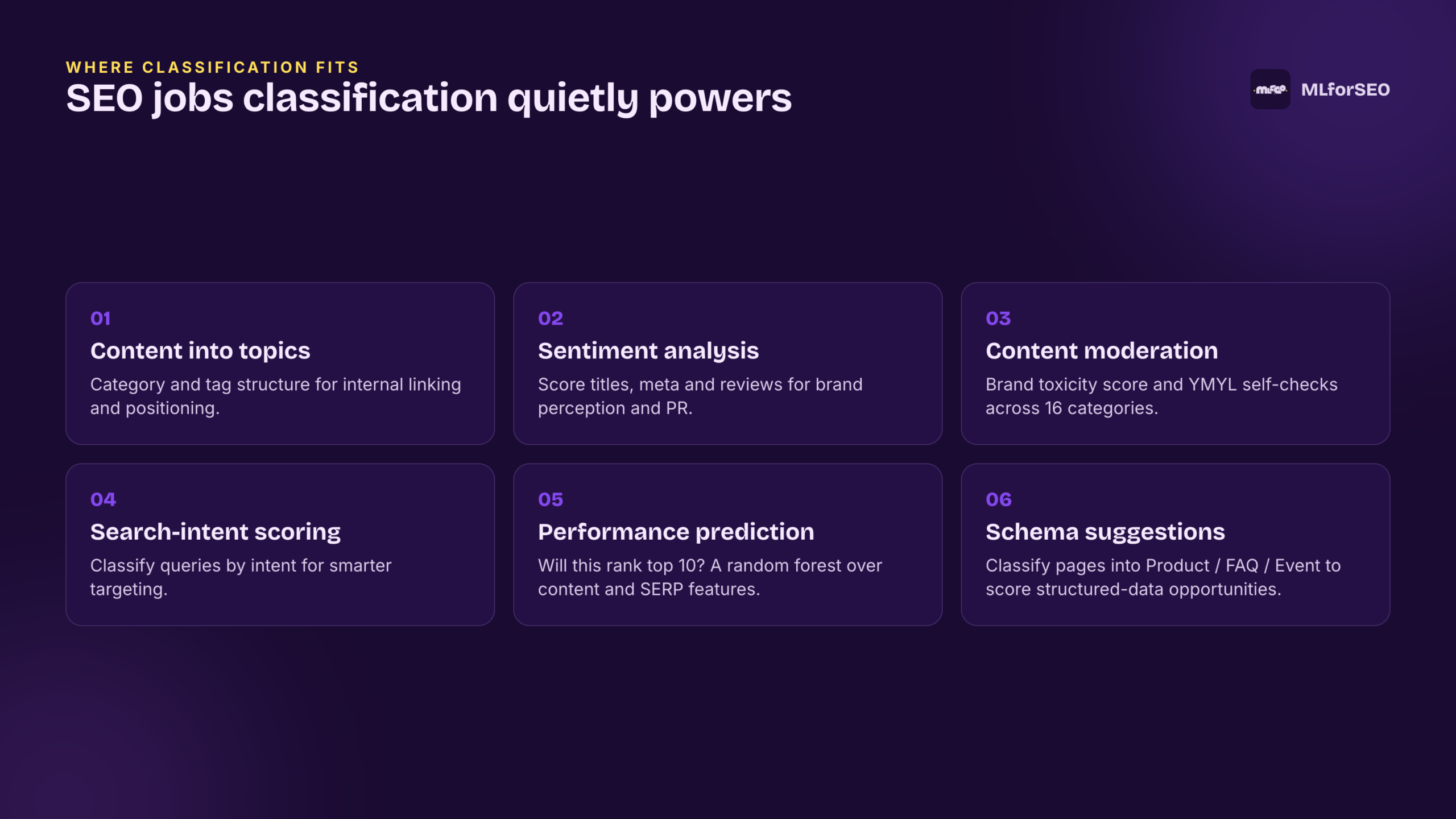
Categorise or discover the topics across your site content and several things get easier at once. Split content into main, secondary and tertiary categories, use those labels as tags, and suddenly your internal linking has real structure, genuine content clusters instead of guesswork. You can check whether your content still aligns with your business positioning, which is invaluable when you inherit a ten-year-old archive that has survived three rebrands and needs a quick pulse-check on what no longer fits. And you can run the exact same analysis on a competitor’s site to see how they have organised their library and what they are really about. The same task extends beyond your website: classify YouTube titles or a whole video catalogue to map a competitive landscape fast, or classify first-party data, form responses, support emails, call transcripts, to see what your audience actually talks about, especially powerful when paired with sentiment and entity analysis.
Sentiment analysis
Sentiment is just classification with emotional labels, and you can run it with no code using our Sentiment Analysis with Google’s Natural Language API guide. Drop in your text, apply a formula, and get a sentiment score and magnitude, is it positive or negative, and how strongly. The demo dashboard plots titles as a bubble chart, rank on one axis, sentiment polarity on the other, bubble size showing the strength of opinion. Do the same for meta descriptions (more text, so more polarity shows up) and you have a fast read on brand perception: which publications lean positive or negative, and a head start on reputation management or digital PR. It gets sharper paired with entity analysis: imagine working for a large marketplace, filtering for the “account” entity, and running sentiment only on account-related coverage, then doing the same for “pricing” or a specific product. One caution I always repeat: correlation is not causation, so read those patterns as insight, not proof.
Content moderation
Classification also powers content moderation, and there is a free, no-code Content Moderation with Google’s Natural Language API guide to try it. The model returns a safety attribute and a confidence score across 16 categories (Toxic, Derogatory, Violent, Health, Finance, Politics, and so on). Because it can assign several at once with confidence labels, this is a multi-label classification job.
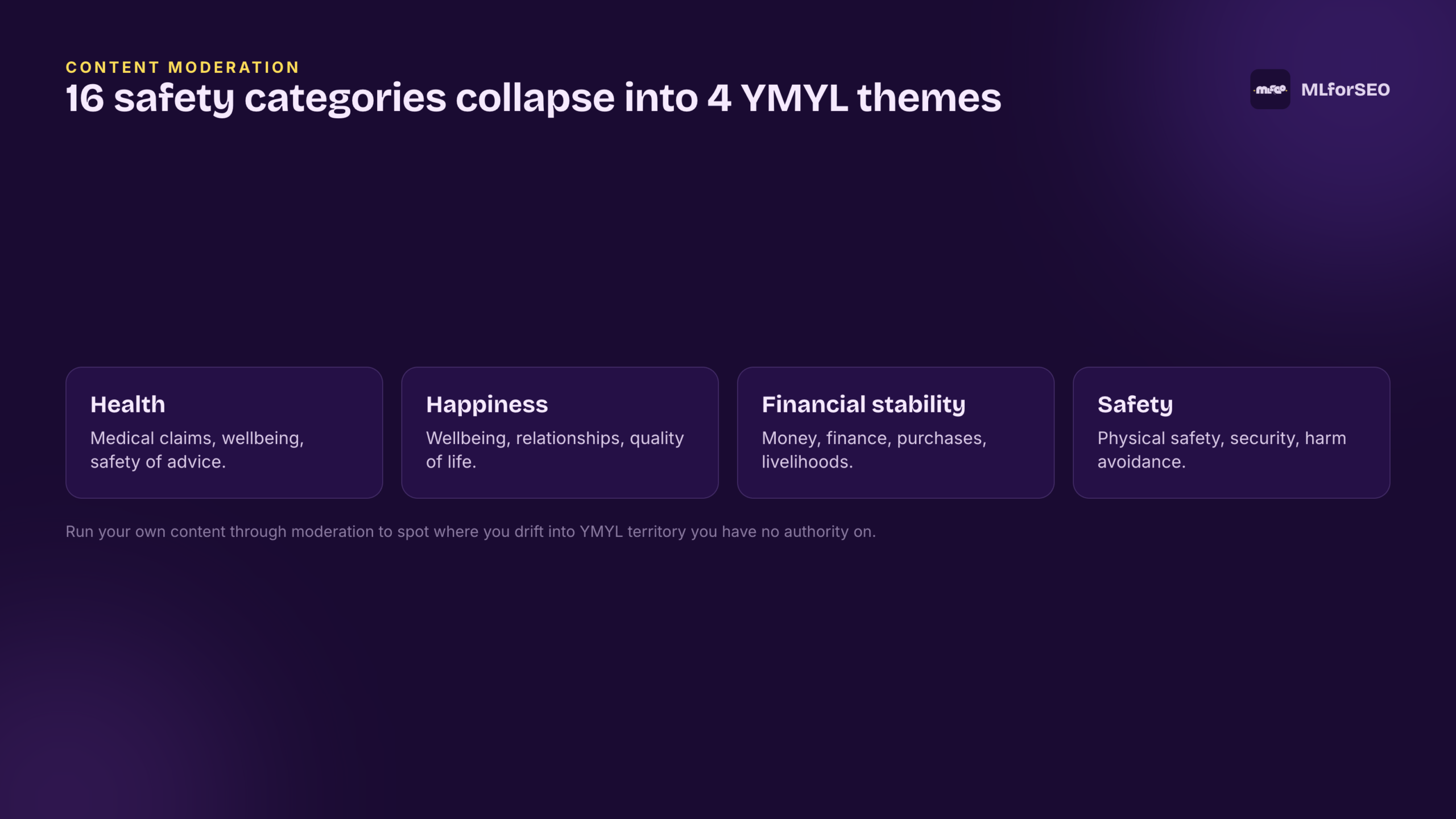
This is useful for two very different jobs. First, monitoring social mentions, reviews and tagged posts to maintain a brand toxicity score, for yourself, competitors or potential influencer partners, and to moderate your own on-site and community content against your guidelines. Second, and this is the SEO angle most people miss, those 16 categories collapse neatly into four that map almost perfectly onto Your Money or Your Life topics: health, happiness, financial stability and safety. Run your own content through moderation and you can spot where you have unintentionally drifted into YMYL territory you have no authority on, which is sometimes exactly why a page is quietly being demoted, because even a little profanity or an off-topic sensitive discussion can affect how content is treated.
And plenty more
Classification shows up all over SEO: keyword categorisation, search-intent classification, content tagging, and page-type identification (a great fit for fine-tuning Google Cloud AutoML on a small sample). It powers SEO performance prediction, will this page rank in the top 10, answered yes or no by a random forest fed content length, title structure, search volume and competitor data. And it drives schema markup suggestions, classifying pages into Product, FAQ or Event to score structured-data opportunities and speed up implementation, using decision trees or AutoML. It is one of the most versatile tools in the whole kit, and the through-line of all of it is the same: turn messy text into structured labels you can act on.
Try it, then go deeper
The fastest way to make this click is to run one. Our Text Classification with Google’s Natural Language API guide lets you classify page content into more than 1,300 predefined categories, no code required, in about 20 minutes, and it doubles as a lesson in why a purpose-built NLP model beats generative AI for this task, on consistency, scale and the confidence scores that generative models simply cannot give you reliably. My advice is always the same: start small, apply classification to one area like page content or keywords, and scale once you see the impact.
Free resources to try this
Classify pages with the free Text Classification in Google Sheets template (no code), or the Python Colab notebook for bigger datasets.
Want the full theory in one place? The Complete Guide to ML Classification for Marketers maps every model to its use cases and is included with the course.
The Role of Classification in AI Search Systems
It is worth zooming out, because classification is not just something you do to your content, it is something being done to it constantly. When Google’s AI Overviews run their query fan-out, breaking one query into many sub-queries and gathering passages from across the web, the very first step is classifying what each query and each candidate passage is about. The clearer and more consistently your content signals its category, its topic, its intent, the easier it is for these systems to match you to the right sub-query. Understanding classification is, in a real sense, understanding how machines decide what you are relevant for.
Where to Take Your Classification Skills Next
This post covers the theory and the landscape. The full Introduction to Classification module inside Introduction to Machine Learning for SEO takes you from here into the hands-on practicals: classifying page content end to end in both Google Sheets and Python, building the Looker Studio visualisation dashboards, the full generative-AI-versus-purpose-built-model comparison, and a whole practical on classifying explicit search intent from SERP features using several different methods.
Related glossary terms
MLforSEO Academy
Take your skills further — pick your path
Introduction to Machine Learning for SEO
by Lazarina Stoy
Ship practical ML workflows — classification, clustering, entity extraction — no CS degree required.
View course →AI Search Optimisation & Agentic SEO
by Beatrice Gamba
How agentic systems retrieve, evaluate and select — and how to become the source they cite.
View course →AI Search, LLMs, Entity SEO & Knowledge Graph Strategies
by Beatrice Gamba
Build the entity authority and knowledge-graph presence that makes AI recognise and trust your brand.
View course →Semantic ML-enabled Keyword Research
by Lazarina Stoy
Query understanding, search intent and semantic clustering for how people and AI really search.
View course →