
 By Lazarina Stoy· August 1, 2026
Fuzzy matching is one of those techniques that feels almost too simple to be machine learning, until you realise how many SEO problems are really just “are these two strings the same, more or less?” Redirect maps, 404 clean-ups, hreflang audits, brand-mention monitoring, they all come down to measuring how alike two pieces of text are. This post explains what fuzzy matching is, the different ways it measures similarity, the specific algorithms and libraries you will use, and, just as importantly, the one big limitation that decides whether it is the right tool or completely the wrong one. It is the conceptual grounding for the fuzzy-matching module of the Introduction to Machine Learning for SEO course.
What fuzzy matching is
Fuzzy matching is a form of string matching, a machine learning problem that dates back to the 1980s. At its core it measures the distance between two strings and turns that into a similarity score, classifying them as equivalent, similar or distant. You will hear a few related terms worth untangling. Fuzzy search (also called approximate string matching) is the same idea applied to retrieving similar-but-not-identical entries from a database; fuzzy matching is the broader umbrella that encompasses it, and both deploy similar algorithms, the search version just has information retrieval as its goal. And where traditional logic is binary, a statement is true or false, information is retrieved or it is not, fuzzy logic expresses the degree to which a statement is true, which is exactly what a similarity score gives you.
It emerged to solve two problems. Error correction is a corruption-correction point of view: finding patterns in a large corpus, retrieving information based on a specified input, spotting similarity mismatches and correcting the error, which is also how you de-duplicate a database. Information retrieval is about providing an input that best describes what you want to pull from a dataset, where the two risks are returning unwanted matches or missing needed ones. Pause and count how many places in SEO a spelling slip or a copy-paste error creeps in, URLs, product databases, customer records, brand mentions, and you will see why this is such fertile ground for us.
It is worth dwelling on just how many SEO and marketing scenarios are secretly string-similarity problems, because once you see the pattern you find it everywhere. Any place a human types data by hand is a place errors accumulate: product databases where the same item is entered three slightly different ways, customer records with misspelled names, tagging systems that drift over time, campaign names that never quite match across advertising platforms. Fuzzy matching is the tool that reconciles all of these back to a single canonical version, which is why it turns up as often in data-cleaning and reporting work as it does in technical SEO.
The similarity problem, and the catch that matters most
Every fuzzy matching algorithm exists to solve the similarity problem: understanding how approximate, how alike, two strings are. The mathematical way each algorithm solves that is where they differ. Broadly, string variation is measured by errors in spelling and typing, and early research found the culprits: mistaking one letter for another (the most common), omitting a letter, inserting one by mistake, or transposing two. Algorithms calculate distance by deciphering which of those errors separates the two strings, then scoring similarity accordingly.
And here is the catch you must internalise, because it decides everything.
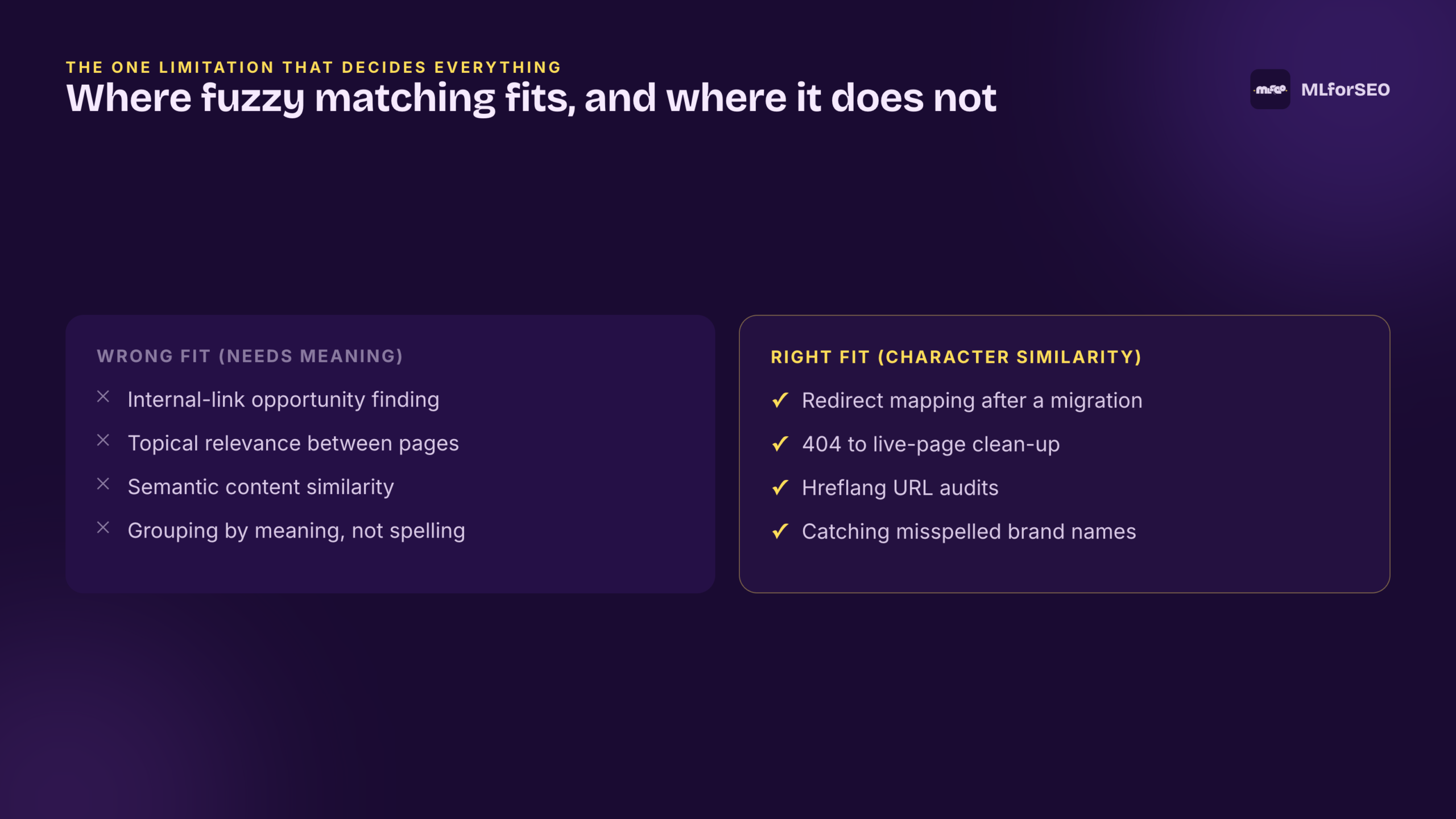
String matching measures similarity at the character level, not the semantic level. It has no understanding of meaning or context. That is exactly why it is perfect for redirect mapping, where you only care whether two URLs are spelled similarly and the semantics of the content have not changed, and exactly why it is the wrong tool for internal-link opportunity finding, where you need to understand whether two pages are actually about related things and would genuinely help a user. For anything semantic, an entity-based approach beats fuzzy matching every time. Keep that line in your head; it will save you from a lot of wasted effort and, worse, from confidently recommending the wrong method to a client.
The approaches to string matching
String-matching methods are classified by how they calculate similarity, or how they resolve that core problem.
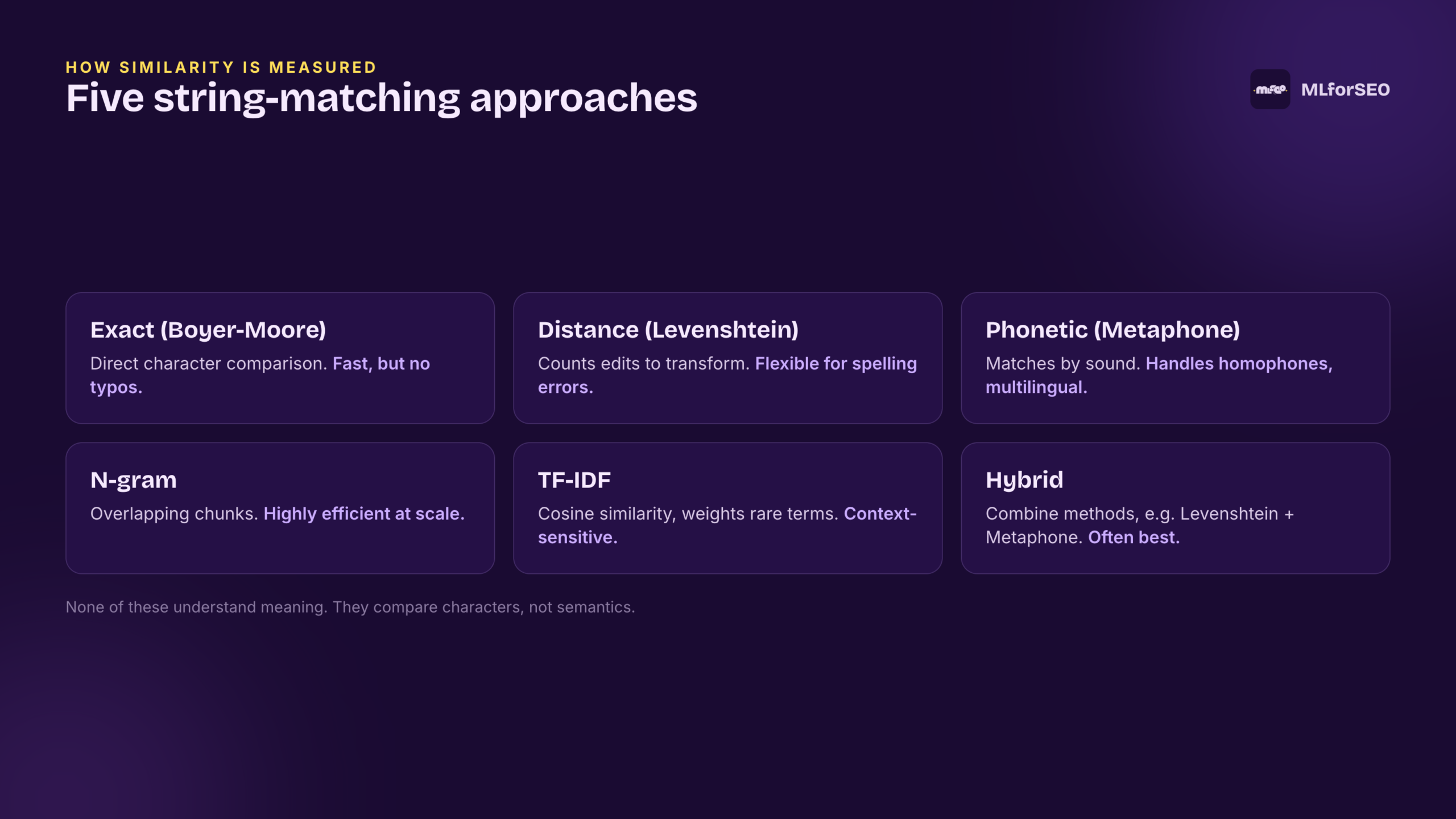
Exact matching (or direct matching) performs a direct, character-by-character comparison for the exact pattern; it is fast and highly accurate with minimal computational cost, but limited to exact matches and useless for typos. Distance-based matching uses edit distance, the minimum number of edit operations (substitutions, insertions, deletions) needed to convert one string into another; it is considered the best group for approximate matches and is flexible for typos and minor spelling differences, but it does not consider semantic meaning. Phonetic matching matches by how words sound, which is key for multilingual environments and handles homophones well, at the cost of lower precision and more false positives. N-gram matching detects occurrences of fixed-length substring patterns, so the phrase “what is string matching in machine learning” splits into bigrams (what-is, is-string, string-matching…) or trigrams, and similarity is scored on shared n-grams across your dataset; it is extremely efficient and scalable for large keyword sets, but computationally heavier for long strings. And TF-IDF matching uses cosine similarity with TF-IDF, analysing the whole corpus and weighting each token as more important if it is rarer, so matches become context-sensitive rather than purely character-based.
Each approach trades off differently, and knowing the trade-offs is how you choose. Exact matching is fast and cheap but fails on any typo. Distance-based matching is flexible for spelling errors but blind to meaning and weak on words that sound alike yet are spelled differently. Phonetic matching handles exactly those homophones and multilingual variation but is low-precision, throwing false positives and sometimes missing close matches. N-gram matching is highly efficient and scalable for large datasets and partial matches, but computationally expensive on long strings and still semantically shallow. And TF-IDF matching brings genuine context-sensitivity by weighting rarer terms, but it does not capture true semantic similarity and needs preprocessing. There is no universal best, only the best fit for your data and your tolerance for false positives versus missed matches.
The algorithms, in detail
Each approach has a flagship algorithm worth knowing by name.
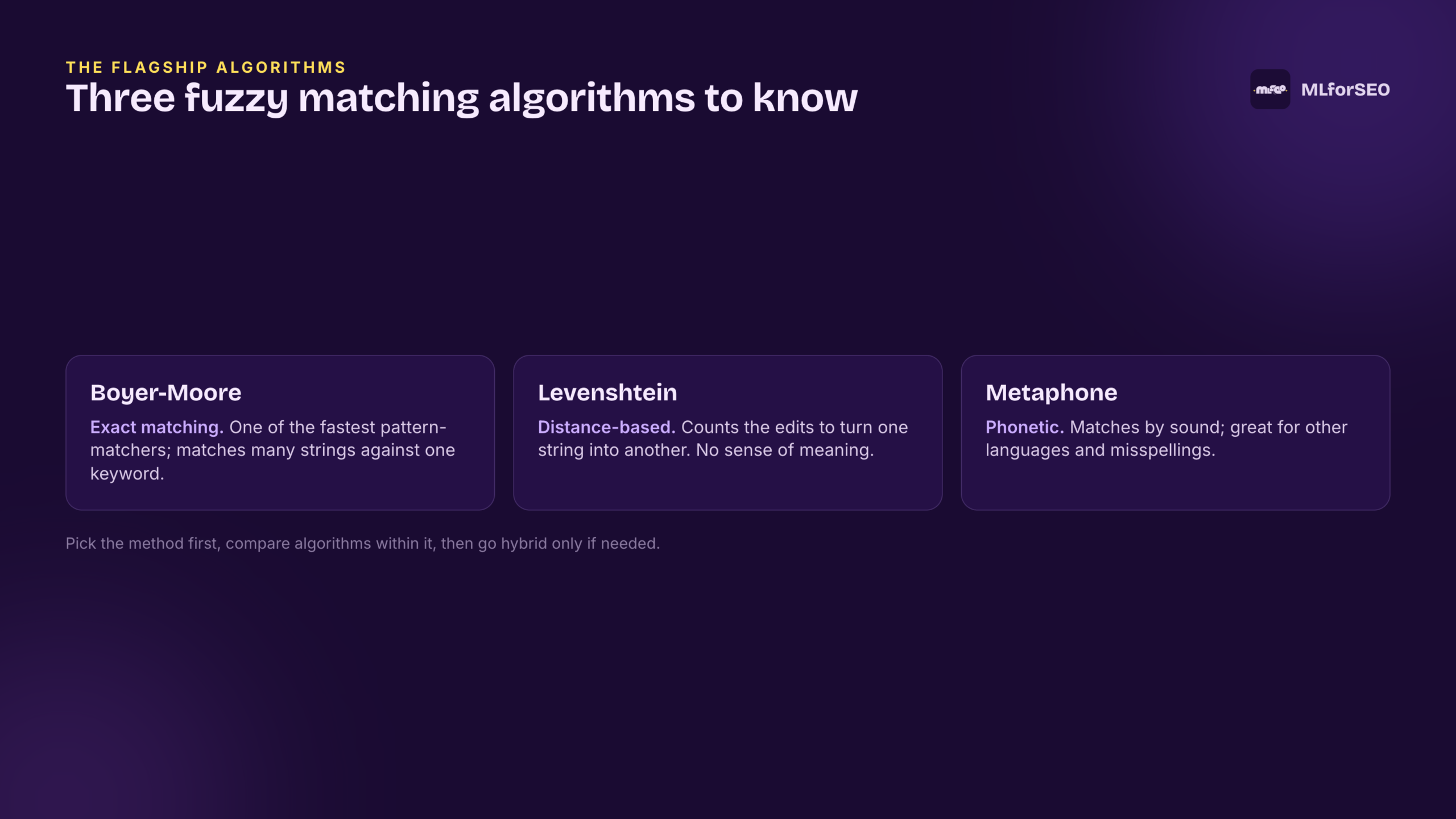
Boyer-Moore is the classic exact-matching algorithm, one of the best-known pattern-matching algorithms and very fast in practice, designed to match many strings against a single keyword; it loops through entries checking characters and length, and where it finds a partial rather than full match it flags a partial keyword match. Levenshtein distance is the workhorse of distance-based matching (first described by Vladimir Levenshtein in 1966): it counts the character shifts needed to get from your input to a dataset entry. Its famous limitation is that it has no sense of meaning, so it will tell you “hard” and “hand” are more similar (one substitution) than “hard” and “harder” (two additions), even though a human reads the latter pair as more related. Metaphone is the go-to phonetic algorithm, excellent for languages other than English and robust to misspellings, missing letters, swaps and extra letters. When one method is not enough, a hybrid architecture often wins, for example Levenshtein plus Metaphone to catch misspelled-but-phonetically-similar words, or n-grams to preprocess before applying TF-IDF for contextual relevance.
In Python you will reach for libraries that bundle these together, so swapping one algorithm for another is often a single line of code: FuzzyWuzzy, RapidFuzz and PolyFuzz, plus Fuzzy Pandas, NLTK, SciKit-Fuzzy and Elasticsearch. Those will take you as far as you need to go as a beginner. The important thing is to pick your method first, then compare algorithms within it, and only reach for a hybrid if a single method underperforms on your data.
Where fuzzy matching fits in SEO
This is where it earns its keep, and there is a lot of it.
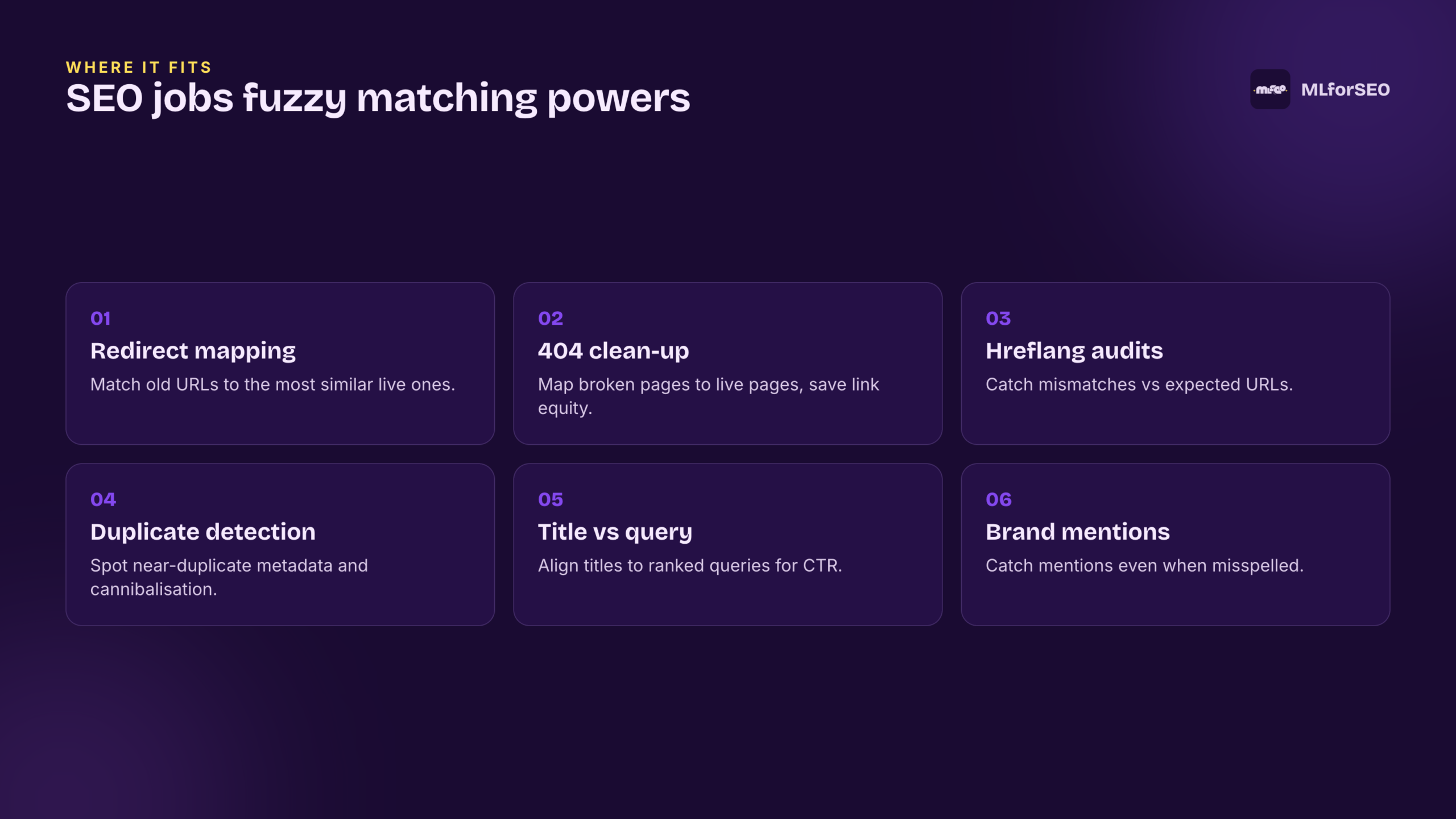
Redirect mapping and 404 clean-up are the classic wins: automatically match old or broken URLs to the most similar live ones, preserving link equity (especially valuable when those broken pages have backlinks) and killing dead ends, remembering it matches on the URL string, not the meaning of the content. Hreflang audits catch mismatches between the URLs your hreflang specifies and the URLs your map says should be there, which prevents real revenue leaks on multilingual ecommerce and lead-gen sites. Duplicate and near-duplicate detection spots accidental content overlap or cannibalisation fast, brilliant for large enterprise sites with accidental section duplication, and best run on metadata (titles, headings, URLs) or, for plagiarism, at paragraph level, since fuzzy matching works best on shorter strings. And a favourite of mine, title-versus-query alignment, compares ranked queries to page titles to spot click-through-rate opportunities and better align the title with how users actually search, brilliantly demonstrated in Natzir Ruiz’s guest tutorial on the MLforSEO blog, which pairs fuzzy matching with generative AI.
Beyond core SEO, it is genuinely useful across marketing: comparing PPC ad copy for similarity (yours or competitors’, using Levenshtein, cosine or n-grams) to improve variations and align weaker campaigns to winning ones; social hashtag normalisation, grouping near-identical hashtags to capture every post on a topic; catching brand mentions across social posts, captions and comments even when your name is misspelled; quick-and-dirty keyword clustering when your topics are closely aligned to the keyword text; and matching product-category or product-name terms unique to your ecommerce brand. Two of the SEO use cases already have full walkthroughs: 404 and redirect mapping with fuzzy matching in Python and automatically optimising metadata with FuzzyWuzzy. It is also a wonderful conversation-starter with siloed teams, PPC, social, product, customer service, all of whom have data you can share scripts with and learn from.
Resources
Grab the free Automated Redirect Mapping with Triple Fuzzy Matching notebook to see a hybrid approach on a real migration, and the deeper Comprehensive String & Fuzzy Matching Reference Guide (every approach, algorithm and use case) is included with the course.
How a fuzzy matching project actually runs
It helps to see the shape of a real job. Take redirect mapping, the most common one. You start with two lists: the old URLs (from your pre-migration crawl, or your backlink and analytics exports) and the live URLs (from a fresh crawl of the new site). You run a distance-based or hybrid algorithm to score every old URL against every live URL, keep the best match for each, and bucket the results by similarity score: a near-100% score is a confident one-to-one redirect, a middling score is a partial match to review by hand, and a low score flags an old URL with no good destination, which you either send to a relevant category page or accept as a genuine 404. Set a sensible similarity threshold and you have turned a week of manual spreadsheet work into a first-pass map you can review in an hour. The 404 clean-up job is almost identical; only the input list changes.
The workflow for improving your results is just as repeatable. Identify the kind of error or variation you are dealing with, pick the method that targets it, compare the specific algorithms within that method, and only build a hybrid architecture if a single method underperforms. Catching misspelled brand names across languages points to phonetic; searching a huge keyword set for partial matches points to n-grams; a job where context and term rarity matter points to TF-IDF. Because the popular Python libraries bundle many algorithms behind a near-identical interface, the cost of testing one against another is close to zero, so test on your own data before you commit. The right choice is empirical, not theoretical, and the comprehensive reference guide that maps each algorithm to its approach, similarity calculation, advantages and limitations makes narrowing it down far quicker.
The Role of Fuzzy and Semantic Matching in AI Search
This character-versus-meaning distinction matters more, not less, in the AI-search era, and I dug into exactly why in a longer piece for iPullRank, Fuzzy Matching and Semantic Search. The core argument is that modern retrieval runs on two layers at once. Fuzzy, lexical matching (edit distance, n-grams, BM25) repairs messy input and tolerates typos, while semantic matching via embeddings captures paraphrases, synonyms and intent. Leading systems combine both in a hybrid pipeline and then rerank the candidates with fusion methods, because neither layer alone is enough.
Three practical consequences follow for anyone optimising for AI search. First, because these systems extract short, self-contained passages, you should map clustered question variants to tight H2 and H3 sections an LLM can lift with high confidence and no hallucination risk. Second, entity consistency, unified NAP and stable, machine-readable schema, reduces the ambiguity that makes a system distrust and skip your content. And third, the metric that matters shifts from ranking to retrieval inclusion: in a retrieval-augmented pipeline, being selected as a candidate passage is step zero. Fuzzy matching keeps your technical foundations clean so you stay eligible; semantic structure is what actually gets you chosen.
Where to Take Fuzzy Matching Next
This post covers what fuzzy matching is and where it fits. The Introduction to Fuzzy Matching module inside Introduction to Machine Learning for SEO takes you into the practicals: 404 and redirect mapping, and competitor or internal metadata opportunity analysis, all hands-on. And remember the golden rule: fuzzy matching is for character similarity. When you need meaning, reach for entity analysis instead.
Related glossary terms
MLforSEO Academy
Take your skills further — pick your path
Introduction to Machine Learning for SEO
by Lazarina Stoy
Ship practical ML workflows — classification, clustering, entity extraction — no CS degree required.
View course →AI Search Optimisation & Agentic SEO
by Beatrice Gamba
How agentic systems retrieve, evaluate and select — and how to become the source they cite.
View course →AI Search, LLMs, Entity SEO & Knowledge Graph Strategies
by Beatrice Gamba
Build the entity authority and knowledge-graph presence that makes AI recognise and trust your brand.
View course →Semantic ML-enabled Keyword Research
by Lazarina Stoy
Query understanding, search intent and semantic clustering for how people and AI really search.
View course →