
 By Lazarina Stoy· August 1, 2026
Entity extraction is, to my mind, one of the most underused techniques in SEO, and one of the most important to understand, because it is close to how machines actually read text. Search engines and large language models do not see your content as a bag of keywords. They see entities, the real-world things your content is about, and the relationships between them. Google has organised knowledge around entities since it launched its Knowledge Graph in 2012, and that entity-first way of understanding text is now the foundation of how AI search decides what you are relevant for. Learn to see text the way these systems do and you can build much better strategies. This post covers what entity extraction is, where it sits in the wider world of language understanding, how entities differ from keywords, the EAV model, how the models are built, and a proper tour of where all of it fits in SEO.
What entity extraction (NER) is
Entity extraction, also called named entity recognition or entity chunking, is a natural language processing technique that identifies and classifies key pieces of text, the named entities, into predefined categories like people, locations, organisations, events and dates. It takes a string written for human readability, a sentence, a paragraph, a page, a PDF, and adds structure and semantic information a machine can use. You can also custom-train it to recognise niche categories for a specialised domain. That structuring step is why NER is such a common preprocessing stage, including inside the large language models generating answers today.
In machine learning terms, NER is supervised and prediction-based: it is trained on labelled examples, then predicts whether the entities it finds in new text match the ones locked in its knowledge graph, weighing context, surrounding words and other entities in the sentence to decide. It can run on any kind of text, social posts, legal documents, scientific papers, and any length, from a single query to a full page.
Where entity extraction sits: semantic analysis
It helps to know the neighbourhood NER lives in, because it explains why the same APIs do so many related jobs.
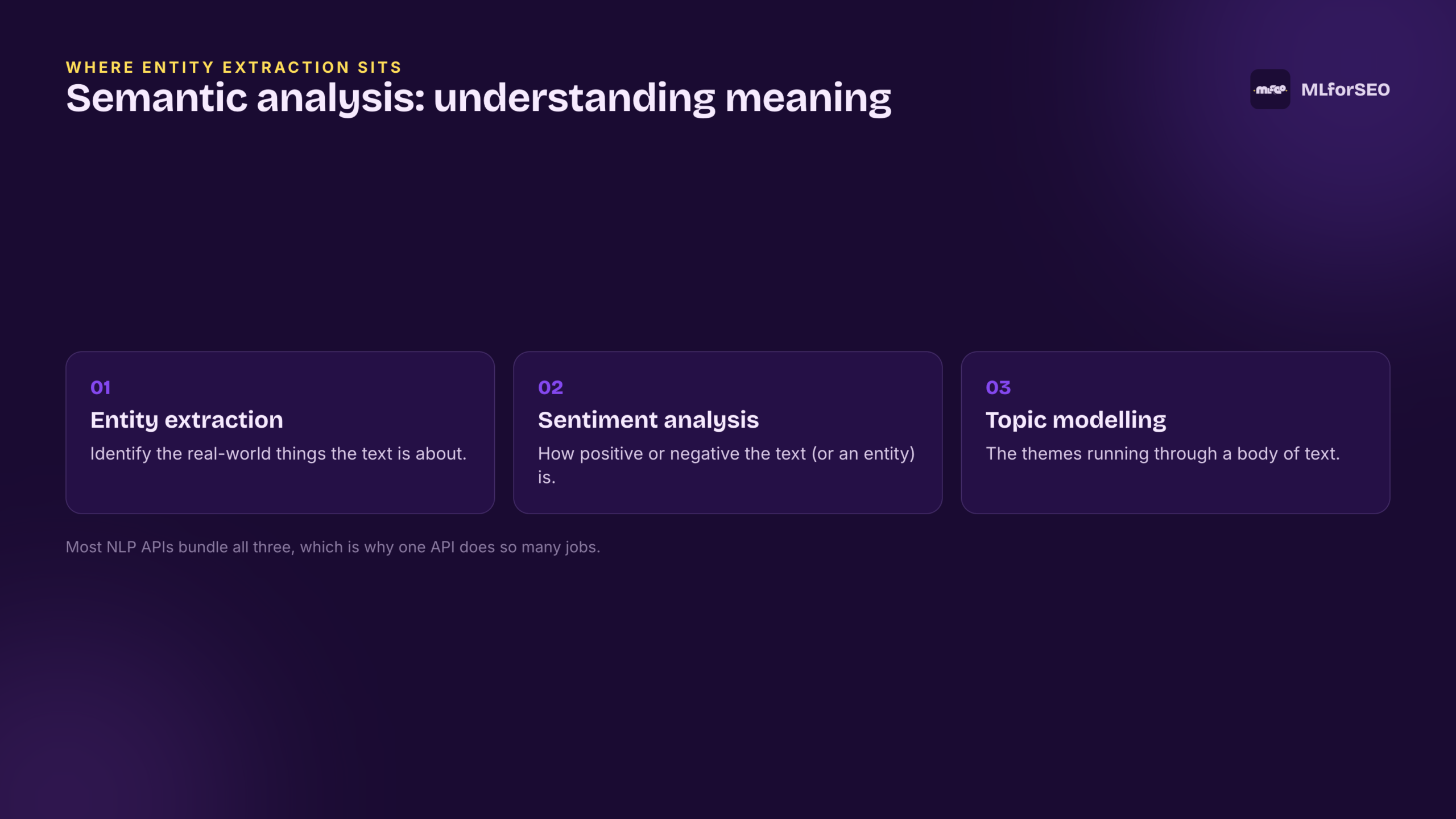
Think of taking high-level human language and passing it through a system, a compiler, to turn it into something a machine can navigate. Entity analysis falls into the phase of that process called semantic analysis, which is concerned with the meaning of a statement, and which also houses topic modelling and sentiment analysis. Semantic analysis uncovers the definitions of words, phrases and sentences, checks whether they are organised in a way that makes sense, and maps the logic of the relationships between entities. This is why most pre-trained NLP APIs (Google Cloud’s, Amazon’s, IBM’s) bundle entity extraction together with sentiment, entity sentiment, content moderation, syntax analysis and classification, they are all facets of understanding meaning. The practical upshot: besides a list of entities, you get entity type, salience (importance in the document), sentiment, metadata (whether the entity is in the knowledge graph, its attributes), mention counts and the different phrasings used. That extra data is what turns “here are some entities” into real analysis.
If you want the fuller picture, entity analysis is one of several phases in how a system moves from raw human language to machine understanding, a process modelled on compiler design in software engineering. Before meaning can be extracted, a syntactic parser establishes grammatical structure, then the system checks for logic and semantic coherence in how the words relate to one another. Semantic analysis, where entity extraction lives alongside topic modelling and sentiment analysis, is the phase that uncovers what the words actually mean and whether their arrangement makes sense. You never implement any of this yourself, the pre-trained APIs handle the whole pipeline, but knowing that entity extraction is one instrument in a larger orchestra of language understanding helps you appreciate why the data you get back is so rich, and why combining entities with sentiment and topics is so much more powerful than any one of them alone.
Entities are not keywords
This distinction trips up a lot of SEOs, so it is worth nailing.
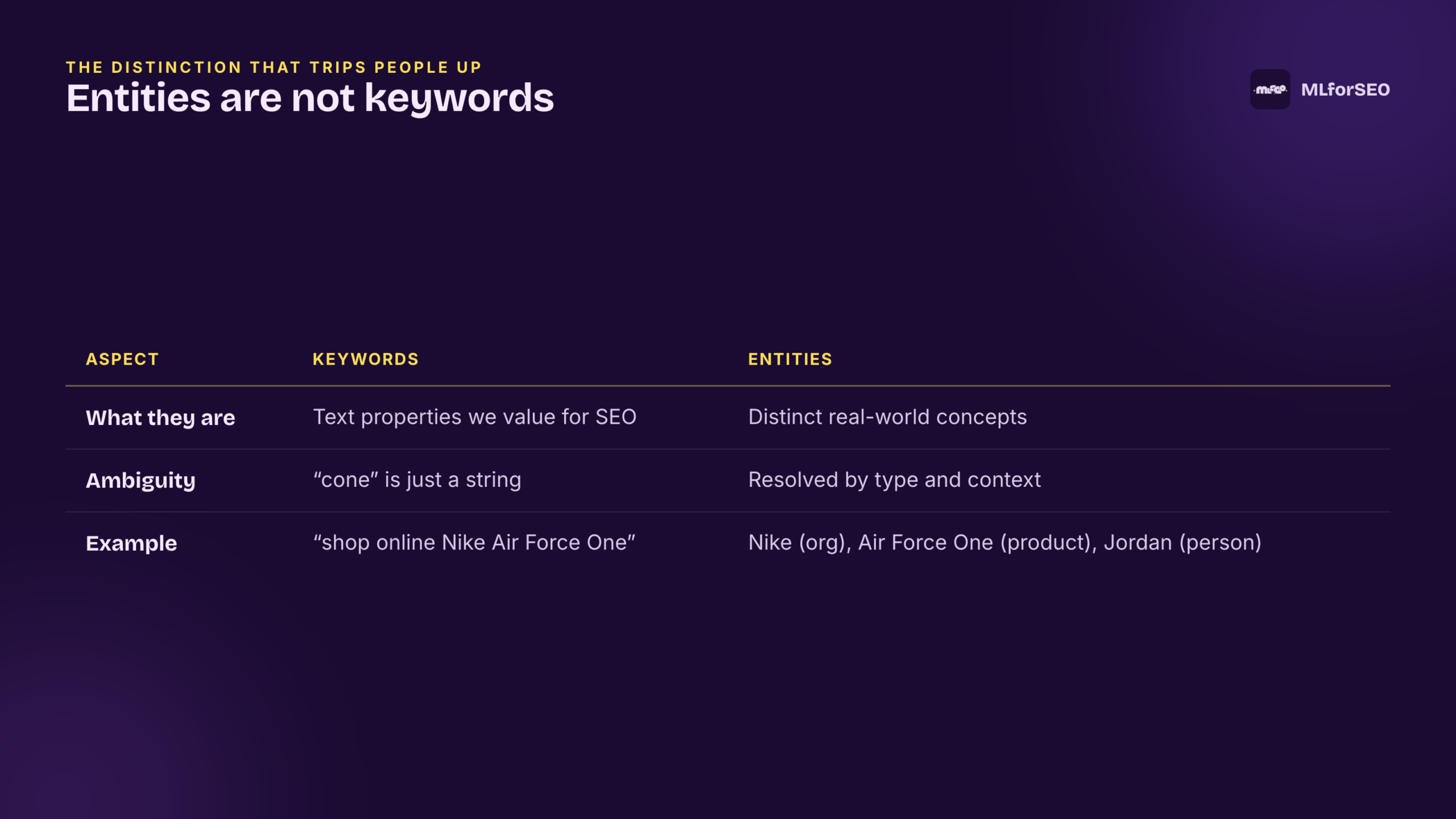
Keywords are specific words or phrases we value for SEO reasons; entities are distinct, well-defined concepts that exist in the real world, a person, a place, a thing, an idea, each with an entity and an entity type (Barack Obama is a person, the Louvre is a place, a smartphone is a thing or product). Take the word “cone”, it could mean three completely different things depending on context, and only entity recognition resolves that. In a query like “shop online Nike Air Force One”, an SEO reads transactional and navigational intent from the words, while entity extraction identifies Nike (organisation), Air Force One (product) and Michael Jordan (person). Sometimes keywords and entities overlap; often they do not. Niche terms like “beginner”, “SEO research” or “guide” get recognised as entities but classified as “other” by general pre-trained models, simply because they are not prominent in the training data.
The EAV model: entities, attributes, variables
Entities get much more powerful once you add structure to them, and this is how they are defined in a knowledge base.
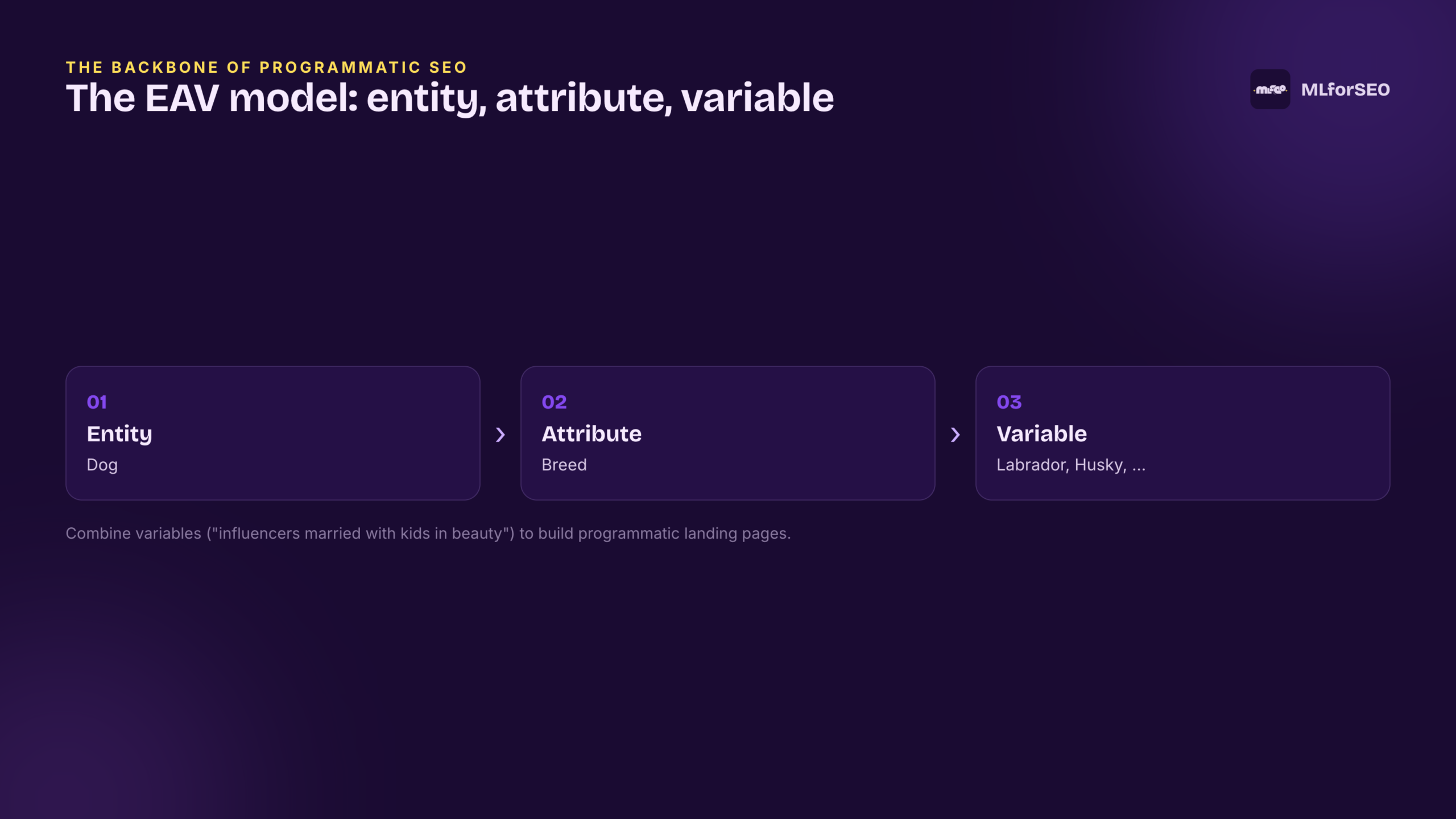
Every entity type has attributes (characteristics or properties), and every attribute has variables (the specific values). Take “dog” as an entity: an attribute is “breed”, and its variables are Labrador, Husky and so on; another attribute is “fur colour”, with its own variables. This EAV model is the backbone of programmatic SEO and information-gain analysis. Take “influencer” as an entity, add attributes like location and family status, and combine variables into “influencers in London”, or multi-variable combinations like “influencers married with kids in the beauty niche”. Each combination is a tailored, finite landing-page target. We go deep on EAV, and how it drives programmatic keyword research, in the Semantic Keyword Research course.
How entity extraction models are built
If you ever consider training your own, the process starts with a representative, human-annotated document collection, which is put through feature extraction, encoding and training to produce a classifier (a support vector machine, or any classifier we met in the classification module) that does the labelling. There are four broad approaches, and knowing their trade-offs tells you why you probably should not start there.
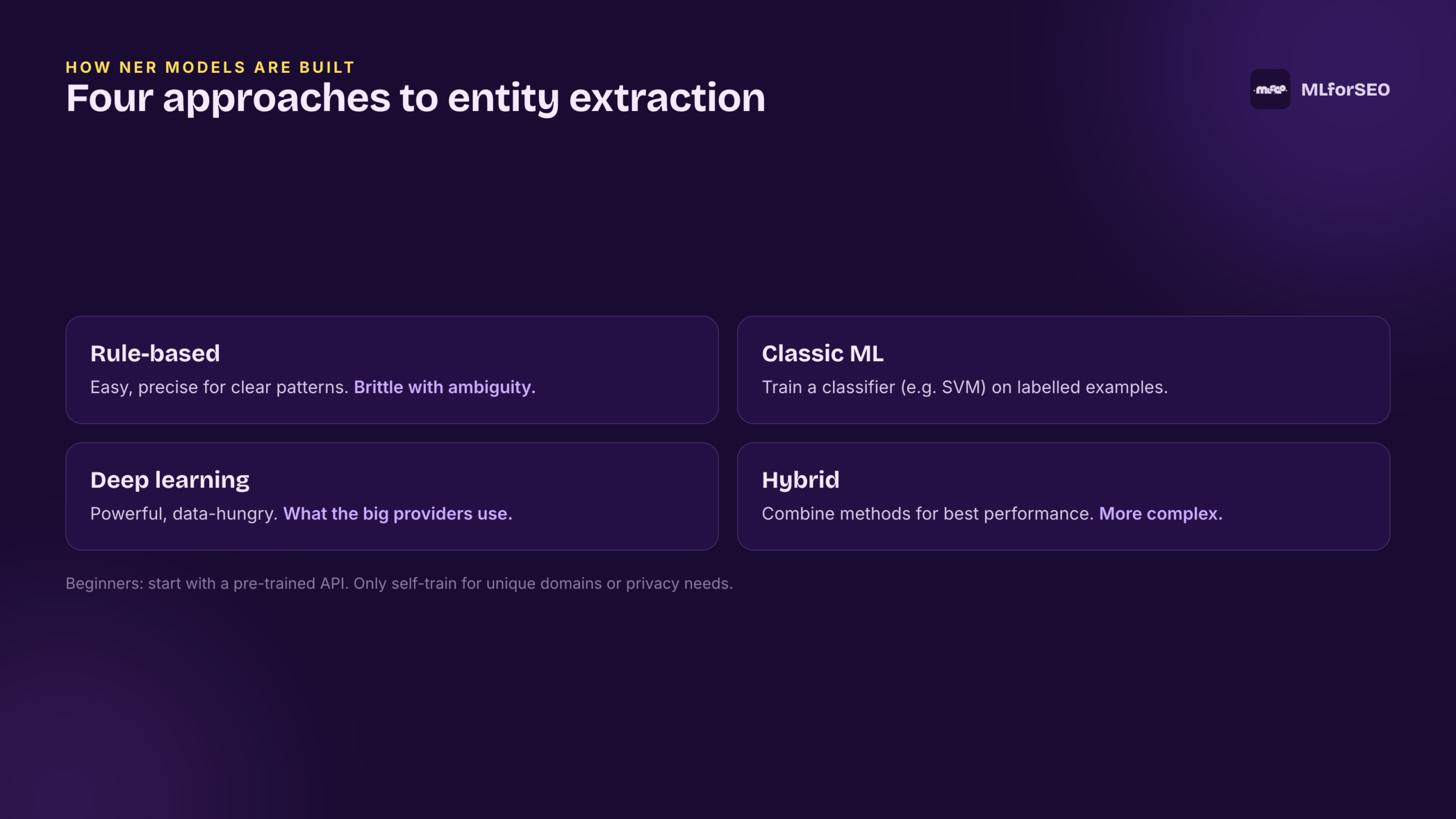
Rule-based is easy to implement and precise for clear patterns, but brittle with ambiguity and language variation, and it needs domain expertise. Classic machine learning trains a classifier on labelled examples. Deep learning and hybrid architectures are what the big providers use, and a hybrid pipeline is more involved than the simple picture: input text runs through segmentation, tokenisation and morphosyntactic analysis (the preprocessing), then an entity-recognition model that may combine classical machine learning, rule-based logic, lexicon-based models and deep learning to extract context and meaning before producing its prediction. These win because the giants have the data and engineering to make them perform. You can custom-train or fine-tune with tools like spaCy, adding contextual word embeddings (which capture meaning in context), conditional random fields (a statistical technique that improves extraction) and active learning (which lets the model pick the most informative examples to label, cutting your labelling effort). But entity extraction is genuinely labour-intensive to build well, so for beginners a pre-trained API like Google Cloud NLP or Amazon Comprehend gets you to a result far faster. Only self-train if you have unique domain entities, strict data-privacy needs (you cannot send data to Google or Amazon), or a real desire to learn the pipeline, and even then, fine-tuning usually beats training from scratch.
If you do weigh up custom training, the factors that decide it are the complexity of the task, how much labelled data you actually have, the computational resources training to a competitive quality would demand, and the accuracy you genuinely need. Weigh those honestly and you will usually conclude that a pre-trained model, or a light fine-tune with spaCy, gets you the great majority of the value for a fraction of the effort, because entity extraction done well needs an enormous, carefully annotated dataset, and the classical approaches on their own rarely match what the giants achieve by combining methods over vast training data.
Where entity extraction fits in SEO
Once you can extract entities at scale, a lot opens up. And the data you can feed it is everywhere.
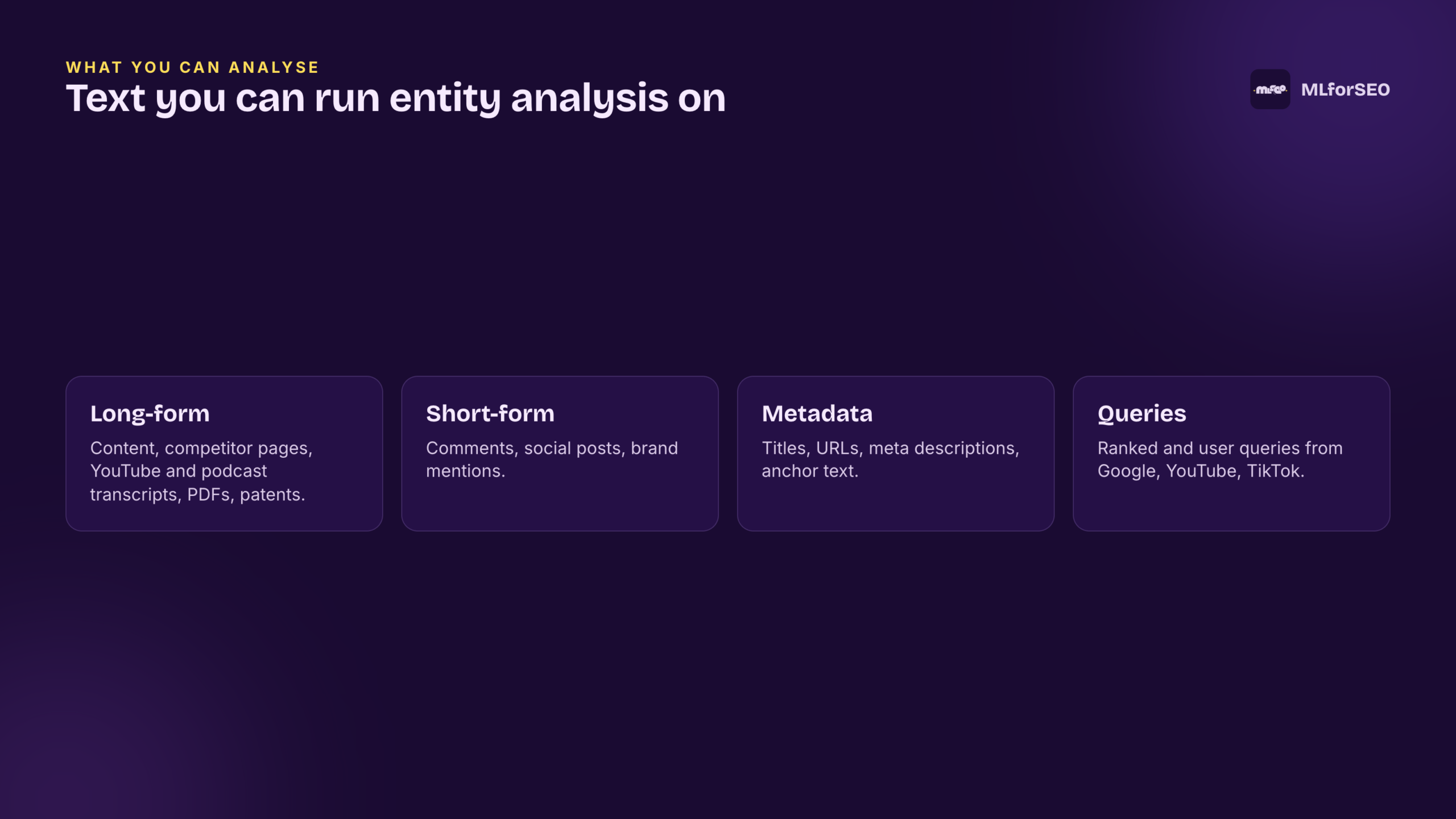
You can run entity analysis on long-form text (your content, competitor content, YouTube and podcast transcripts, Reddit posts, PDFs, patents), short-form text (comments, social posts, brand mentions), metadata (titles, URLs, meta descriptions, anchor text for internal and external links) and queries (ranked queries and user queries from Google, YouTube or TikTok). That breadth is what makes it so versatile.
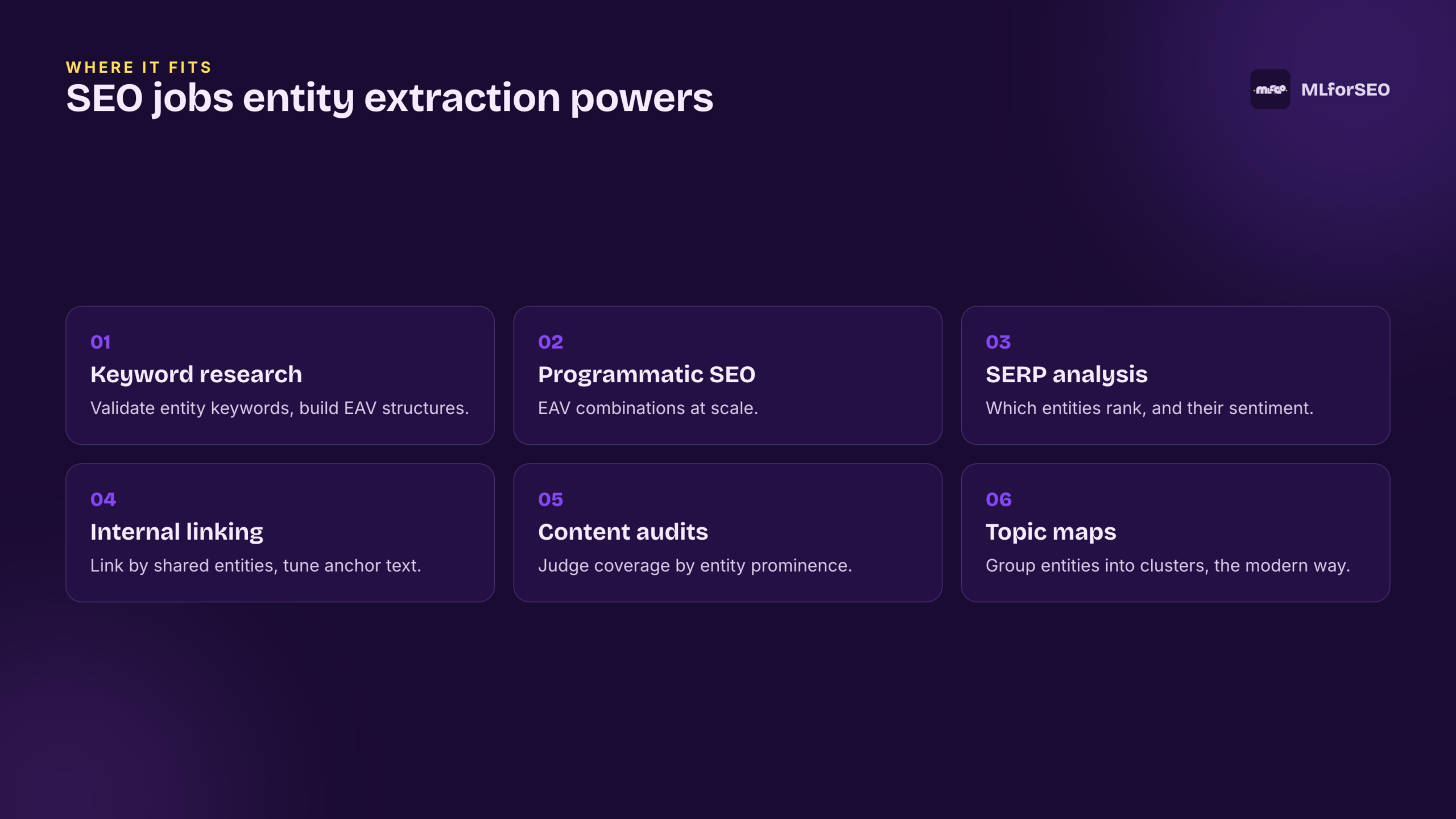
Keyword research gets an entity layer: validate which keywords contain entities, create content maps from closely linked entities, build lists of entity attributes and variables for your writers, and validate which entities sit in the knowledge graph and what their closest associated entities are for linking. Programmatic SEO practically requires it, EAV combinations at scale become your page structure, and doing programmatic work without understanding entities is cumbersome at best. SERP analysis is a big one: use a service like Data4SEO to scrape titles, meta descriptions and URLs for your branded queries, extract the entities, and see which entities appear, how often, whether they sit in the title or the body, and how their sentiment relates to ranking position (with the eternal caveat that correlation is not causation).
Internal linking improves when you identify articles that mention shared entities, link them, and tune anchor text to those entity mentions. Content audits use entity prominence as a lens: flag an entity as prominent if it appears more than a set number of times per page, then check whether your best page on that entity actually covers its attributes in enough depth to compete, whether the entity appears in the title and meta, and whether other articles link to it with the entity in the anchor text, while spotting thin articles with no entities at all as candidates for enhancement, consolidation or sunsetting. And topic maps, the modern way to plan content, are built by grouping entities into clusters; combine entity analysis with EAV query exploration, SERP analysis, competitor analysis and your content audit and you get a genuinely comprehensive map of what to produce to stand out, rather than pumping out content for its own sake. Entity analysis is a central part of how topic mapping should be done today, so do not skip it. It also powers entity-driven feedback and review analysis (mapping how positively customers talk about specific aspects of your service, your shipping, billing, pricing, support) and digital-PR tracking (measuring the sentiment your brand is mentioned with across ranked coverage).
A couple of these deserve a closer look, because they are where entity analysis earns its keep fastest. On SERP entity analysis, once you have scraped the ranking titles, meta descriptions and URLs for a set of branded or topic queries and run extraction over them, you can build a table of which entities appear across the top results, how often, and with what sentiment, then hunt for patterns: do pages that mention a given entity in a positive context tend to rank higher, which entity types dominate the niche, and which entities your own pages are missing entirely? That last question is an information-gain goldmine, the entities your competitors never mention are your opportunity to become the unique source on them. On entity-driven review and feedback analysis, you extract the entities customers mention (shipping, billing, a specific product, a member of staff) and the sentiment attached to each, giving you a precise map of which aspects of your business people love and loathe, insight that is as useful to your product and content teams as it is to SEO. In both cases the pattern is the same: entities turn an unreadable pile of text into a structured picture you can actually act on.
Resources
Run your first extraction with the free Entity Extraction with Google’s Natural Language API guide, and the deeper Complete Guide to Entity Extraction & Sentiment Analysis is included with the course.
The Role of Entity Analysis in AI Search Systems
Entities matter more every year, because AI search does not really rank documents so much as it assembles answers from facts, and facts are entities and their relationships. I go deep on this in my iPullRank article, Entity Recognition in AI Search, and a few points are worth carrying into your own work. Retrieval happens at the passage level, so each section of your content needs to be semantically complete in isolation, able to stand on its own when an LLM lifts it out of context. Entity linking then resolves ambiguity: canonical identifiers like Wikidata Q-numbers let systems deduplicate synonyms and know which “Jordan” you mean, and schema markup with persistent @id and sameAs links makes your facts groundable and reusable by search systems and agents.
The strategic shift follows from query fan-out: because these systems generate dozens of synthetic sub-queries, content organised into hubs around priority entities, with supporting spokes, captures far more of the reasoning chain than keyword-focused pages ever could. And measurement moves with it, from tracking URLs to tracking entities, their performance, their schema validity and their ambiguity rates. It all reinforces the lesson from the previous section: for extraction at scale, reach for a task-specific NER API, not a chatbot, because production pipelines need the richer, consistent metadata only purpose-built models return.
Where to Take Entity Analysis Next
This post covers what entity extraction is and where it fits. The Entity Extraction and Analysis module inside Introduction to Machine Learning for SEO then goes hands-on: comparing NLP APIs against generative AI, query entity extraction, semantic analysis of customer reviews, and entity-based internal linking. Read the companion post on which NLP API to actually use next, and see it applied in the customer-review analysis walkthrough.
Related glossary terms
MLforSEO Academy
Take your skills further — pick your path
Introduction to Machine Learning for SEO
by Lazarina Stoy
Ship practical ML workflows — classification, clustering, entity extraction — no CS degree required.
View course →AI Search Optimisation & Agentic SEO
by Beatrice Gamba
How agentic systems retrieve, evaluate and select — and how to become the source they cite.
View course →AI Search, LLMs, Entity SEO & Knowledge Graph Strategies
by Beatrice Gamba
Build the entity authority and knowledge-graph presence that makes AI recognise and trust your brand.
View course →Semantic ML-enabled Keyword Research
by Lazarina Stoy
Query understanding, search intent and semantic clustering for how people and AI really search.
View course →