Sentiment classification is one of the most beginner-friendly problems in data science. That does not make it easy to do, though.
There are various models developed to perform sentiment analysis on datasets. It is important to understand how they came to be and how they function, to ensure that the model you choose is most suited to the data you have at hand.
In this guide, I will summarise the theory behind sentiment analysis, explain the rationale behind it, and show some applications of successful sentiment classification. The theory part is compiled as a result of a systematic literature review on topic modelling and sentiment analysis I did. Then we’ll get practical: how to get started without writing a line of code, and seven ways to put sentiment analysis to work in your digital marketing and SEO strategy.
Updated October 2026: what changed since the first version
I first wrote the theory part of this guide in 2021 and the practical part in 2023, as two separate posts. They now live together here, and I’ve refreshed both. The short version:
- There’s now a runnable notebook that puts the methods from this guide side by side (lexicons, classic machine learning, a transformer and the Google Cloud Natural Language API) and benchmarks them on the same data. My results are below.
- Transformers and large language models have changed what “the machine learning approach” means in practice. I’ve added a section on what that changes, and what it doesn’t.
- Google’s Natural Language API has a v2, which scores the same text differently from v1 and has no entity sentiment method. Pick one version and stick with it for anything you track over time.
- Most of the research below uses Twitter data, which got much harder to collect after X put its API behind a paywall in February 2023. The methods still apply to reviews, comments, survey responses and, increasingly, AI-generated answers about your brand.
In this guide, you’ll find:
- the theory: what sentiment analysis is, how it’s done, and which models you can use
- the two main ways to do sentiment analysis (lexicons and machine learning), their benefits and limitations, and how they compare on real data
- why companies implement sentiment analysis, based on the research
- how to get started doing sentiment analysis in Google Sheets (without any coding skills needed)
- seven practical projects to implement the analysis with, and how each helps with strategy formulation.
All of the code in this guide is in one runnable Colab notebook: grab it from the MLforSEO code hub, open it in Google Colab and run it top to bottom.
What is sentiment analysis in NLP?
Sentiment analysis is a subset of Natural Language Processing (NLP).
NLP is a field of research that studies the ability to decode data from natural language using computational means. NLP also examines how this decoded data can be incorporated into machine learning and statistical programming software.
Through NLP, computer programs can perform data analysis using machine learning algorithms on textual data, which is abundant in a public-source format. In addition, they can extract meaning from data, or otherwise: semantics.
The main aim of the NLP field is to bridge the gaps in communication between computer programs and humans. Programs are constantly improved to decode language and speech data into meaningful semantic insights through processing, analysis, and synthesis.
How can sentiment analysis be defined?
Sentiment analysis is a discipline that aims to extract qualitative characteristics from users’ text data, such as sentiment, opinions, thoughts, and behavioural intent, using natural language processing methods.
As explained in Zhang et al.’s (2018) study on sentiment analysis, social media texts are particularly useful for sentiment analysis research as they are:
- used to express a standpoint
- filled with subjective text.
Social media texts are defined in academic literature as short-form texts. This type of text is more challenging to do sentiment analysis on, as there is less context for the model to work with. In comparison, sentiment analysis performed on long-form text, such as news articles, is less challenging.
The effectiveness of sentiment extraction in short-form text relies on the application of more advanced methodologies, such as deep convolutional neural networks.
Social media data in particular requires more complex methods in information retrieval due to the use of creative language, slang, and abbreviations. The presence of these can impact the efficiency of the sentiment analysis model, if not accounted for.
You can see this for yourself in the notebook. “This update is fire 🔥🔥 no cap” is enthusiastic praise to any human, but both lexicon methods I tested (VADER and AFINN) and a classic TF-IDF model scored it as negative, because “fire” looks like a bad thing word by word. Only the transformer model, which was trained on millions of tweets, got it right (Google’s Natural Language API, which runs its own deep learning model, also scored it positive).
How is sentiment analysis done?
Traditional studies on sentiment analysis aim to detect polarity in a given text by classifying it as positive, negative, or neutral.
This categorisation need is considered one of the key limitations of traditional sentiment analysis. Some academics argue that sentiment analysis in its traditional form is unable to address the complexities of modern-day expression, as it fails to capture objectivity and subjectivity. For instance, if a model is tasked to categorise between fake news or someone’s opinions and facts, traditional sentiment analysis will not be sufficient.
More advanced methods attempt to recognise multiple differentiated affective manifestations in text, which indicate emotions and opinions through analysis of the language used for self-expression. (This is what emotion detection tools do today: instead of one positive-to-negative score, they return separate scores for joy, anger, sadness, fear and so on.)
Such methods often aim to simultaneously detect and extract topic models. For this reason, deep learning approaches such as convolutional neural networks (CNNs) are often used. CNNs are also used in sentiment analysis of short-form texts, as indicated in multiple research papers (e.g. Dos Santos and Gatti (2014), Kale et al. (2018), and Tang et al. (2015)).
What models can be used for sentiment analysis?
Sentiment analysis can be done via supervised, semi-supervised, and unsupervised machine learning algorithms.
Supervised machine learning models are the most difficult to obtain data for in sentiment analysis, as they require labels for a subset of the data, with which to train the model.
Semi-supervised approaches utilise a small number of labelled samples as training data as a means of improving classification accuracy, with an example being the model published by da Silva et al. (2016), where Twitter data is classified using a Support Vector Machines (SVM) classifier.
Unsupervised approaches need no labels at all. Lexicon-based methods (more on those below) are the classic example: they score text against a dictionary rather than learning from labelled examples.
In 2026 there’s a fourth option most marketers actually use: a model somebody else has already trained. That can be a pre-trained transformer you download from Hugging Face, a cloud API like Google’s Natural Language API, or a large language model you prompt. You still need to know which family it belongs to, because that tells you where it will fail.
What text can sentiment analysis be performed on?
Sentiment analysis can be performed at a document level, sentence level, and aspect (word) level.
Short-form texts, such as content from social media, are best analysed with sentiment analysis at a sentence level, as they usually consist of a single or few sentences.
Some models analyse individual words with the assumption that words in the same sentence share the same emotion. Such an approach is Tang et al.’s (2019) hidden Topic-Emotion Transition model, which models topics and emotions in successive sentences as a Markov chain.
This approach enables the simultaneous detection of document-level and sentence-level emotion.
Why does the level matter? Here’s a five-sentence product review I ran through the transformer model in the notebook. As a whole document, it came back positive. Sentence by sentence, it tells a much more useful story:
| Sentence | Sentiment |
|---|---|
| I’ve been using this tool for three months. | Neutral |
| The keyword clustering is brilliant and saves me hours every week. | Positive |
| The interface, however, is confusing and slow. | Negative |
| Customer support never replied to my ticket. | Negative |
| Still, I’d recommend it for the clustering alone. | Positive |
If you’re analysing reviews to decide what to fix, the document-level “positive” hides the two things this customer is unhappy about. Aspect-level analysis goes one step further and ties each opinion to the thing it’s about (clustering: good; interface and support: bad), which is what entity sentiment analysis does.
Can sentiment analysis be performed on another type of data, besides text?
Multimodal sentiment analysis has grown as a field in recent years, with models proposed in the area taking advantage of recent developments in weakly supervised deep learning approaches.
Multimodal event topic modelling has also emerged, which has been demonstrated as promising for the area of predictive analysis of consumer behaviour and sociology.
Together, topic modelling and sentiment analysis in a multimodal context are recognised as a way of improving human-agent interactions. An example of how this is applied is the area of automatic speech recognition.
Since then, multimodal models have gone mainstream: today’s multimodal LLMs can take an image, a video or an audio clip and describe the tone of it. That’s handy for a first pass over video content, but treat the output as a hint rather than a measurement.
What are the two main ways to do sentiment analysis?
#1 Using a pre-developed, manually built sentiment lexicon
Sentiment analysis has initially been performed using pre-developed, manually built sentiment lexicons.
Such lexicons are:
- Subjectivity Wordlist
- WordNet-Affect
- SentiWordNet
- SenticNet
- AFINN
- Sentiwords
- SO-CAL
- Opinion lexicon
- WordStat
Each of these has a different rating scale and a different word count.
Such lexicons have been used as foundations for model development, with examples being:
- Polarity Classification Algorithm (PCA), which classifies tweet sentiment
- Enhanced Emoticon Classifier (EEC)
- Improved Polarity Classifier (IPC)
- SentiWordNet Classifier (SWNC).
Amongst these, superior performance is demonstrated by the PCA.
Benefits and limitations of this approach
These approaches are useful in:
- distinguishing subjective or objective speech
- categorising sentiment as positive, negative, or neutral.
As a limitation, they only enable researchers to extract sentiment primarily from the perspective of the writer as opposed to the reader.
They also count words rather than read sentences, which is where they trip up. In my tests, AFINN scored “Not bad at all, honestly.” as negative (it sees “bad” and misses the “not”). VADER, a lexicon with extra rules for negation, intensifiers, capitals and emoji, built specifically for social media, got that one right. Neither of them caught the sarcasm in “Oh great, another password reset email. Just what I needed.” To be fair, none of the other methods did either.
If you want to try a lexicon today, VADER and AFINN are both a pip install away and run instantly on a laptop. They’re transparent (you can see exactly why a text got its score), free, and need no training data, which makes them a good baseline to beat.
#2 Using a machine learning approach
Except for lexicon-based approaches, sentiment analysis can be performed using a machine learning approach.
This can be done via statistical models trained on human-annotated datasets, hence utilising semi-supervised learning.
Another way is to combine multiple shallow machine learning approaches. For instance, for sentiment analysis of tweets, Ahuja et al. (2019) conclude that TF-IDF performs better than N-grams in terms of feature extraction. The combination of TF-IDF with logistic regression is considered the most efficient among the studies sampled in their paper.
Ensemble classifiers are also shown to be a good way to solve one of the limitations of lexicon approaches. Specifically, a 2018 study approaches the problem of multi-label sentiment classification from the perspective of the reader, applying a model to a news dataset. The study demonstrates the superiority of ensemble classifiers when compared to other methods.
As mentioned previously, deep learning techniques can also be applied in sentiment analysis.
Benefits and limitations of this approach
Each perspective offers its limitations and opts for compromising either the accuracy or generalisability of the analysis. Here is a summary of the benefits and limitations of common sentiment analysis machine learning approaches:
- N-gram models (or conditional random fields) work via sequence tagging (e.g. part-of-speech tagging or shallow parsing). They capture word order and grammar well. Their disadvantage is high feature dimensionality.
- Semi-supervised learning approaches are good for quick and easy determination of the polarity of text. They are not so good at determining subjectivity or objectivity in the text.
- Deep learning approaches are good at meta-level feature extraction with large datasets and typically perform better than N-gram models. They do not perform well when there is a lot of noise in the data, such as slang, abbreviations, or even emojis. This makes them ill-suited to social media sentiment analysis.
- Multiple kernel learning models work when features are organised into groups. This enables multimodal sentiment analysis, but the computation is slow.
One update to that third point: it described the deep learning models of the late 2010s. Transformer models pre-trained on huge amounts of social media text have largely closed the “noisy data” gap. The model I tested, Cardiff NLP’s Twitter RoBERTa, was trained on about 124 million tweets, and it was the only one of the four methods I benchmarked that understood “fire 🔥🔥 no cap”. The trade-off moved rather than disappeared: these models need more computing power and are harder to explain than a lexicon.
The main challenge in sentiment analysis is language ambiguity, or the fact that many times when language is spoken, there might be a presence of mixed semantic attributes. This makes it difficult for a classification algorithm to perform its function.
It is also difficult for people who will view the program’s output and classification to categorise the context in which the semantics are given, which might hinder the effectiveness of the classification overall and its usability in a real-world context.
Even so, it is considered that these hindrances are outweighed by the benefits that sentiment classification offers in terms of speed in comparison with human evaluation and insight.
What about transformers and large language models?
When I first wrote this guide, “the machine learning approach” mostly meant training your own model. Today, most practitioners pick from three kinds of ready-made models instead:
- Pre-trained transformers (BERT, RoBERTa and their many fine-tuned versions on Hugging Face). Free, run locally or in Colab, and very good when they were fine-tuned on text like yours. There are multilingual versions too.
- Purpose-built NLP APIs like the Google Cloud Natural Language API, Amazon Comprehend or IBM Watson NLU. No setup beyond an API key, consistent output, and a free tier.
- Large language models (ChatGPT, Gemini, Claude and open models), prompted to label sentiment “zero-shot”. Flexible: you can ask for custom labels, aspects or a one-line reason. But they’re slower, cost more per item at scale, and can return different answers to the same text on different runs.
My position hasn’t changed much: if the task is a well-defined classification you’ll repeat at scale, use a purpose-built model or API, and test it on a sample of your own data first. Reach for an LLM when you need something the purpose-built tools can’t do, like custom labels or explanations. I tested this head to head in Comparing NLP APIs for entity and sentiment analysis (vs generative AI) if you want the details.
Lexicon vs machine learning vs transformer: how they compare on real data
To make the theory concrete, I ran four methods on the same 2,000 tweets from the TweetEval sentiment test set (each tweet labelled negative, neutral or positive by humans):
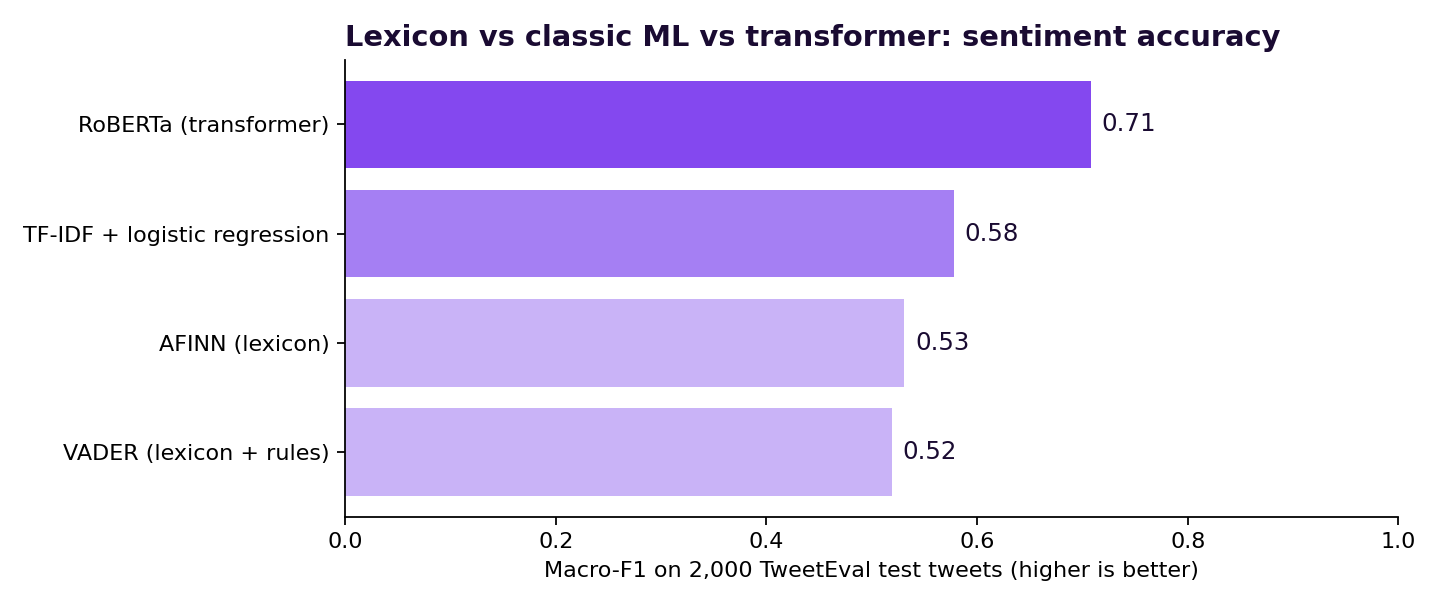
| Method | Family | Accuracy | Macro-F1 |
|---|---|---|---|
| VADER | Lexicon + rules | 0.52 | 0.52 |
| AFINN | Lexicon | 0.53 | 0.53 |
| TF-IDF + logistic regression (trained on ~45,000 TweetEval tweets) | Classic (shallow) machine learning | 0.60 | 0.58 |
| Twitter RoBERTa | Deep learning (transformer) | 0.71 | 0.71 |
A few things to take away from this:
- The ranking follows the theory. Lexicons are the weakest, a simple trained model beats them, and a deep learning model fine-tuned on similar text beats everything.
- Even the best model is wrong about three times in ten. Three-way sentiment on tweets is genuinely hard (humans disagree on plenty of these too), so don’t treat any single label as gospel. Look at patterns across hundreds of items instead.
- The transformer had a home advantage. It was fine-tuned on TweetEval’s training data, so of course it shines on TweetEval’s test data. On long product reviews or B2B survey answers, the gap might be smaller, or bigger. This is exactly why I said at the start that the model you choose should suit the data you have.
The notebook also runs the same sample texts through Google’s Natural Language API, v1 and v2. For “The delivery was fast, but the product broke after two days.”, v1 returned a score of -0.6 and v2 returned -0.03, practically neutral. Same company, same text, different model. If you track sentiment over time, never switch versions mid-series.
Why should companies implement sentiment analysis?
There can be many reasons why companies would like to tap into sentiment analysis and natural language processing technologies.
Based on my research, I’ve summarised five main reasons, for which I will also be providing examples of how this is done in real life.
#1 Increase competitive advantage
The implementation of sentiment analysis and predictive behaviour modelling techniques is considered a source of competitive advantage for organisations and is recommended by scholars.
#2 Evaluate the power of a company’s consumer network
Sentiment analysis can also be used in measuring the power of the consumer’s network. This relates to measuring how efficient word-of-mouth marketing can be.
It can also be used to track individual recommendations given amongst members of online societal groups. This can enable companies to target consumers with personalised web ads, based on the recommendations given by their peers.
#3 Utilise public, user-generated, and readily available data
Textual data is also more available than numeric data, and it can be argued that high-level human language contains a huge amount of complexity and nuance.
This has led to sentiment analysis being researched as a potential solution to a variety of business problems in various contexts, such as pattern recognition of social media for the detection of road accidents, or stock market prediction, to name a few.
#4 Identify patterns and make accurate, data-driven predictions about market changes
Asur and Huberman argue that a deep understanding of social media communications can aid accurate predictions of the outcome of future events. The example they provide is real-time analytical software using Twitter feed data to predict box-office success. This outperformed Hollywood Stock Exchange information.
Twitter data has also been used for cluster analysis by a cognitive pattern recognition system, which picked up real-time information on road-traffic events before any mainstream reporting channels.
Similar studies help affirm that social media platforms are a pool of collective wisdom. Thus, companies are incentivised to apply machine learning for data mining and behavioural prediction to accurately inform future actions of business users for various purposes:
- market prediction, e.g. the stock market
- outcome forecasting, e.g. for political elections
- crisis management
- understanding individual and collective emotional response communication. A similar approach was implemented in one of Lidl’s social media campaigns.
All of these studies anticipate errors in forecasts when conducting intelligent analytical processes on human emotion, response, and social behaviour, due to the unpredictable nature of us humans, and have noted this as a model limitation.
#5 Efficiency, processing speed, and reduced human errors
Due to the existing constraints of machine learning software in performing text analytics, companies have intense human-resource-related spending for staff to manually validate data. Yet there are even further inefficiencies when humans do these tasks themselves, mostly related to the time needed to sift through data.
Just imagine how inefficient it would be for anyone to go through thousands of tweets and classify them!
This presents an opportunity to create value by solving existing business problems through continuous improvement of the models operating in the industry. The implementation of an autonomous solution could reduce the risk of human error in the interpretation of the data.
Why use sentiment analysis in digital marketing and SEO projects?
Despite its many benefits for organisations and its practical application possibilities, sentiment analysis is still not widely used in digital marketing and SEO.
Sentiment analysis is a valuable tool for digital marketers and SEO professionals seeking to gain insights into customer sentiment, identify emerging trends, and optimise their campaigns for better results, going beyond basic metrics like clicks and views.
By analysing sentiments expressed in social media posts, reviews, and online interactions, marketers can gain a nuanced understanding of public perception towards brands, products, or campaigns. This enables them to tailor their strategies to better resonate with their audience, identify areas for improvement, and predict market trends.
For SEO, sentiment analysis helps in understanding the emotional context of search queries, ranked results, and user-generated content, allowing for more targeted and effective content strategies. This alignment not only enhances user engagement but also aids in building a more positive and impactful online presence, driving both brand loyalty and conversion rates.
Before diving into the practical projects, let’s recap how to get started with doing sentiment analysis.
How to get started doing sentiment analysis in Google Sheets (without any coding skills needed)
A common misconception is that you need coding skills to start doing sentiment analysis. This couldn’t be further from the truth.
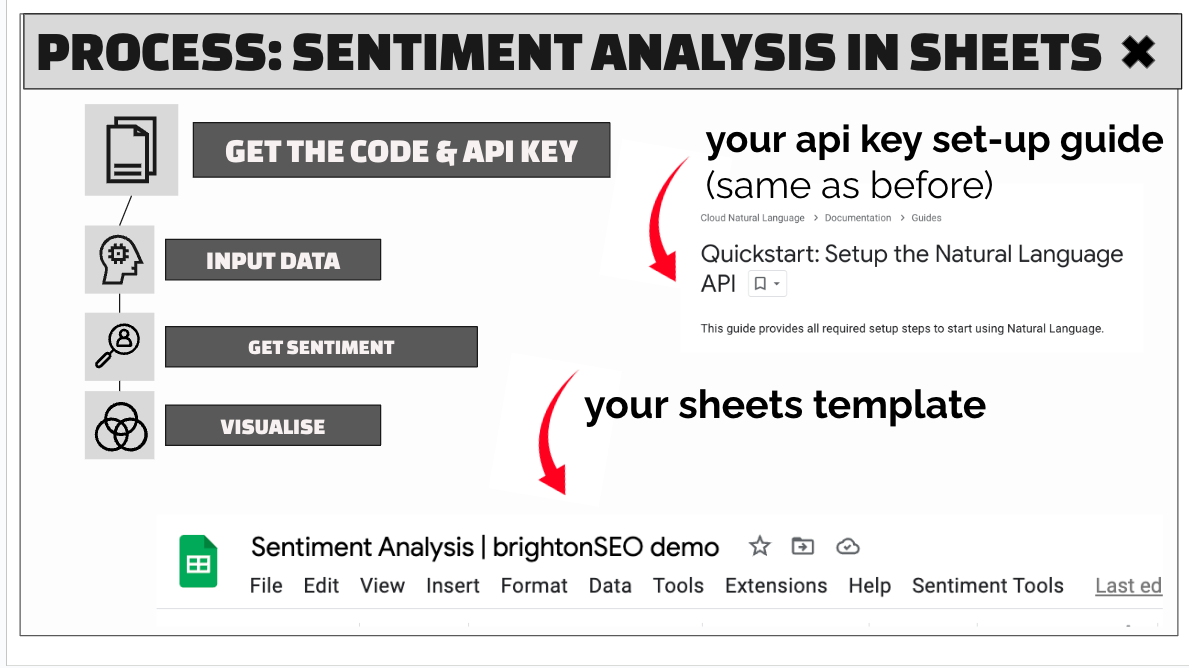
Sentiment analysis using Google’s Natural Language API is a very beginner-friendly way to get started without any coding skills required. The procedure requires obtaining an API key and using a Google Sheets template. It’s worth noting that the Apps Script behind this kind of template isn’t my invention: versions of it have been available publicly for a considerable time, developed by various people in the field.
To get started, follow these simple steps:
- Get your Google Natural Language API key. You’ll need a Google Cloud project with the Natural Language API and billing enabled. The first 5,000 units of sentiment analysis each month are free (one unit is up to 1,000 characters of text), which is plenty for testing.
- Copy the sentiment analysis no-code Google Sheets template.
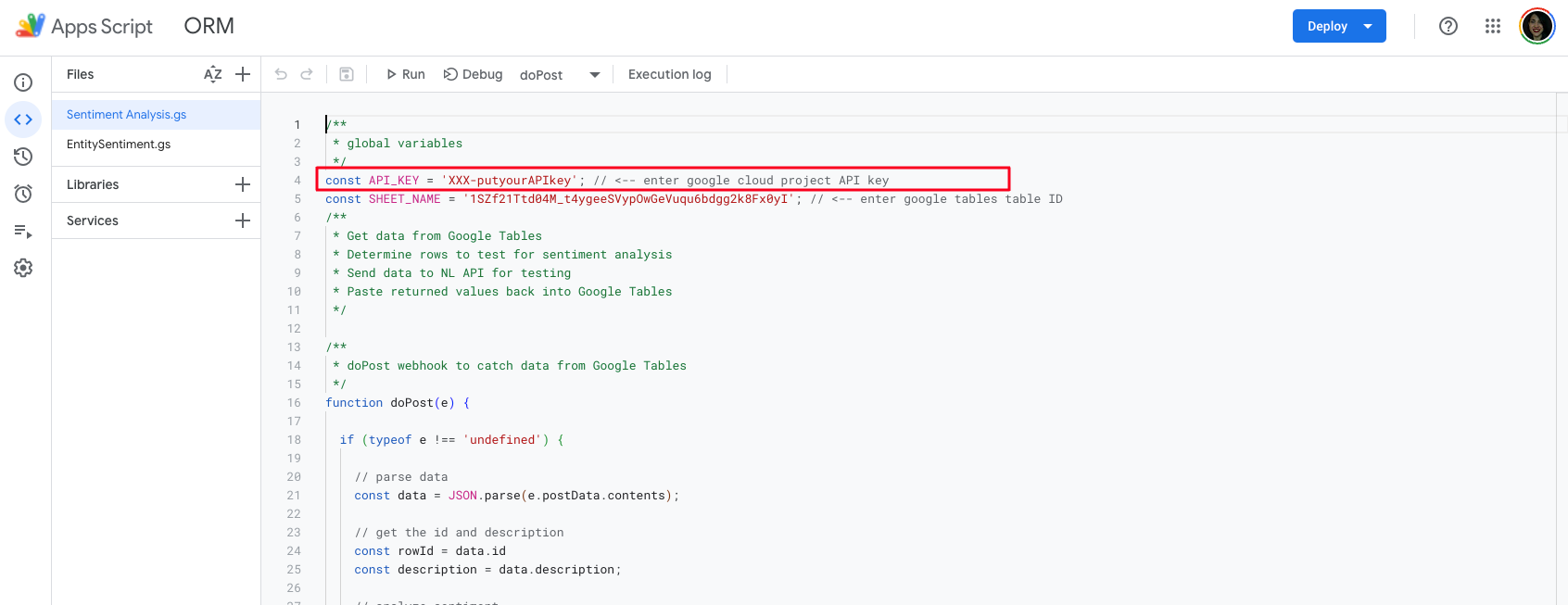
- Click on the Extensions menu at the top, then Apps Script, then replace the placeholder with your API key (it’s near the top of the code). Then click Save project.
- Return to the sheet. Paste the text data in the first column.
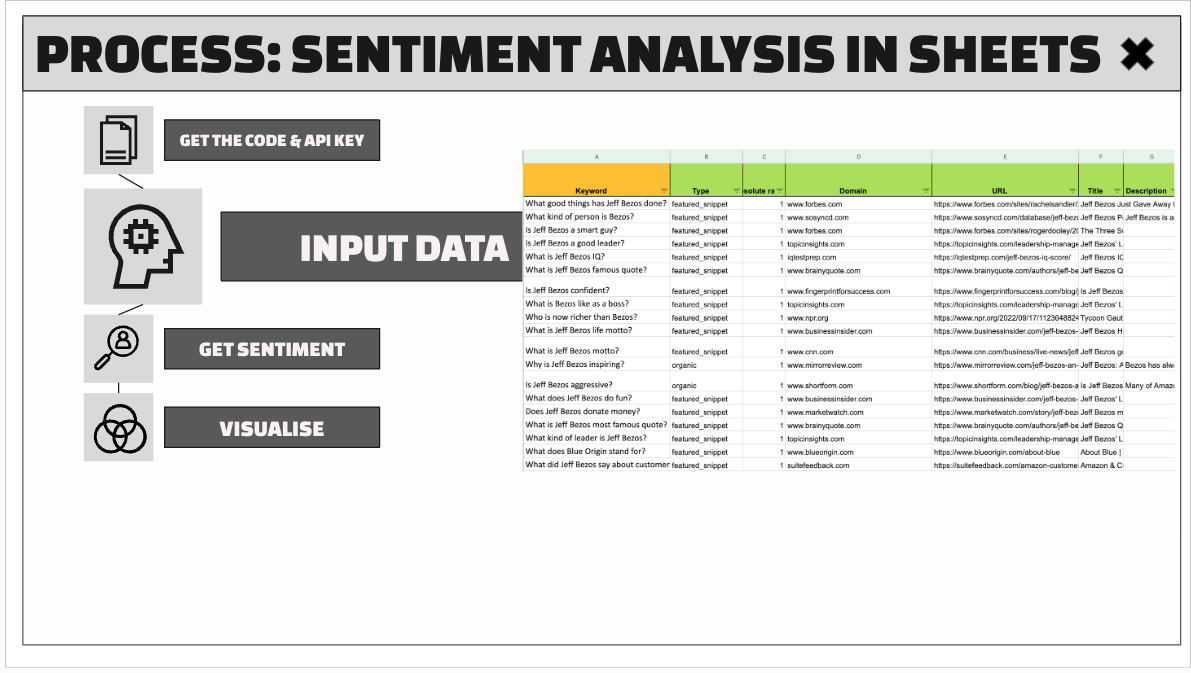
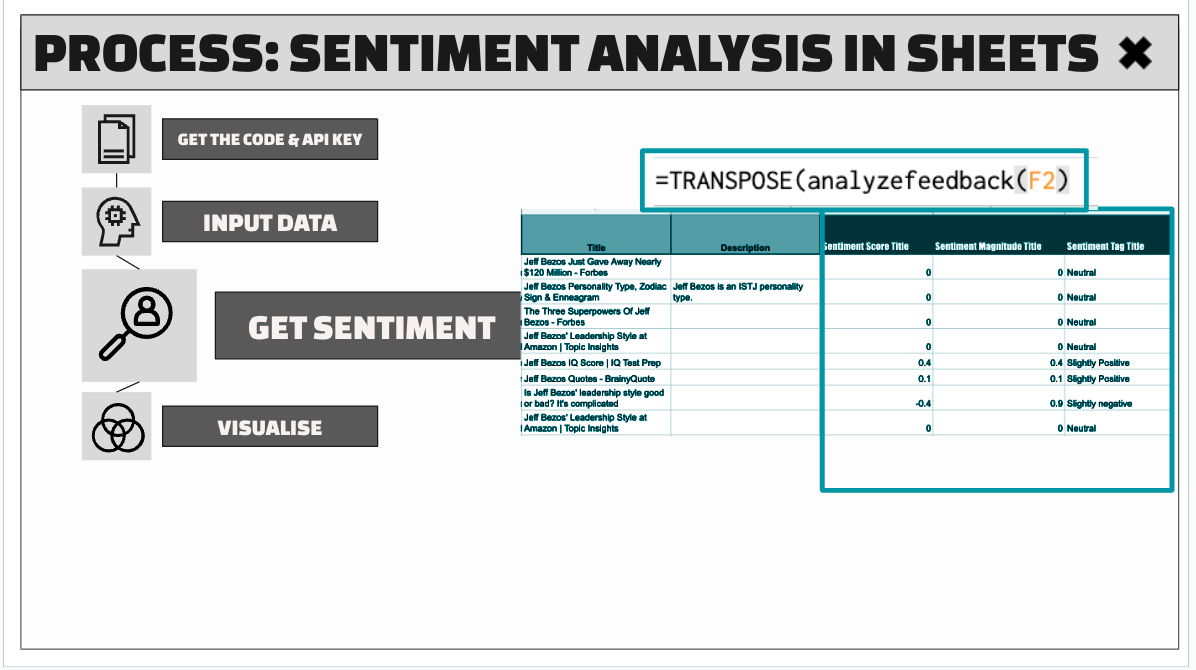
- Click on the cell under the sentiment score title and paste the formula
=TRANSPOSE(analyzeFeedback(A2)), pointing it at the cell with your text. This will return the sentiment score, magnitude and the associated sentiment label category. Drag it down to all the rows you want to analyse.
- Your data will populate in the result columns and is ready for you to visualise (check out my Data Studio dashboard if you need help with the visualisation of the data).
This process is streamlined and user-friendly: the Apps Script integrated into the template powers the analyzeFeedback formula. This analysis yields three critical insights: the sentiment score of the text, its magnitude, and a sentiment tag, which can be custom-adjusted via the script.
Importantly, this system is flexible. Users can tailor it to their understanding of sentiment magnitude and can even create custom sentiment tags for more personalised analysis (e.g. instead of “slightly negative”, have “Customer not happy”). This adaptability is a key feature, enhancing the tool’s applicability to various scenarios.
Not sure how to read the numbers? The sentiment score runs from -1 (very negative) to +1 (very positive). The sentiment magnitude runs from 0 upwards and tells you how much emotion there is, regardless of direction. A score near 0 with a high magnitude usually means mixed feelings; a score near 0 with a low magnitude means the text is simply neutral. Google suggests you set your own thresholds for “clearly positive” and “clearly negative” after testing on your data.
For the full walkthrough, with screenshots of every step (from creating the API key to translating non-English text before you analyse it), follow my step-by-step guide to sentiment analysis with Google’s Natural Language API in Google Sheets. Prefer Python? The notebook has the same API call, plus free alternatives that need no API key at all.
7 practical ways to implement sentiment analysis and insights into your digital marketing or SEO strategy
Now that you see how easy it is to do this type of analysis in Google Sheets, let’s see how to practically implement this method in digital marketing or organic search (SEO) tasks.
1. Use sentiment analysis to monitor online reputation in web results
If you were to analyse the sentiment of the titles of results ranking for your branded queries, you could regularly do online reputation sentiment analysis. While this can be done at a title or meta description level (analysing the titles or meta descriptions of the entries that rank for the queries in results 1–10), it can also be done at a page text level, where you scrape the text on those pages and analyse the entire text’s overall sentiment.
Another approach is to analyse the sentiment of social media mentions in Facebook comments, Facebook Group posts that mention your brand, or tweets (or posts on X, as we’re now meant to call them). Analysing the sentiment of such entries can help you quickly get a helicopter view of whether your customers or target customers are mentioning your brand with positive or negative sentiment, and how strong their emotions are, based on the way they’ve expressed themselves.
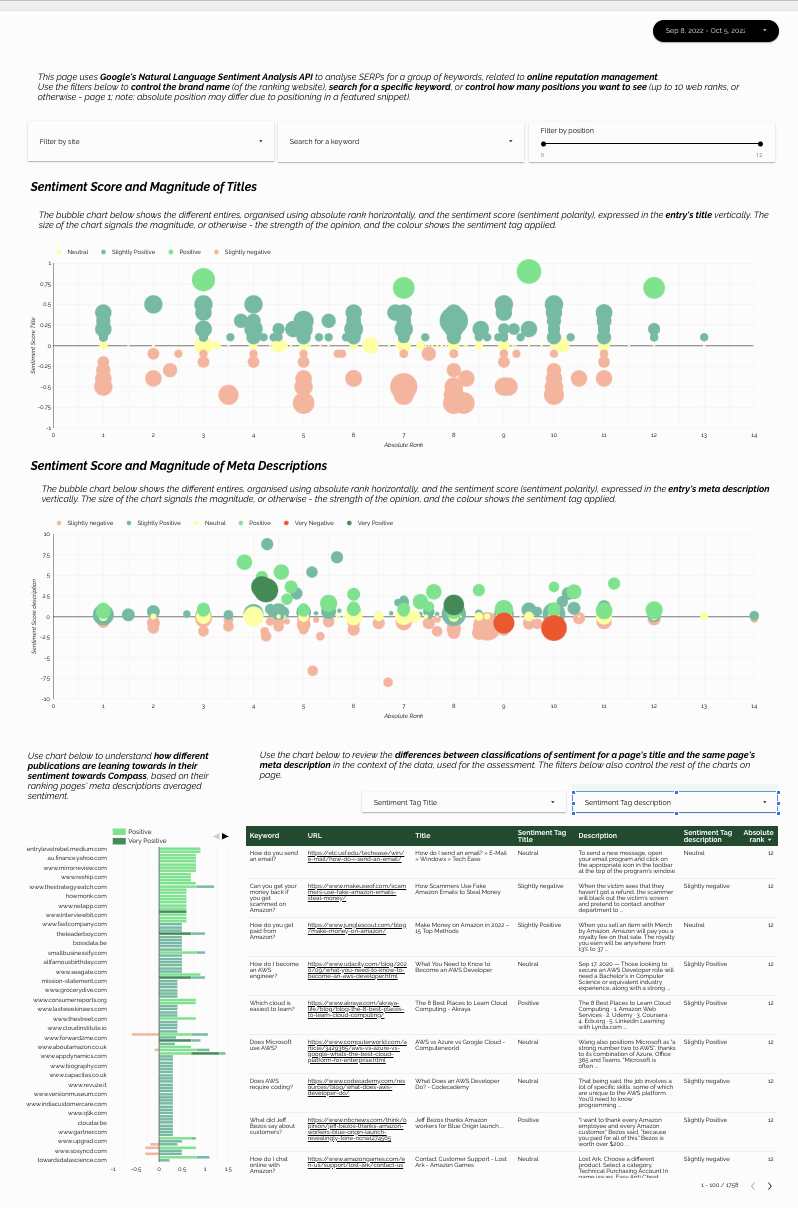
Let’s quickly go through a sample process of analysing the sentiment of branded queries, which I presented in my video on YouTube on SERP analysis. Let’s imagine that we have collected a group of questions related to the brand Amazon and its founder, Jeff Bezos. We then collected the top 10 results (their titles, meta descriptions and URLs) via a SERP scraper, like DataForSEO, and analysed the sentiment using Google’s Natural Language API.
For instance, the keyword “Why is Jeff Bezos inspiring?” yielded titles like “Jeff Bezos, an Inspiration to All” from Mirror Review, indicating a positive sentiment score of 0.4. Conversely, a title like “How to Check Amazon Seller Feedback and Not Get Scammed” for the query “How do you know if the Amazon seller is legit?” suggests a negative sentiment, with a score of -0.6. (These scores came from the API’s v1 model at the time; v2 may score the same titles differently.)
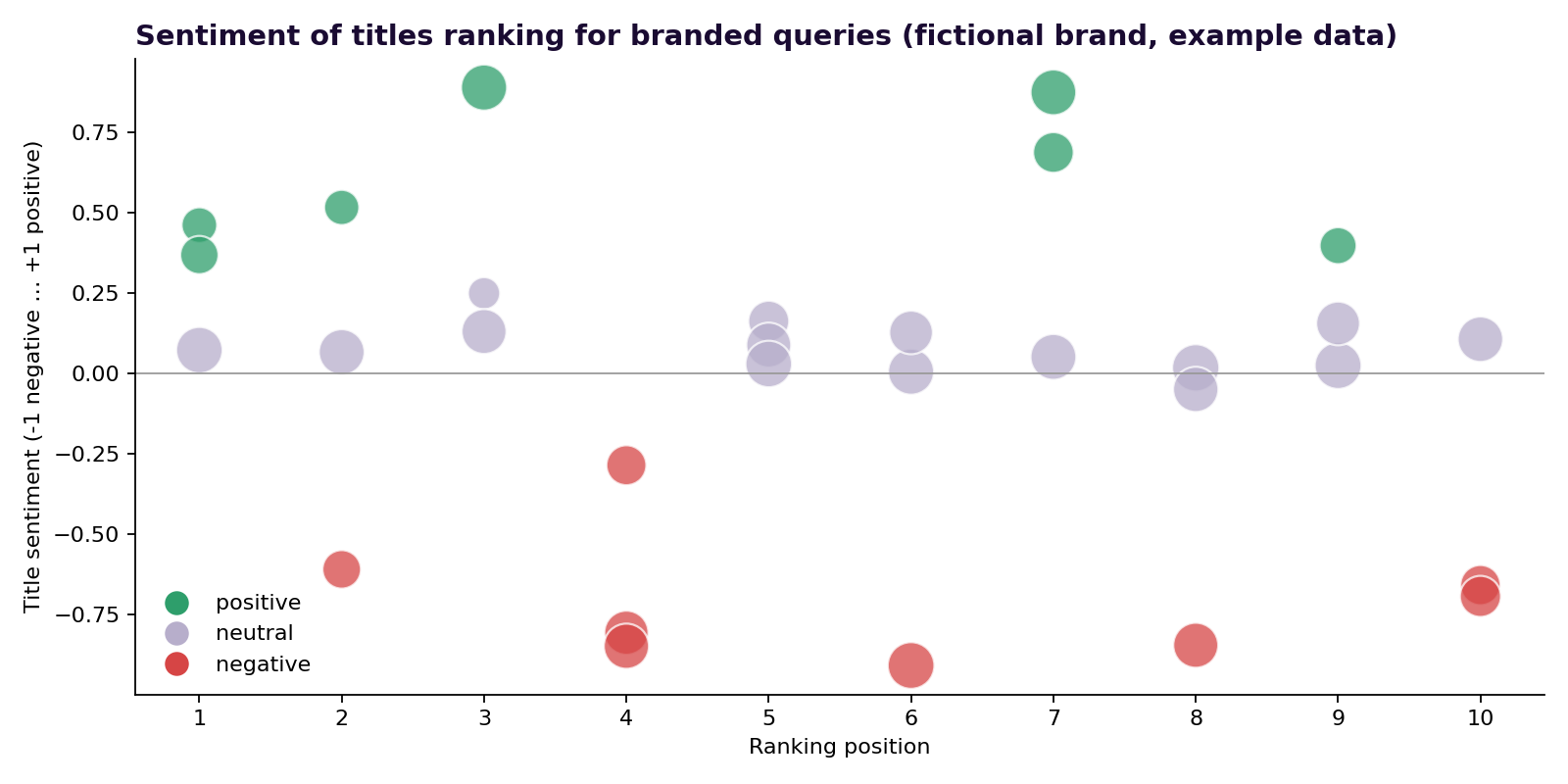
By visualising this data, simple yet effective visualisations can be created, though more complex ones are also possible. This visualisation plots titles based on their sentiment score and rank, with the bubble size representing the sentiment magnitude, which allows us to see at which positions and for which keywords some entries are negative for our brand, using the provided filters.
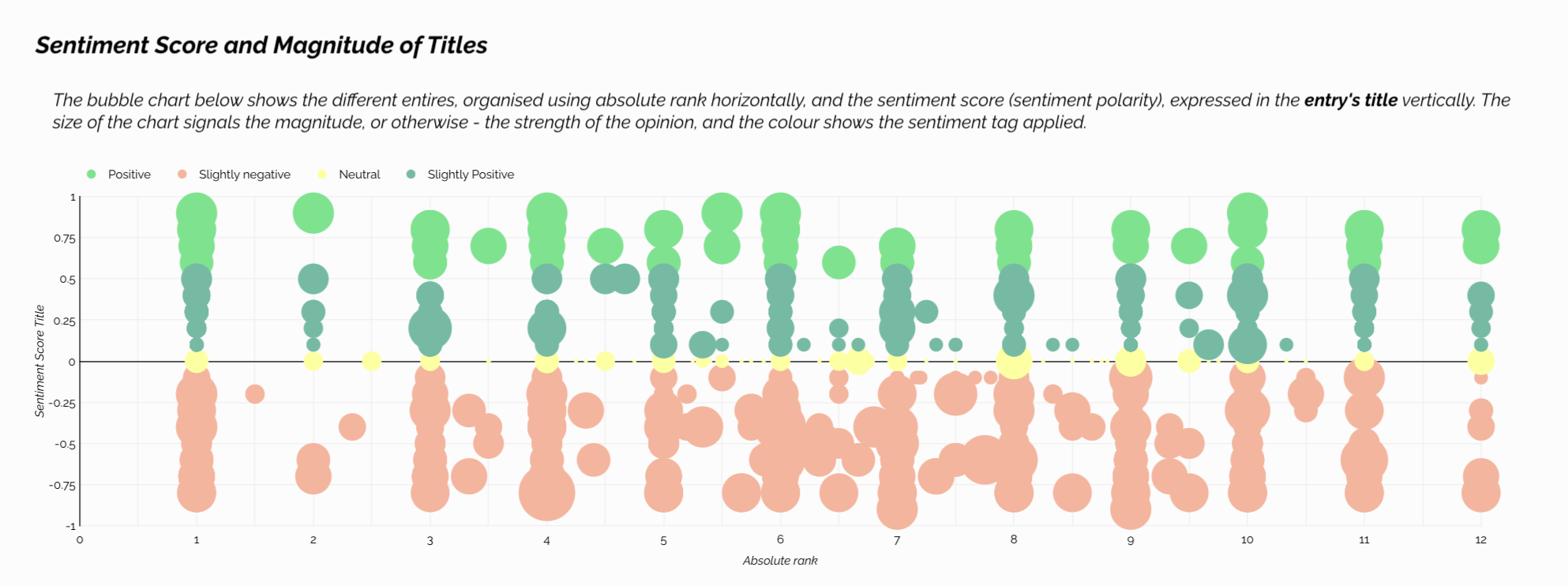
Furthermore, the report allows for filtering based on sentiment, aiding in identifying both opponents and advocates of your brand in search engine results pages (SERPs). This is vital for online reputation management, as it reveals the content that ranks with negative sentiment and identifies websites frequently publishing negative or positive content related to your brand.
This kind of analysis is not only insightful for SEO managers but can also shape content and link strategy. For instance, looking at data where the results in the top 10 are mostly negative, an SEO or PR consultant might initiate link building efforts to promote more brand-positive results to key positions. This analysis can also highlight the need for creating content that addresses user concerns, whether it be about product usability, pricing, or other aspects negatively impacting brand perception.
If you’d rather do this in Python, section 7 of the notebook takes a SERP export (keyword, position, title, URL), scores every title with the transformer model, draws the same kind of bubble chart, lists the negative titles by position and counts which domains publish negative content most often. Here’s what it produces on example data for a made-up coffee brand:
The same idea now extends beyond the ten blue links. AI Overviews, ChatGPT, Gemini and Perplexity all describe brands in their answers, and those answers can be collected and scored for sentiment exactly like titles or meta descriptions. Several brand-monitoring and AI-visibility tools have started reporting this. Whichever you use, check how it defines “positive” before you report on it.
2. Use sentiment analysis to understand the sentiment of text on pages or videos ranking in the SERP
A similar project to the one described in the previous section might be used with a different purpose. Let’s imagine you are working with a keyword list of terms relevant to your brand, website, or product: terms that are topically relevant for your presence online. You have collected the SERP data for these terms and have scraped the content on the pages that are ranking in key positions. By analysing the sentiment of the text in these pages, together with the positions they rank for, you will be able to gain a holistic overview of the search landscape and its relation to sentiment.
To clarify, here are some questions that you might address via sentiment analysis of text in ranking pages or videos:
- Are there discrepancies between the sentiment expressed in the top 10 results? For example, is there always a balanced view showing for a group of topically relevant keywords, are they all positive or all negative, or are there some of each sentiment expressed?
- Are there patterns in where negative-sentiment pages or videos appear in the SERP? For example, is there always a page or video with a negative sentiment about the topic ranking in the top 10 results?
Here’s how this analysis can shape content strategy:
- If you see that Google likes to surface opposing views for product or service searches, ensure that there is a distinct opinion and sentiment towards the product expressed in your content.
- If you see that Google likes to surface negative results, and you see that for your target keywords most of the results are positive in sentiment, write a content piece from a “limitations” angle to offer more competitive coverage of the topic.
3. Use sentiment analysis to analyse feedback from your customers or users
Customer feedback is a goldmine of insights, directly influencing your brand’s roadmap and reputation. Leveraging sentiment analysis to dissect customer feedback can turn this raw data into actionable strategies, refining your user experience and product offerings.
Imagine sifting through thousands of customer reviews, social media posts, or survey responses manually: it’s not only time-consuming but prone to biases. Here, sentiment analysis can be a useful and powerful tool. By employing algorithms that can detect nuances in language and emotion, you can systematically categorise feedback into positive, negative, or neutral sentiments.
Let’s consider a practical scenario: your company has recently launched a new product, and the initial feedback on social media is voluminous. Utilising sentiment analysis, you can quickly gauge the general sentiment. Are customers thrilled about its features? Are there complaints about its usability? Is the sentiment around price overall negative? This immediate insight is invaluable, enabling you to respond swiftly to customer concerns or capitalise on positive buzz.
Moreover, this analysis can be segmented further. For instance, by breaking down feedback based on demographics or specific features of your product, you can uncover patterns and preferences unique to different user groups. Such segmentation can guide targeted improvements or marketing strategies.
An example of this in action could be analysing user feedback on a new software update. Suppose the sentiment analysis reveals that users from a non-technical background are expressing frustration over the complexity of new features. This insight could prompt the creation of more user-friendly guides or even a reconsideration of the feature design to better suit your audience’s needs.
To get started analysing first-party data for sentiment, think about the data you already have at your disposal in your organisation and how this data can be used for digital marketing or organic marketing functions. Here are some examples:
- If you are collecting data via feedback forms on your website: analyse whether there are patterns in the text people are writing in those forms. Common pain points? Content, product or service requests?
- If you are collecting replies to your company emails, sent as part of your email marketing strategy: anonymise and analyse the collected data to extract content ideas or capture the general sentiment of the effectiveness of your email marketing campaign.
- If you are regularly sending out customer surveys for service or product appraisal that have free-form text fields: anonymise and analyse the collected text data for the sentiment expressed, to identify common concerns with a product or service, or to identify product or service features that your users love. The loved features can become great assets for content marketing of the offering, as well as being used as part of testimonials and other marketing materials.
Remember the document-versus-sentence example from earlier: for feedback, sentence-level (or aspect-level) analysis is usually worth the extra step, because one review often praises one thing and complains about another.
In essence, sentiment analysis of customer feedback is more than just a reactive tool; it’s a strategic asset. It enables businesses to stay ahead of the curve, pre-emptively addressing issues and aligning product development with user expectations. You can also take this analysis a step further by granularly analysing feedback for the entities mentioned and their associated sentiment. I walk through a full example of that, pairing entity and sentiment analysis on customer reviews, in Semantic analysis of customer reviews with machine learning.
4. Use sentiment analysis for content opportunity identification
Sentiment analysis can be effectively utilised to identify content opportunities that resonate with your target audience and align with their interests and needs. By analysing the sentiment of comments, forum posts, or other text online, you can uncover hidden opportunities to capture an audience that does not currently have their needs addressed by the content that is out there.
Here’s how to harness sentiment analysis for content opportunity identification:
- Monitor online conversations: regularly track online conversations about your industry, competitors, and target audience through social media, forums, review websites, and news articles. Analyse the sentiment associated with these conversations to identify topics, trends, and pain points that are generating positive or negative reactions.
- Identify gaps in existing content: analyse your existing content library to identify topics that are not adequately covered, or areas where customer sentiment suggests a need for more detailed or specific content. Prioritise content gaps that align with emerging trends or topics generating positive sentiment among your audience.
- Track competitor content and reactions: monitor competitor content, including blog posts, articles, and social media updates, to identify topics they are covering that are generating positive reactions from their audience. Analyse the sentiment associated with competitor content to identify opportunities to differentiate your content and address customer concerns or preferences that are not being addressed by competitors.
- Identify high-potential content formats: analyse the sentiment associated with different content formats, such as blog posts, videos, infographics, and podcasts, to identify the formats that resonate best with your audience and generate positive reactions. Focus on creating content in formats that align with customer preferences and are likely to attract attention and engagement.
5. Use sentiment analysis to analyse YouTube comments and other social video interactions
On social video platforms like YouTube or TikTok, comments and interactions are not just feedback; they are rich, untapped sources of audience sentiment. Utilising sentiment analysis in this context can unlock powerful insights, shaping the way you create and adapt your content strategy.
Imagine the time and effort it takes to leave a comment under your YouTube videos! Every reaction to your Facebook or Instagram video posts is not just a string of words, but a meaningful indicator of your audience’s feelings and preferences. Sentiment analysis enables you to transform these interactions into quantifiable data, revealing the emotions behind them. Whether viewers are expressing joy, frustration, surprise, or disappointment, this analysis helps you understand the emotional pulse of your audience in real time.
For instance, consider a YouTuber analysing comments on a series of tutorial videos. By employing sentiment analysis, they can quickly gauge the overall reaction. Are viewers finding the videos helpful and enlightening? Or are there aspects that are causing confusion or dissatisfaction? This can be crucial for refining the content strategy of videos.
Alternatively, are users commenting under videos that they would like the content in written format, too? This can be insightful for expanding the content strategy into different formats.
A practical tip: comments are short-form, slang- and emoji-heavy text, which is the hardest kind for lexicons (remember “fire 🔥🔥 no cap”). Use a model trained on social media text, like the Twitter RoBERTa model in the notebook, or its multilingual sibling if your audience comments in several languages.
6. Incorporate sentiment analysis into competitive analysis
To gain a competitive edge in the dynamic digital landscape, it’s crucial to stay ahead of the curve by analysing competitor sentiment. Sentiment analysis can be a powerful tool to identify your competitors’ strengths, weaknesses, and areas for improvement. By analysing the sentiment associated with their brands, products, and services, you can gain valuable insights into their customer perception and market positioning.
Start by gathering data on how customers feel about your competitors’ offerings. This involves scrutinising online reviews, social media mentions, and forum discussions about their products or services. Sentiment analysis tools can process this vast amount of data, categorising feedback into positive, negative, or neutral sentiments. The goal is to uncover patterns: what aspects are customers consistently praising or complaining about? For instance, a competitor might be lauded for their customer service but criticised for product durability. These insights reveal areas for improvement in your own strategy and potential gaps in the market that you could fill.
Compare your brand’s sentiment against competitors to assess your overall performance and identify areas where you can differentiate yourself. This comparative analysis will help you understand how your brand is perceived relative to your competitors and pinpoint areas where you can enhance customer satisfaction and gain a competitive advantage. Maybe your products are well received for their innovation but fall short in user-friendliness compared to competitors? These contrasts not only highlight areas for improvement but also opportunities to differentiate your brand in the market.
By understanding the emotional drivers behind customer preferences and perceptions, you can tailor your marketing strategies, product development, and customer service to appeal more effectively to your target audience, gaining a competitive edge. For example, if sentiment analysis reveals that customers feel strongly about sustainable practices, and this is an area where competitors are weak, focusing your efforts on sustainability can attract a more environmentally conscious customer base.
Moreover, sentiment analysis can help identify emerging trends and shifts in customer sentiment. Staying ahead of these changes allows you to adapt quickly, keeping your brand relevant and appealing in a constantly evolving market.
To implement this strategy, consider using tools like Brandwatch, Mention or Semrush’s Brand Monitoring app, which offer sentiment analysis across various online channels and can track it over time, providing insights that can guide your competitive strategy. If you want to compare how AI assistants talk about you and your competitors, some of these platforms (Semrush’s AI Visibility Toolkit, for example) now report brand sentiment in AI answers too.
7. Utilise sentiment analysis for influencer marketing
In the realm of influencer marketing, it’s crucial to partner with personalities who not only have reach but also resonate with your brand’s ethos. Sentiment analysis can play a key role in this assessment. By analysing the sentiment associated with various influencers in your niche, you can gauge how their audience perceives them and whether this aligns with your brand’s values and target audience. This analysis helps in avoiding mismatches that could lead to ineffective campaigns or even brand damage.
Once you’ve identified influencers whose sentiment aligns with your brand, the next step is collaboration. These partnerships can extend your reach and positively influence your brand’s perception. For instance, if your brand is seen as innovative and an influencer is positively regarded for their cutting-edge content, a collaboration could amplify this perception among a wider audience.
The final, and perhaps most critical, step is measuring the impact of your influencer campaigns. Sentiment analysis of the content generated by influencers, as well as the feedback from their audience, provides valuable insights into the campaign’s effectiveness. This data goes beyond traditional metrics like views or likes; it delves into how the content emotionally resonated with the audience. Using the same tactics discussed in the section about analysing YouTube comments, analyse the user comments received on the campaign and ask: did it spark excitement, trust, or even controversy? Understanding this can help in refining future campaigns and strategies, ensuring better alignment and impact with your target audience.
Take sentiment analysis further
If you’re really serious about your machine learning journey as a search marketer, the Introduction to Machine Learning for SEO course shows you how to run semantic analysis on customer reviews, pairing entity and sentiment analysis, with templates, notebooks and dashboards for each step.
Final thoughts
One of the challenges faced by natural language processing, and machine learning in general, is that useful and problem-relevant information is often seeded in a large pool of chaotically clustered data. Another challenge is that the data might not provide any insight, or might be considered useless in relation to the business problem when approached for consideration by a human agent.
These challenges are also reflected in sentiment analysis, it being a subset of NLP.
This has sparked a wave of research into understanding the constructs of language and mining from it: user intent, sentiment, and subjectivity.
Such models are targets for organisations due to the potential of:
- increased competitive advantage
- the ability to predict behaviour and response
- the ability to better target consumers at different stages of their consumer journey
- a reduced need for human involvement, and thus greater efficiency and reduced operational costs.
Through monitoring of public sentiment, companies can become more adaptive to the market.
Key takeaways
Sentiment analysis is a powerful tool that can be effectively employed to enhance various aspects of digital marketing and SEO strategies. Despite there being many ways to get started, one of the easiest for beginners is via the Google Natural Language API in Google Sheets, which requires no coding skills.
By harnessing sentiment insights, marketers and SEO professionals can gain a deeper understanding of customer sentiment, identify emerging trends, and optimise their campaigns for better results. From monitoring online reputation and tracking brand mentions to analysing content and social media interactions, sentiment analysis offers a wealth of practical applications that can transform digital marketing efforts.
And whichever method you choose (a lexicon, a model you train, a transformer, an API or an LLM), test it on a sample of your own data before you trust it. As the benchmark above shows, the right model for tweets isn’t automatically the right model for your reviews.
Keep learning
- Step-by-step, no code: How to do sentiment analysis with Google’s Natural Language API in Google Sheets
- Entity + sentiment on real reviews: Semantic analysis of customer reviews with machine learning
- APIs vs generative AI, tested: Comparing NLP APIs for entity and sentiment analysis
- Templates: Sentiment analysis no-code template (Google Cloud NL API), IBM Watson NLU sentiment and emotion template and Entity & sentiment analysis APIs: comparative review
- Which technique for which marketing question: Complete guide to entity extraction & sentiment analysis: marketing and SEO use cases (with the course)
- The code: sentiment analysis methods notebook on the MLforSEO code hub
- More resources: the MLforSEO resources library
Frequently asked questions
What is sentiment analysis?
Sentiment analysis is a subset of natural language processing (NLP) that aims to extract qualitative characteristics from text, such as sentiment, opinions, thoughts and behavioural intent. In its traditional form it classifies text as positive, negative or neutral; more advanced methods also detect emotions, subjectivity and the sentiment attached to specific aspects or entities.
What are the main methods of sentiment analysis?
There are two main families. Lexicon-based methods score text against a manually built dictionary of words with sentiment values (e.g. AFINN, SentiWordNet, VADER). Machine learning methods learn from labelled examples, from shallow models like TF-IDF with logistic regression, to ensemble classifiers, to deep learning models such as CNNs and transformers. Today, many practitioners use pre-trained models instead of training their own: transformers from Hugging Face, NLP APIs such as the Google Cloud Natural Language API, or large language models.
Which sentiment analysis method is the most accurate?
It depends on your data. In my October 2026 test on 2,000 tweets from the TweetEval dataset, a transformer fine-tuned on tweets scored 0.71 macro-F1, a TF-IDF + logistic regression model scored 0.58, and the lexicons AFINN and VADER scored 0.53 and 0.52. But the transformer was trained on similar data, so always test a few methods on a labelled sample of your own text before choosing.
Can I do sentiment analysis without coding?
Yes. The easiest route is Google’s Natural Language API in Google Sheets: get an API key, copy a sentiment analysis template that uses Apps Script, paste your text, and run a formula that returns the sentiment score, magnitude and a label for each row. The first 5,000 units a month are free.
What is the difference between sentiment score and sentiment magnitude?
In Google’s Natural Language API, the score runs from -1 (very negative) to +1 (very positive) and shows the overall emotional leaning of the text. The magnitude runs from 0 upwards and shows how much emotion the text contains, whatever its direction. A score near zero with a high magnitude suggests mixed sentiment; a score near zero with a low magnitude suggests neutral text.
Can ChatGPT or other LLMs do sentiment analysis?
Yes, LLMs can label sentiment zero-shot and are flexible (custom labels, aspects, explanations). For repeatable classification at scale, though, purpose-built models and APIs are usually cheaper, faster and more consistent. Use an LLM when you need something they can’t do, and test either option on your own data.
How can sentiment analysis be used in SEO and digital marketing?
Seven practical ways: monitoring online reputation in the results ranking for branded queries; understanding the sentiment of pages and videos ranking for your topics; analysing customer and user feedback; identifying content opportunities; analysing YouTube and social video comments; competitive analysis; and influencer marketing selection and measurement.
Why is sentiment analysis of short texts like tweets and comments harder?
Short-form texts give the model less context to work with, and social media text is full of creative language, slang, abbreviations, emoji and sarcasm. Word-counting lexicons struggle most with this. Models trained on social media text, such as transformer models fine-tuned on tweets, handle it much better, though sarcasm still fools most methods.
Related glossary terms
MLforSEO Academy
Take your skills further — pick your path
Introduction to Machine Learning for SEO
by Lazarina Stoy
Ship practical ML workflows — classification, clustering, entity extraction — no CS degree required.
View course →AI Search Optimisation & Agentic SEO
by Beatrice Gamba
How agentic systems retrieve, evaluate and select — and how to become the source they cite.
View course →AI Search, LLMs, Entity SEO & Knowledge Graph Strategies
by Beatrice Gamba
Build the entity authority and knowledge-graph presence that makes AI recognise and trust your brand.
View course →Semantic ML-enabled Keyword Research
by Lazarina Stoy
Query understanding, search intent and semantic clustering for how people and AI really search.
View course →