 By Lazarina Stoy· July 31, 2026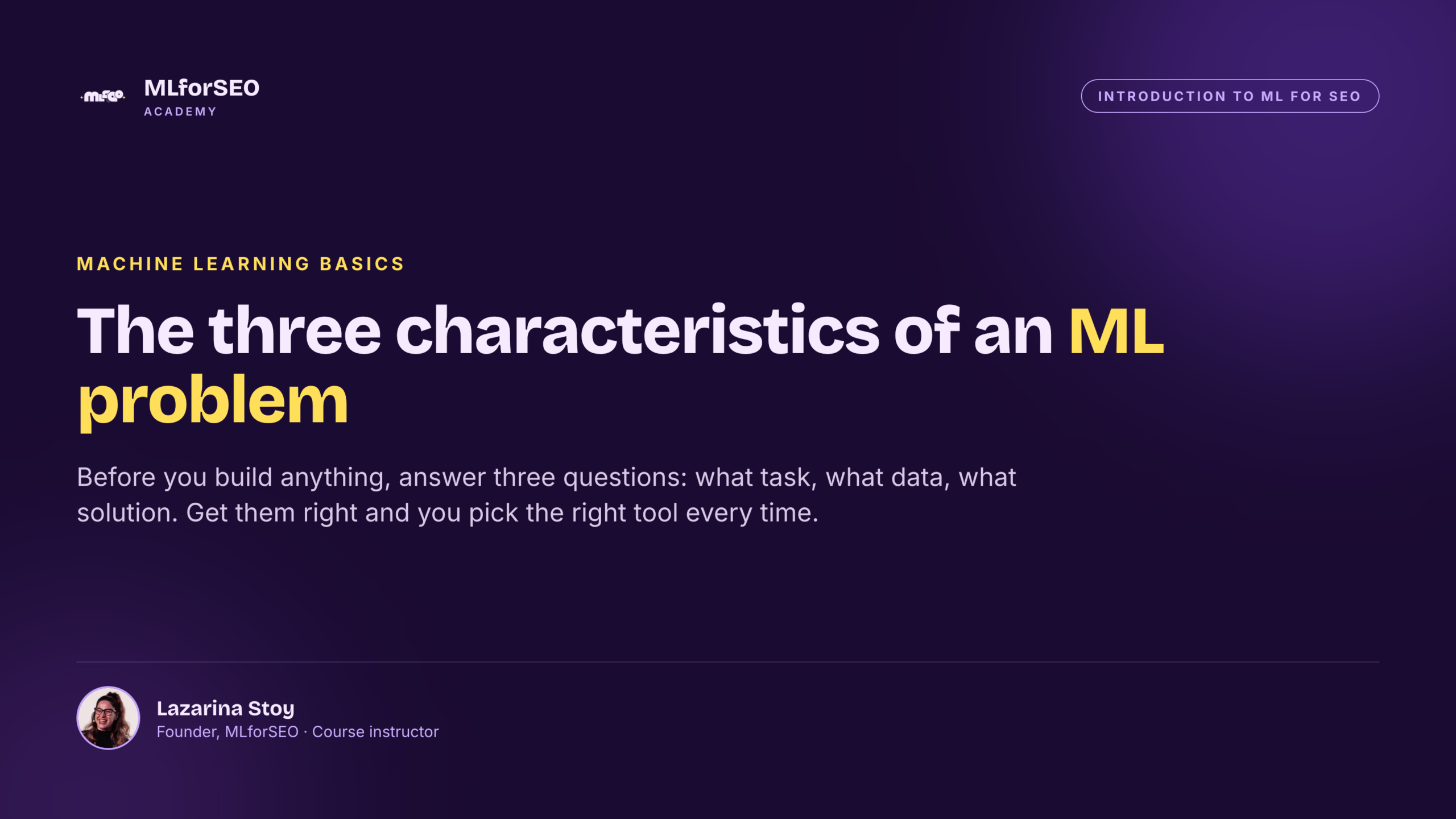
The single most useful machine learning skill I teach SEOs is not writing code. It is knowing whether a task is even a machine learning problem before you sink a week of your life into it. That judgement, honestly, is what separates people who quietly automate half their workload from people who burn out trying to build a neural network for a job a spreadsheet formula could have done in an afternoon.
Whenever I start any machine learning project, I ask three questions. What is the task I am trying to perform? What is the data I have to work with? And what does the solution actually need to look like to be useful? Get those three characteristics right and you will pick the correct tool almost every time, or, just as valuable, you will correctly decide that machine learning is the wrong tool and save yourself the trouble. This is the framework that underpins the whole of the Introduction to Machine Learning for SEO course, and it is the one thing I would want you to take away even if you read nothing else.
Here is the part that makes this more than a beginner exercise. The exact same three characteristics explain a lot about the AI search systems you are already competing inside. They explain why Google often cannot tell a creator why their traffic dropped, and why ChatGPT hands you a slightly different answer every single time you ask it the same question. So let’s build the framework properly, and I promise it will change how you look at both your own automations and the black boxes ranking your content.
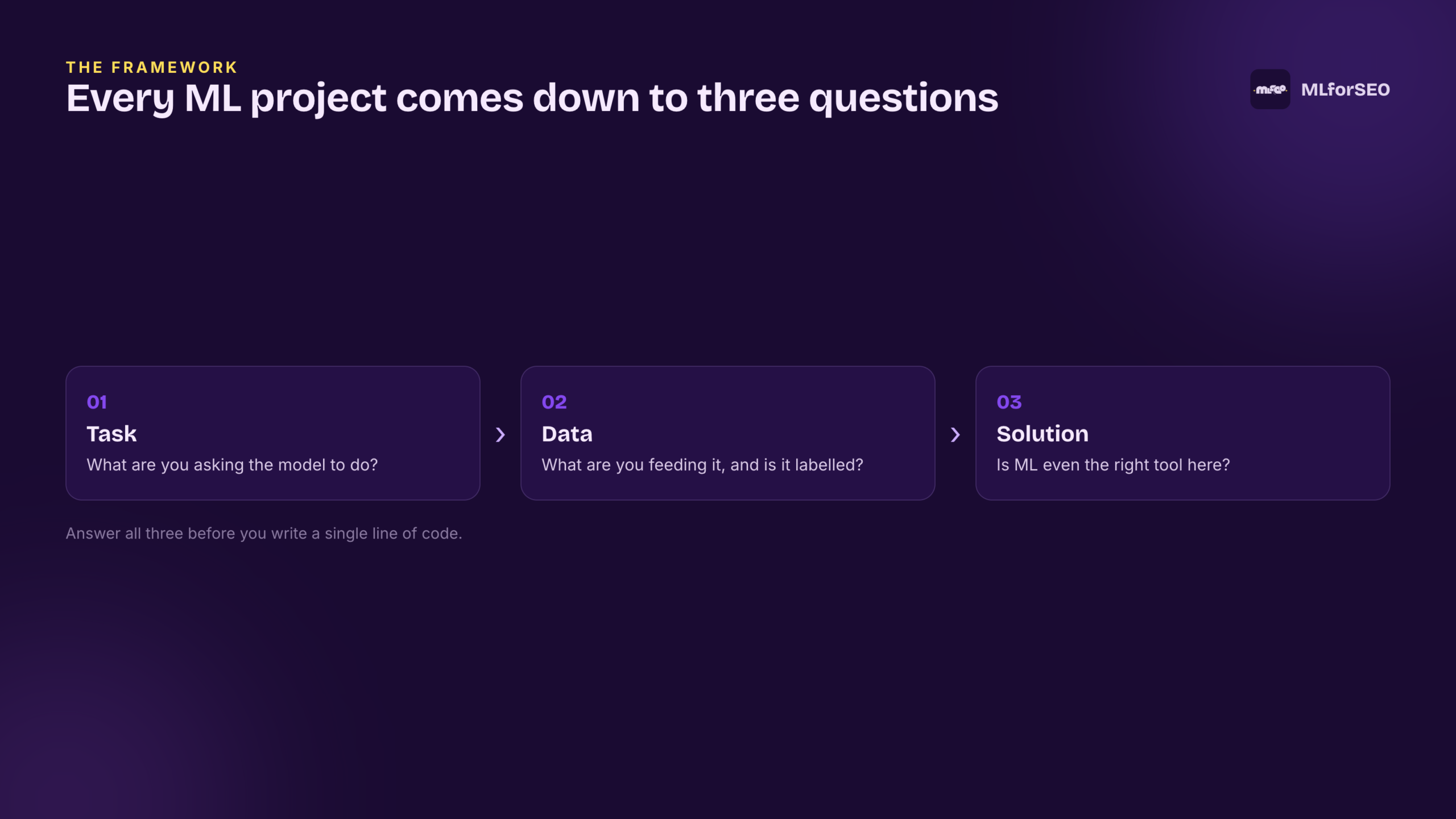
Start with the real first question: is this even a machine learning problem?
You do not need to become a machine learning engineer. You need to become a marketer who can spot an automatable task and match it to the right approach. That is a completely different, and much more achievable, goal, and it is worth saying out loud because the limiting belief that “I am not technical enough for this” stops more people than any actual technical barrier ever does.
There is a saying I picked up from Noah Lerner that I think about constantly: build painkillers, not vitamins. When you are learning, the temptation is to reach for the most impressive-sounding solution, a custom model, an AI agent, a fine-tuned transformer, because it sounds fancy and earns you social points. Resist it. The best first automation is the one that removes a genuine, recurring pain in your workflow, no matter how unglamorous the method. Confidence compounds. Ego points do not. Every task you successfully automate makes the next one easier to see and quicker to build.
So before anything else, walk a task through the three lenses below. If it survives all three, you have a machine learning candidate. If it does not, that is not a failure. That is you saving your own time, and that discipline is exactly what makes you reliable to the stakeholders who depend on your judgement.
Task characteristics: what are you actually asking the model to do?
At its core, every machine learning task is either supervised or unsupervised, and each of those splits into a handful of sub-tasks. The dividing line is beautifully simple: do you have labelled data, meaning do you already know the correct answer for at least a subset of your data?
Supervised learning needs labelled data. You already know the right output for some of your examples, you train the model on those, and then you let it predict the rest. Unsupervised learning works on unlabelled data. You do not have the answers, so the goal is to let the model surface hidden patterns and structure that you then interpret yourself.
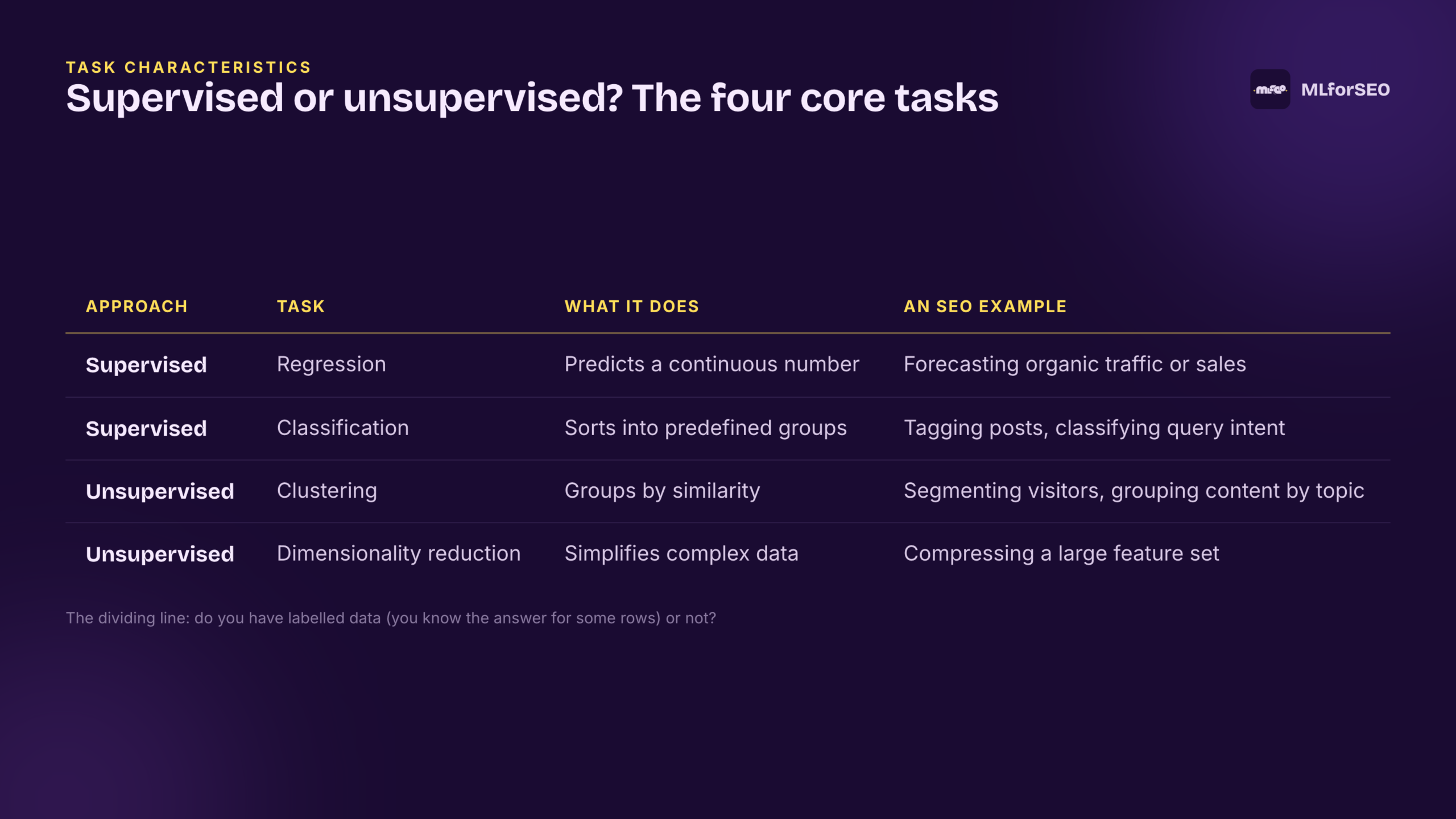
Supervised learning breaks down into regression (predicting a continuous number, like forecasting website traffic or sales trends) and classification (sorting items into predefined groups, like flagging an email as spam or ham, or deciding whether an image is a medical X-ray or a product photo). Unsupervised learning breaks down into clustering (grouping items by similarity, like segmenting visitors by behaviour or grouping articles by topic) and dimensionality reduction (simplifying complex data into fewer dimensions while keeping the important signal, so you can visualise or model it).
This is a deliberately simplified view, by the way. In reality supervised learning branches further into tree-based models and linear models, unsupervised branches into clustering and association, and each of those has its own family of algorithms with different strengths, applications and blind spots. You do not need all of that on day one. You need to know which of the four boxes above your task lives in, because that single decision narrows the entire field of options down to something manageable.
Beyond the basics: deep learning and reinforcement learning
Two terms you will bump into a lot are worth defining, because knowing when they apply is mostly about knowing when they do not.
Reinforcement learning is a flavour of unsupervised learning where a model learns through trial and error, optimising its own performance over many attempts based on the outcomes of its previous actions. The image I always use is a Boston Dynamics robot falling over a million times until, on attempt one-million-and-one, it works out the exact sequence of movements to stand up. Genuinely powerful, and almost never what you need for a marketing automation.
Deep learning uses deep neural networks and can power both supervised and unsupervised tasks. It excels at image recognition and natural language processing, but it demands large datasets and serious computing resources. It is also, as we will see in a moment, notoriously hard to explain. As a beginner you will very rarely reach for it, and that is completely fine; recognising when a problem is a deep-learning problem is more useful than being able to build one.
A shortcut for spotting the right category
The clearest map I have found for navigating all of this is a flowchart from the brilliant Karen Hao, which walks the whole field of AI as a series of yes-or-no questions. Is it finding patterns in large amounts of data? Then it is machine learning (if not, it is probably a rule-based, if-else system). Is it being told what to look for? Then it is supervised. Does it involve deep neural networks? Then it is deep learning. Is it reaching a goal through trial and error? Then it is reinforcement learning. It is worth keeping open while you build your intuition; you can find it in her piece “What is machine learning?” for MIT Technology Review.
Key considerations when choosing a task
The nature of the problem is only the start. Before you commit, run through these too, because each one quietly rules options in or out:
Outcome validation. Do you have labelled data to check the model against? Yes points you to supervised methods. No points you to exploratory, unsupervised ones. This is the same labelled-versus-unlabelled question as before, but asked from the angle of “how will I know if it worked?”
Complexity and resources. Simple tasks like basic classification can be handled with straightforward, pre-built models. Complex tasks like image recognition pull you toward deep learning, and the hardware bill, the GPUs and the distributed computing that come with it. Scale matters here too: a few hundred rows is a different project from a few million.
Skill level. Start with tasks you can do using pre-trained models and friendly libraries like scikit-learn. Save neural networks and reinforcement learning for when you have the data and the confidence to match. There is no prize for making your first project the hardest one.
Repeatability. Is this a one-off analysis or something that needs to run in production every day? A one-time automation is far more forgiving; a production system means you have to care about the reliability and uptime of whatever library or API you depend on. We will come back to this under solution characteristics.
Real-world feasibility. Do you genuinely have the data, the time and the resources? Most people who dream about building a custom model do not have the labelled data it would require, and finding that out three weeks in is expensive. Be honest with yourself here, early. Machine learning takes trial and error, especially when you move past following someone else’s tutorial and try to build something from scratch, and that time is real.
Data characteristics: what are you feeding the model?
Data in, data out. The type of data you hold shapes everything downstream, the task you can run, the algorithm you can use, even which API is available to you. If you do not understand your data’s format and limitations, matching it to the right method is mostly guesswork, and guesswork is where beginner projects quietly die.
Most of the data you will meet in SEO falls into six types. Here is what each one looks like and where it shows up in our world.
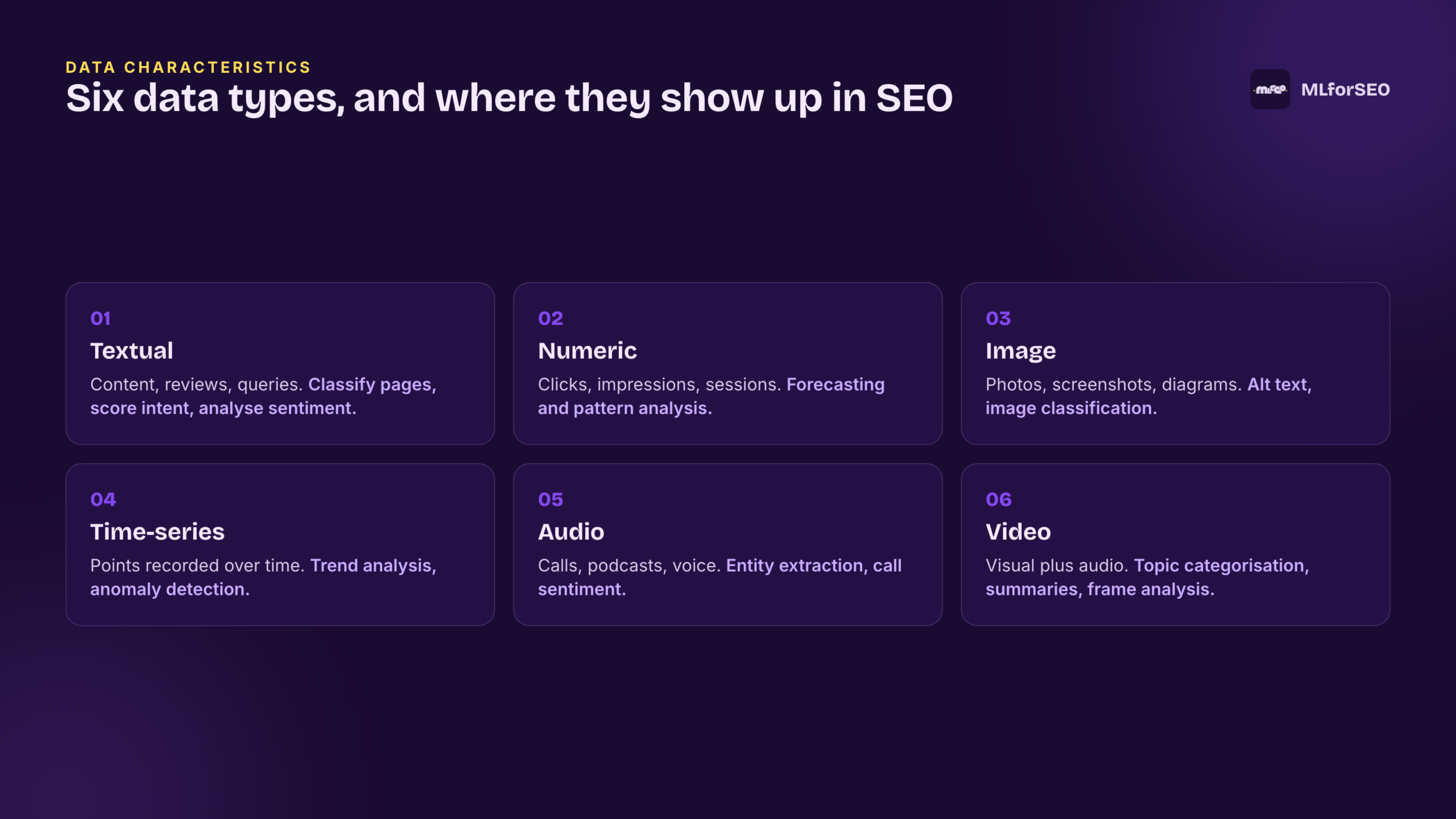
Textual data is your website content, user reviews and search queries, the raw material for classifying pages into categories, sorting queries by intent, or running sentiment and entity analysis on reviews. Numeric data is clicks, impressions and sessions, the stuff of forecasting and conversion analysis. Image data covers photos, screenshots and diagrams, used for generating alt text, classifying product images versus infographics, or image recognition. Time-series data is sequential points recorded over time, perfect for analysing historic traffic, forecasting seasonality and detecting anomalies. And with multimodal media on the rise, audio (call transcripts, podcasts) and video (product and tutorial content) are increasingly analysable too, for entity extraction from calls, sentiment on support conversations, or auto-generating video chapters and summaries.
Notice how many of these you can already access. Google Analytics and Search Console hand you numeric and time-series data on a plate. Others take more effort: user reviews might need a scraper, call transcripts might mean collaborating with your support team, video needs its own extraction step. Knowing the source is half the battle, and mapping data type to data source to ML task is exactly the exercise that turns a vague idea into a plan.
Four questions to ask about your data
What format is it in? Numeric, textual, image, time-series, audio or video. This alone narrows your options fast, because whole families of algorithms are format-specific.
Is it labelled or unlabelled? Do you know the expected outcome for at least a subset? This is the fork in the road between supervised and unsupervised, so it is worth answering carefully rather than assuming.
What is the scale? A few hundred rows or a few million? Scale drives your costs, your techniques and the skills you will need. It is the difference between a Google Sheet and a distributed pipeline, and getting it wrong in either direction wastes effort.
Is it clean? Missing values, duplicates and inconsistencies will quietly wreck your results, especially if you are self-training a model. Clean data is not glamorous, but it is where most of the real work in any serious project actually lives.
Free resource
To make this concrete, I mapped each data type to its typical SEO data source, the matching ML task, and the algorithms and APIs you might use. Grab the ML Data Characteristics, Mapped to SEO and ML Tasks guide, free.
Solution characteristics: is ML actually the right tool, and which kind?
You have a task and you understand your data. Now the honest question: should you use machine learning at all, and if so, what kind of model? This is where I run every idea through a quick four-question gut-check that has saved me from a lot of bad projects.
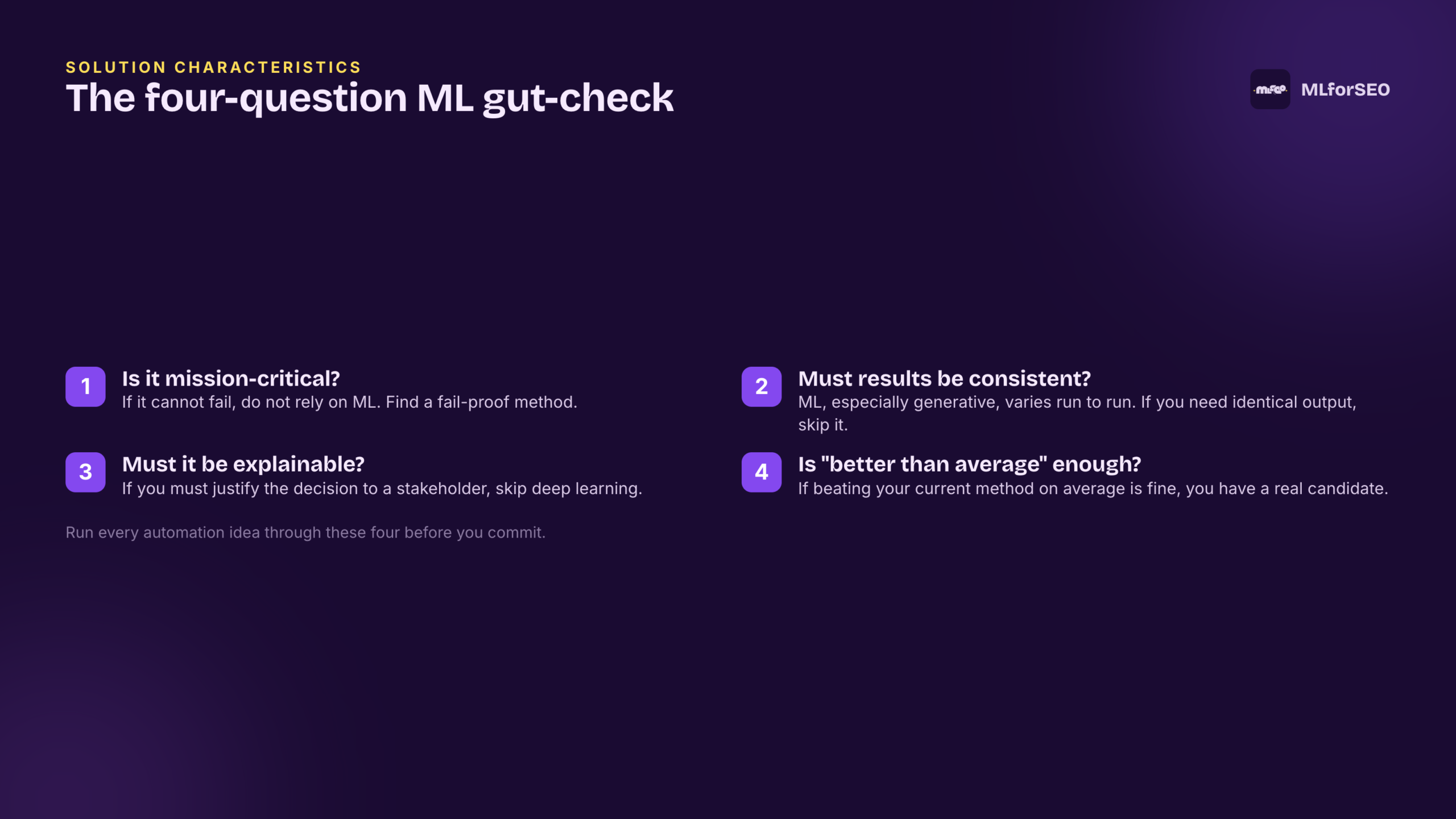
1. Is the task mission-critical? If it is unacceptable for the method to occasionally fail, and it will occasionally fail, in ways you do not expect, then do not rely on machine learning. If someone’s job or a real business outcome hinges on this being right 100% of the time, like forecasting the numbers behind next year’s board presentation, walk away and find a fail-proof method. Seriously. This is the question that rules out the most bad ideas.
2. Must the results be consistent every time? Machine learning, and especially generative and unsupervised methods, will often give you a slightly different output on each run, even with identical input. Write a meta description with an LLM three times and you get three correct but different descriptions. If your task truly needs identical output every time, ML is the wrong fit.
3. Must the results be explainable to a stakeholder? If you need to tell a client exactly why the system reached a decision, skip deep learning. The calculations inside a deep model are extremely hard to deconstruct into a story a human can follow, and “the algorithm decided” is not an answer a client accepts.
4. Is “better than average” good enough? If it is acceptable that, on average, the model beats your current method, on accuracy, on consistency, or simply on time saved, then congratulations, you have a real machine learning candidate. Go take a look at your options.
Pre-trained, self-trained or fine-tuned?
Say you have decided ML fits. The next decision is where your model comes from. There are three options, and for most marketers the answer is almost always the first one.
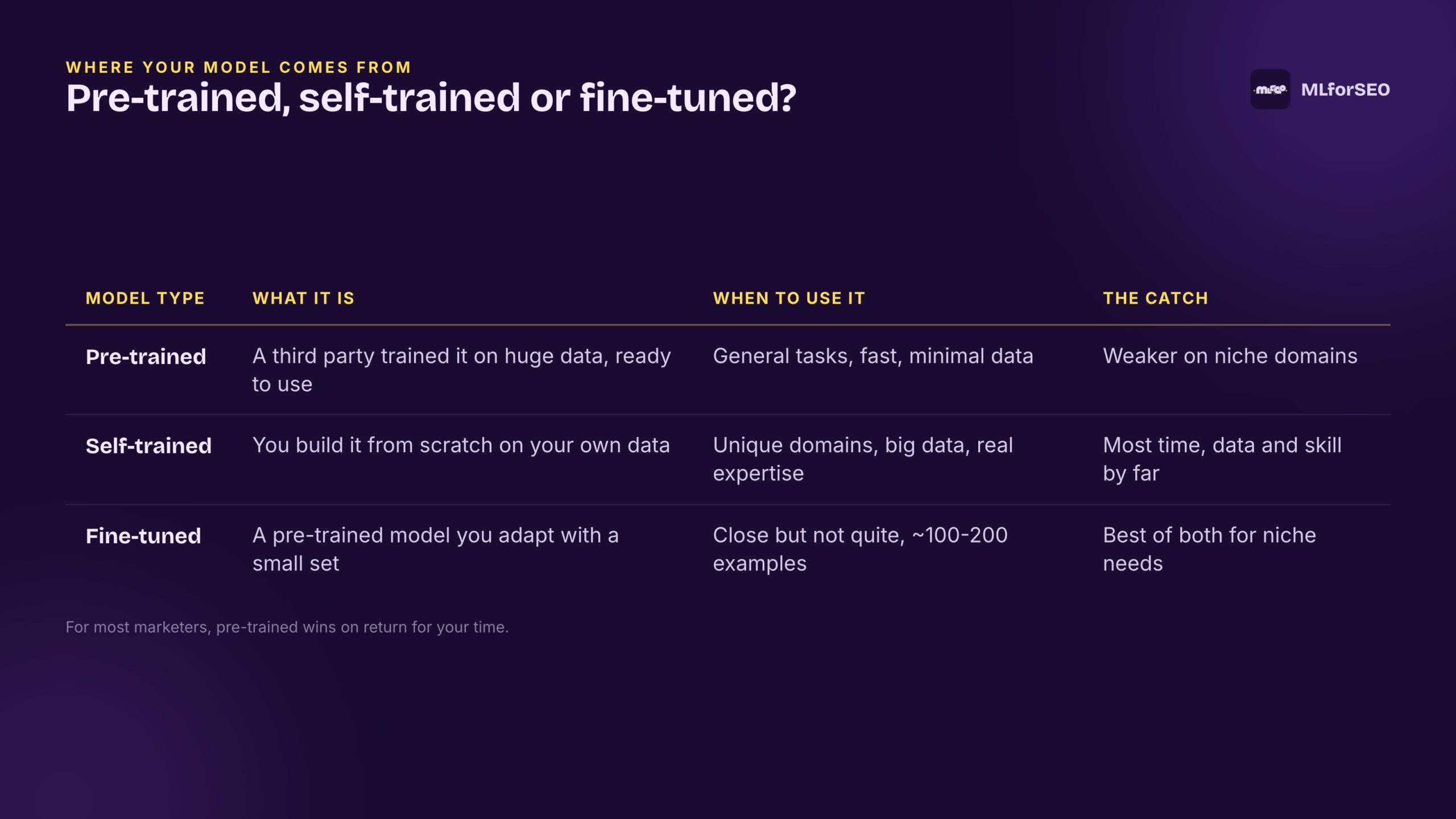
A pre-trained model is one a big organisation (Google, Amazon, Meta) trained on a vast dataset and released ready to use. They are excellent for general tasks and common topics, fast to implement with minimal data or expertise, but weaker in niche or fast-moving domains like medical research, cryptocurrency or cybersecurity. A self-trained model is one you build from scratch on your own data, the right call only when you have a genuinely unique domain, a large labelled dataset and real expertise, because it demands the most time, skill, storage and dev resources by a wide margin. A fine-tuned model sits in between: you take a pre-trained model and adapt it with a small, domain-specific dataset, using tools like Google Cloud AutoML that can specialise a model with as few as 100 to 200 labelled examples.
Here is the thing to internalise: you are not training to become a machine learning engineer, you are training to become a marketer who works more efficiently. As a beginner, pre-trained models from the big providers or from Hugging Face will give you the best return on your time, every time. You can always graduate to fine-tuning later, and you will know when you need to because a pre-trained model will start visibly underperforming on your niche.
A quick word on training, testing and validation data
If you ever do go down the self-training route, you will split your labelled data into three parts. You do not need to memorise this, but knowing the vocabulary helps you talk to stakeholders and developers without bluffing.
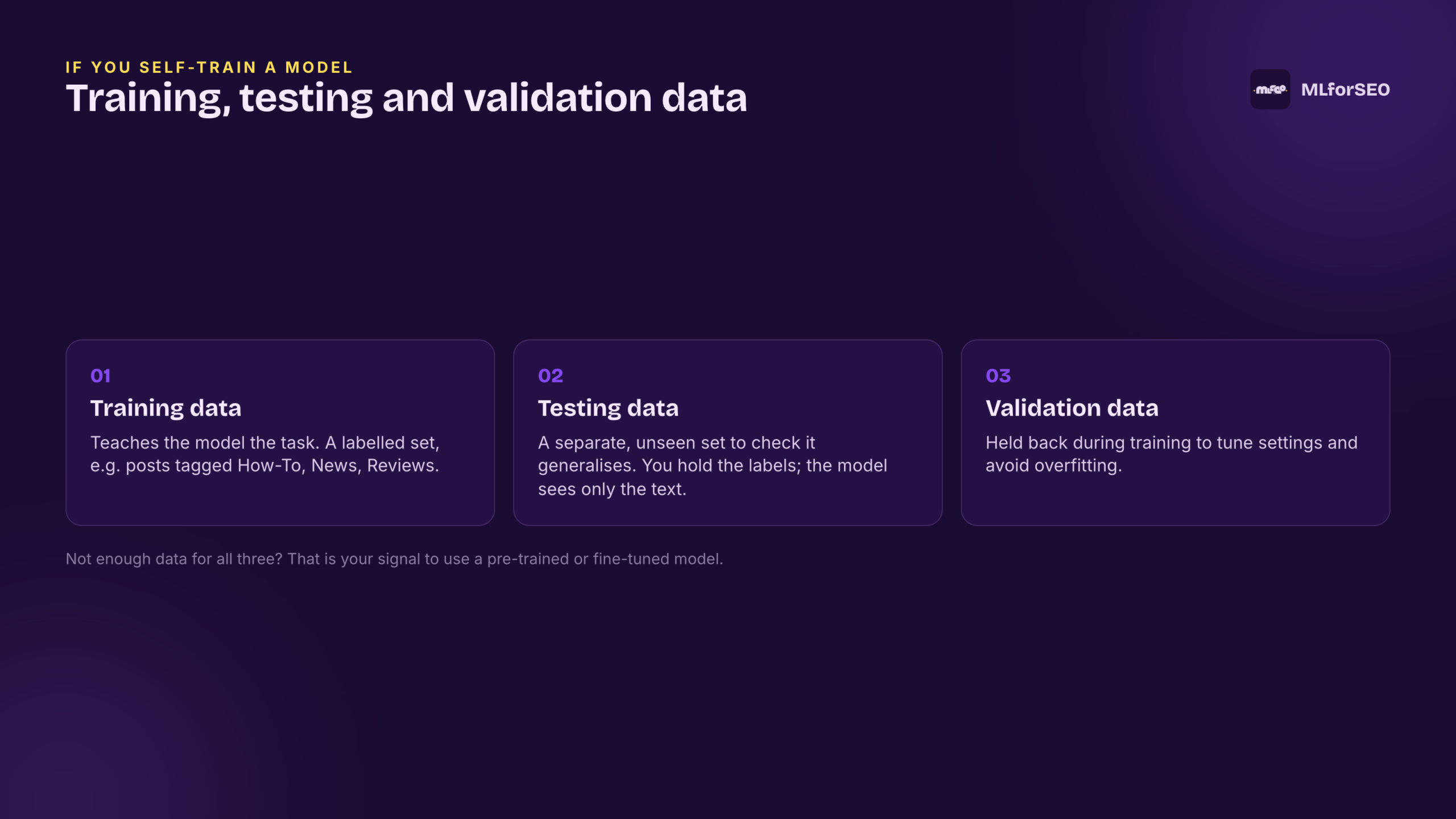
Training data teaches the model how to perform the task, for example a labelled set of posts tagged Product Reviews, How-To and News. Testing data is a separate set the model has never seen, used to check how well it generalises, you hold the labels; the model only sees the text. Validation data is held back during training to tune settings like learning rate and avoid overfitting to the training set. If you do not have enough data to fill all three buckets, that is your signal to use a pre-trained or fine-tuned model instead. No shame in it, and no lost points.
Do not forget bias
Machine learning models can be biased, meaning they favour some outcomes and quietly exclude others. We have seen job adverts shown mostly to users a platform identified as male, facial recognition that performs worse on certain skin tones, and generative image models that produced results wildly unrepresentative of the real world. When you train from scratch, use large and representative datasets and deliberately include a range of backgrounds and cases, even synthetic data where needed. When you use a pre-trained model, you can steer it with careful prompting that includes counter-examples to its bias. Bias is not a footnote; it is part of doing this responsibly, and it is part of what you are accountable for when you put a model in front of a client.
The scorecard I actually use
When I am deciding whether a machine learning solution justifies the effort, I do not rely on gut feeling. I score it against a spread of factors and look at the bottom line as a whole.
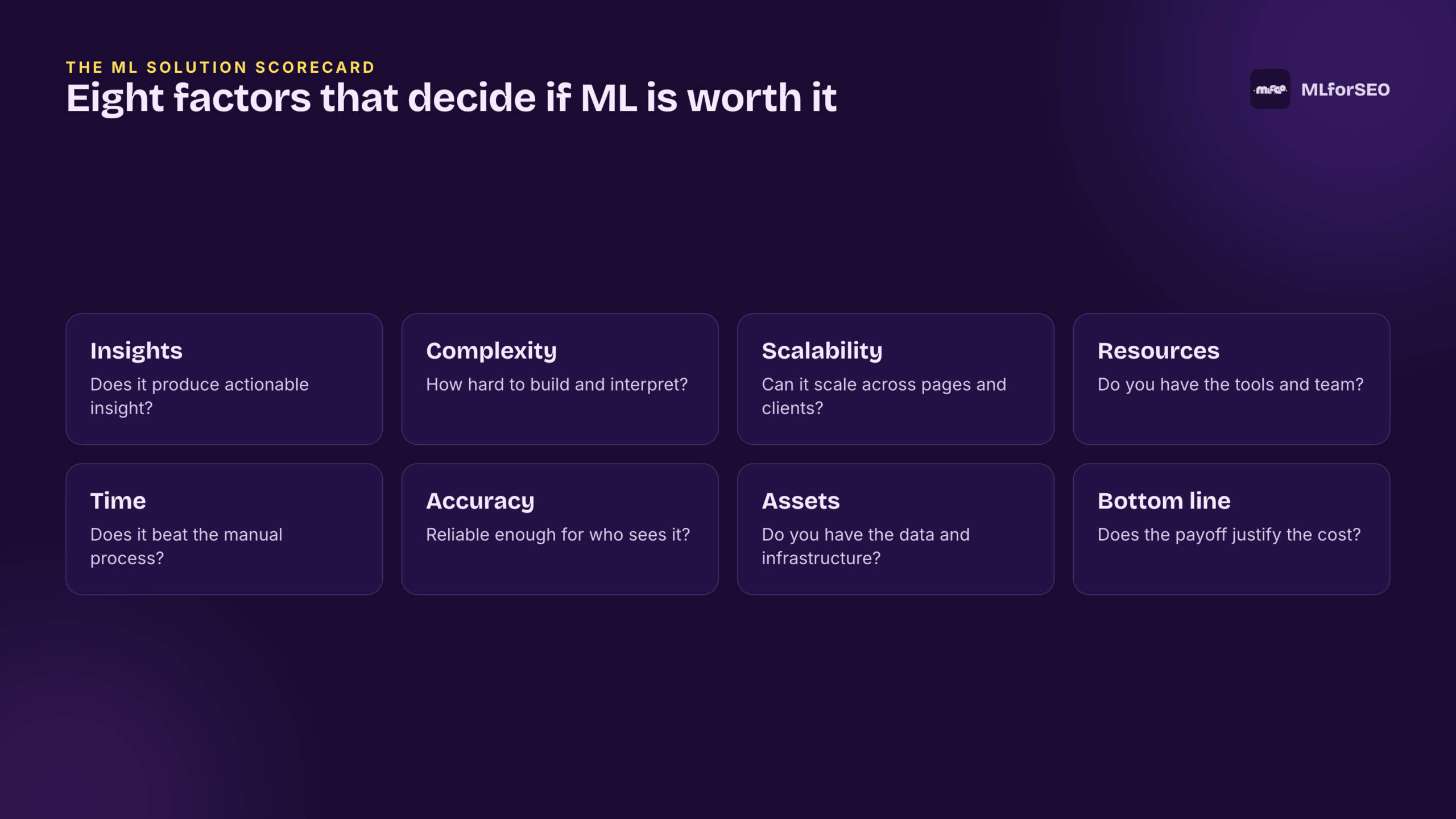
Does the solution produce genuinely actionable insight? How complex is it to build and to interpret? Can it scale across more pages and more clients? Do you have the resources, tools and team? Does it beat the manual process on time? Are the results accurate enough for who will see them? Do you have the assets (datasets, infrastructure)? And ultimately, does the payoff justify the investment, the bottom line? Run a few tasks through this and a pattern emerges quickly. Some tasks are a clear fit for machine learning and others simply are not. Both answers are useful, and a shared, consistent scorecard across your team is what stops you automating things you will later have to un-automate.
Putting it together: a worked example
Let’s take a task every SEO knows, writing meta descriptions, and walk it through all three characteristics. Data: the input is textual, specifically your page content, easy to access. Task: this is a transformation task, turning page content into a summary under 160 characters, and it can be generative if you want them written from scratch; no labels required, so it sits on the unsupervised side. Solution: is it mission-critical? No. Are different results each time acceptable? Yes. Do you need to explain the process? Not really. Does it beat the current method? Absolutely, far faster than writing each by hand.
Four green lights. This is a textbook machine learning automation, and a perfect first project. Now run the same three lenses over “forecast next year’s revenue for the board” and watch how fast the mission-critical and consistency questions turn red. That contrast is the whole skill, and the free When to Use Machine Learning in SEO decision checklist turns it into a repeatable worksheet.
How ML Characteristics Explain AI Search Systems
Here is why this framework matters more than ever. The systems deciding whether your content gets surfaced, Google’s ranking stack, AI Overviews, AI Mode, ChatGPT, Perplexity, Gemini, are themselves built on exactly the characteristics we just covered.
When Google held a creator event after the helpful content update, creators asked engineers to explain precisely why their content had stopped ranking. The engineers could not articulate it. That is not evasiveness, it is the explainability problem in action. Google’s ranking system leans heavily on deep learning, and deep learning trades away the ability to give a clean, step-by-step reason for its decisions. The system knows there is a failure point; it cannot always point to where.
The consistency question explains the other thing you have noticed. Ask an LLM the same question twice and you get two different answers, because generative models are probabilistic by design. That is also why measuring your visibility inside AI search means sampling many responses rather than trusting a single check. And it connects to how these systems actually select sources: Google’s AI Overviews use a query fan-out technique, breaking one query into many sub-queries, running them concurrently, and stitching the answer from passages across different pages, with research finding that passages of roughly 130 to 170 words earn the highest citation rates. Underneath that is classification (what is this query about?), clustering (which sub-topics does it fan out into?) and entity extraction (which real-world things does it concern?), the very tasks we have been discussing. Once you can see the task, the data and the solution characteristics behind a system, it stops being a black box and starts being a set of trade-offs you can reason about. That is a genuine competitive advantage in AI search.
Where to Take the ML Problem Framework Next
This post covers the framework I use to decide whether a task is a machine learning problem and, if it is, what kind of model to reach for. The full walkthrough, with the complete decision flowcharts, the bias-reduction techniques, and hands-on examples of running these judgements across real SEO workflows, is inside Introduction to Machine Learning for SEO, in the Machine Learning Basics module.
To start applying it today, grab the free ML Data Characteristics guide and the When to Use Machine Learning in SEO decision checklist. Then read the companion post on how to find ML-enabled automation in your own SEO workflow, which turns this framework into a repeatable way to search for opportunities.
From there, the rest of this series gets hands-on with each technique the framework points to: classification, clustering, entity extraction and fuzzy matching.
Related glossary terms
MLforSEO Academy
Take your skills further — pick your path
Introduction to Machine Learning for SEO
by Lazarina Stoy
Ship practical ML workflows — classification, clustering, entity extraction — no CS degree required.
View course →AI Search Optimisation & Agentic SEO
by Beatrice Gamba
How agentic systems retrieve, evaluate and select — and how to become the source they cite.
View course →AI Search, LLMs, Entity SEO & Knowledge Graph Strategies
by Beatrice Gamba
Build the entity authority and knowledge-graph presence that makes AI recognise and trust your brand.
View course →Semantic ML-enabled Keyword Research
by Lazarina Stoy
Query understanding, search intent and semantic clustering for how people and AI really search.
View course →