
 By Lazarina Stoy· July 31, 2026
Most people come to machine learning in SEO looking for one magic script that does everything. I want to gently talk you out of that, because the marketers who actually get value from this are not the ones with the fanciest model. They are the ones who have built a habit of spotting small, automatable tasks and quietly wiring them up, one at a time, until half their week runs itself.
In a previous post I laid out the three-pillar framework I use to decide whether a task is a machine learning problem: its data characteristics, its task characteristics, and its solution characteristics. This post is about what you do with that framework once you have it. How do you take a normal SEO project, break it apart, and systematically find the machine-learning-enabled automation hiding inside it? That is the real skill, and it is very learnable.
The method: keep your search specific to data, task and solution
When you have an idea for an automation, the mistake is to search for something vague like “AI tool for SEO.” You will drown in noise. Instead, describe the job in the language of the three pillars. What data am I working with? What task am I asking a model to perform? What solution constraints do I have? Once your idea is framed that precisely, finding an existing script, API or no-code template becomes far easier, because someone in the SEO community has very likely already built and shared something close to it.
Here is the mindset shift. You are not trying to invent machine learning from scratch. You are trying to translate the SEO tasks already on your plate into machine learning language, and then go looking for what already exists.
The practical trick is to keep your search queries specific to the data, the task and the solution, rather than searching for a vague “AI SEO tool”. If you want to automate image captioning, you are looking for image data, an unsupervised recognition or generative task, and a solution that tolerates variation, so you search for exactly that combination, and you will almost always find that a creator in the SEO community has already built and shared something close. You are standing on a lot of shoulders here; the job is to find the right shoulders and adapt what they built, not to reinvent it.

Take one project apart: on-page optimisation
Let’s use an on-page optimisation project, because it is familiar and it is deceptively full of automatable pieces. Sit down and list every distinct task inside it. You will get something like this:
Writing meta descriptions. Rewriting titles and H1s. Improving headings. Clustering content for better page labelling. Generating image captions and alt text. Finding internal linking opportunities. Doing keyword research. Generating and implementing schema markup.
Now, I know what you might be thinking. Surely no single script can do all of that. You are right. One script cannot. But a handful of them, each solving one task well, absolutely can, and you do not need an end-to-end autonomous system to get value. You just need to work through the list and translate each task with the framework.
Let’s do exactly that for three of them, so you can see how quickly the framework produces a decision.
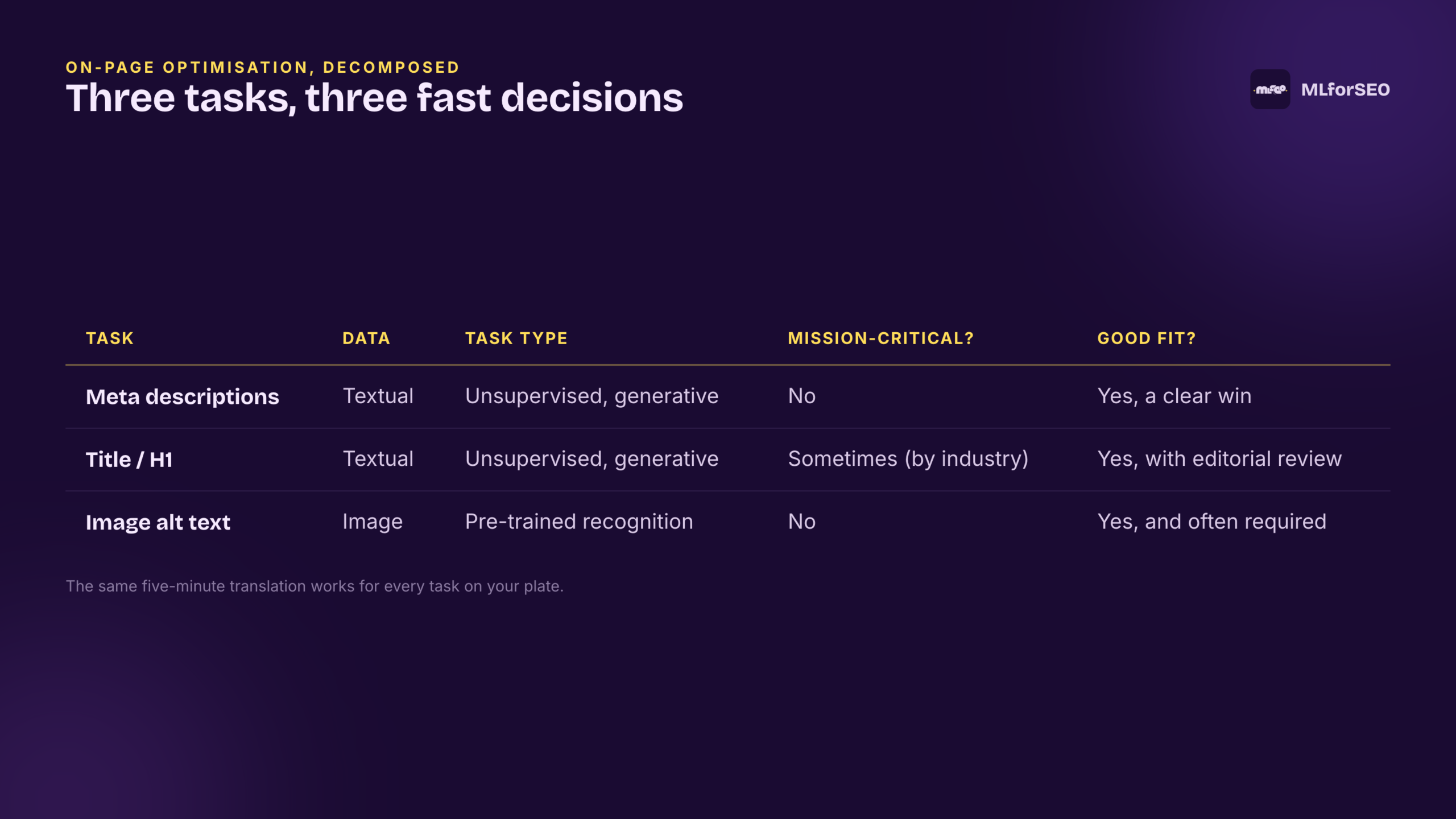
Look at how much clarity that gives you in about five minutes of thinking. Meta descriptions are a no-brainer. Title work is a yes with a caveat: in a Your Money Your Life domain like medical or finance, an imprecise auto-written title can genuinely harm the brand, so you keep automation but you route the output through editors who understand the subject. Image captions are an easy yes, and in some jurisdictions alt text is a legal requirement, so not automating it actually leaves you at a disadvantage.
That is the whole move. Decompose the project, translate each task, decide. Some tasks will be a green light, some will be a firm no, and knowing which is which is exactly the value.
Why one imperfect automation beats a perfect fantasy one
If someone is selling you a fully automated system where you drop in your data and it spits out a finished strategy, be sceptical. We are not there yet, and pretending otherwise sets you up to distrust the whole field when the fantasy inevitably underdelivers.
The far more useful truth is that small, incremental improvements compound. Consider what actually changes when you automate even a few tasks:
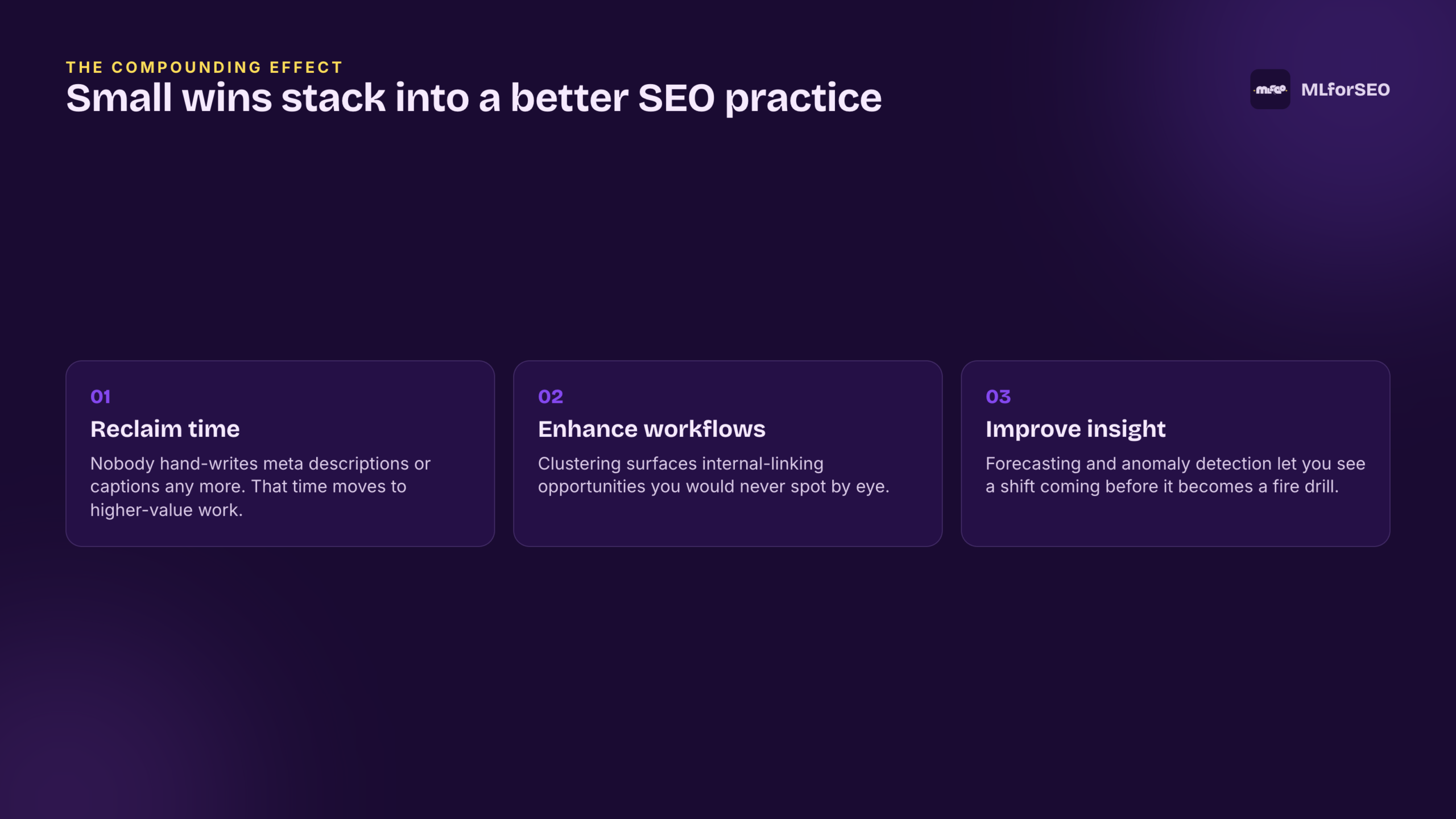
You reclaim time. Nobody on your team is hand-writing meta descriptions or image captions any more. That time goes to higher-value work.
You enhance existing workflows. Using clustering to surface internal linking opportunities gives you more targeted, defensible link suggestions than manually eyeballing a sitemap ever did.
You improve your insight. A forecasting or anomaly-detection routine lets you see a seasonal shift or a sudden traffic drop coming, and tell your stakeholders about it before it becomes a fire drill.
Each of these is a small win. Stacked over a quarter, across a content portfolio, they add up to an SEO practice that is meaningfully more efficient than the one you started with. That compounding effect, not any single clever model, is the point.
Why this skill compounds in the AI-search era
There is a strategic reason to build this muscle now, beyond the hours it saves. As search shifts toward AI systems that assemble answers from many sources, the grunt work of SEO, writing hundreds of meta descriptions, tagging content, spotting internal-link opportunities, is exactly the kind of repetitive, tolerant-of-variation task machine learning handles well. Automating it frees your human attention for the work AI cannot do: strategy, positioning, judgement, and building the genuine authority these systems reward. The marketers who automate the repetitive layer are not replacing themselves; they are buying back the time to do the thinking that actually moves rankings and visibility.
None of these wins individually looks like a revolution, and that is exactly the point. The revolution is cumulative. A team that automates meta descriptions this month, internal-link discovery next month, and anomaly detection the month after has, by the end of a quarter, quietly rebuilt how it works, without ever betting the business on a single fragile mega-automation. That is the safe, sustainable way to bring machine learning into an organisation, and it is far more defensible to a cautious stakeholder than promising a magic end-to-end system you cannot fully explain.
You are not meant to do this alone
One reason I am so relaxed about the “you don’t have to build it from scratch” message is that so much already exists. The SEO and tech communities are full of people actively building and sharing solutions for exactly these tasks. Your job is often to find what is out there, adapt it to your data, and give credit. And when you build something yourself, share it back, including the parts that failed, because that is how a whole community levels up.
If you want people to compare notes with while you experiment, the MLforSEO Slack community is where a lot of this happens. You will find plenty of marketers on the same journey, which makes discovering a new field a lot less lonely.
Free resource
I built a decision checklist to be your little buddy for exactly this process. It walks you through identifying the data, the task and the available solutions, how to search for them, and how to judge whether a solution is practical, with space for your own notes. Grab the When to Use Machine Learning in SEO decision checklist.
Key Takeaways for Spotting ML Automation
Three things. First, a practical framework: always evaluate a task through the lens of data, task and solution characteristics. Second, a realistic approach: not everything needs machine learning, and correctly ruling it out is a win, not a failure. Third, the confidence to start small, lean on tools and resources that already exist, and iterate.
We are not training to become machine learning engineers, or even researchers. We are marketers trying to get sustainable, safe value out of technologies that already exist. Adding value does not require a fully autonomous system. It requires the muscle of spotting where automation helps, and the discipline to build it one reliable piece at a time.
Where to Take Your ML Automation Practice Next
This post, and the framework behind it, closes out the Machine Learning Basics module of Introduction to Machine Learning for SEO. The course then moves into the hands-on techniques you would actually reach for, classification, clustering, entity extraction and fuzzy matching, each with full walkthroughs you can run on your own data. If keyword research is where you want to start automating, my Semantic AI-powered SEO Keyword Research course goes deep on that specifically.
Related glossary terms
MLforSEO Academy
Take your skills further — pick your path
Introduction to Machine Learning for SEO
by Lazarina Stoy
Ship practical ML workflows — classification, clustering, entity extraction — no CS degree required.
View course →AI Search Optimisation & Agentic SEO
by Beatrice Gamba
How agentic systems retrieve, evaluate and select — and how to become the source they cite.
View course →AI Search, LLMs, Entity SEO & Knowledge Graph Strategies
by Beatrice Gamba
Build the entity authority and knowledge-graph presence that makes AI recognise and trust your brand.
View course →Semantic ML-enabled Keyword Research
by Lazarina Stoy
Query understanding, search intent and semantic clustering for how people and AI really search.
View course →