 By Beatrice Gamba· July 30, 2026
Agentic systems decide whether your content is used before anyone sees an answer. Ranking measures the wrong thing. The distinction that reorganises everything is indexed versus selected.
A founder wrote to me last month with a problem she had diagnosed with confidence. Her page ranked first for her category. First. And yet when she asked ChatGPT the exact question that page was built to answer, her brand was nowhere in the response. Her conclusion was that she had a ranking problem in AI search, and that if she could just rank higher in these new systems, the citations would follow. Let’s notice what has happened here: she has taken the mental model that worked for ten years and applied it, unchanged, to a system that does not work that way at all.
Most of what is currently called AI SEO is conceptually wrong for exactly this reason. People are applying the old mental models to systems that operate on a fundamentally different logic. This is not a criticism of effort. The founder had done real work. It is a criticism of the model she was using to interpret the result. And the correction begins with one distinction that reorganises everything else: being indexed is not the same as being selected.
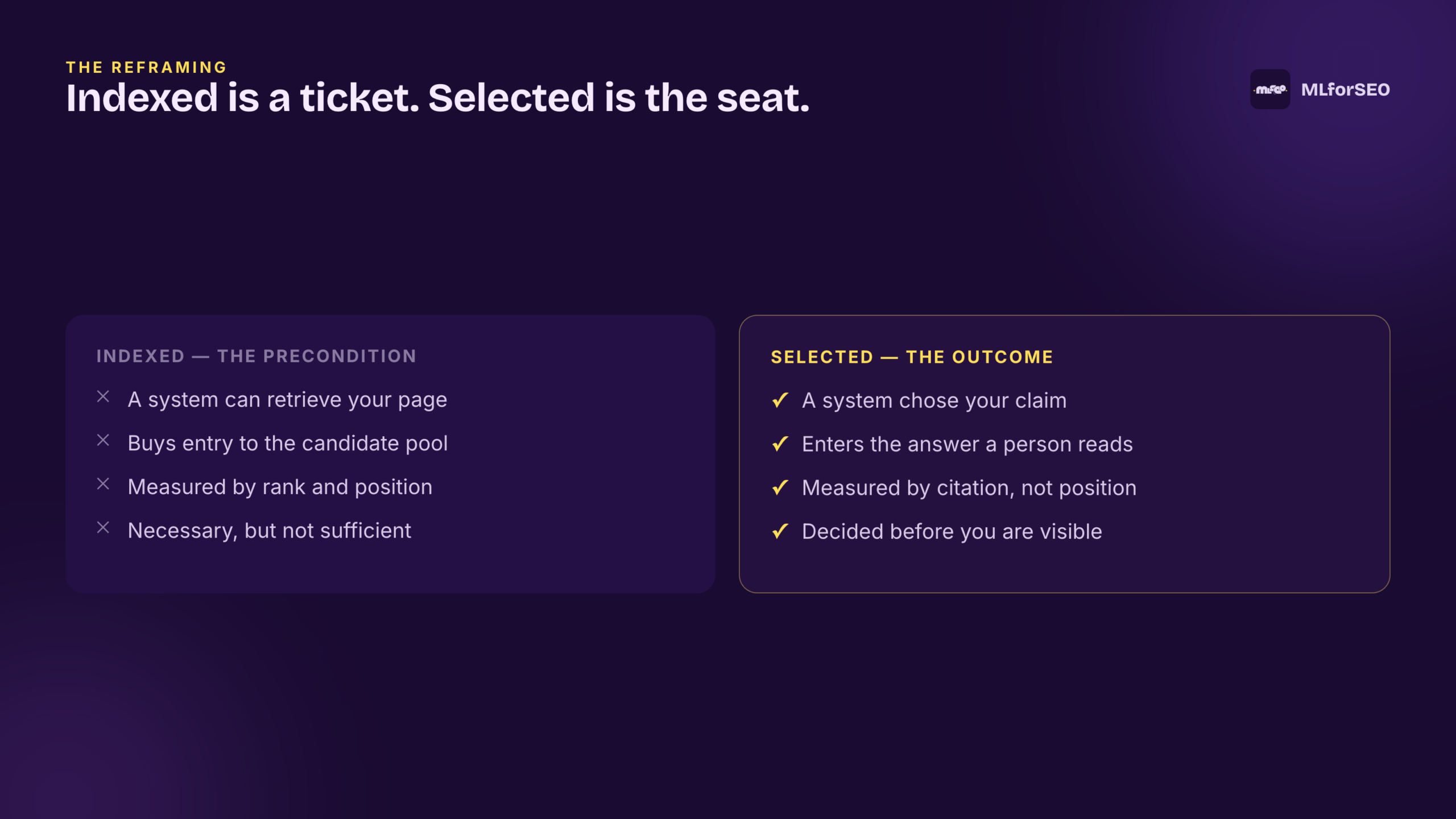
So let’s be precise, because in this topic every word is load-bearing. Indexed means a system can retrieve your page if it chooses to. Selected means the system chose your claim and put it into the answer a person actually reads. These are two different achievements, and the gap between them is where almost every AI search problem lives.
What the machine decides before you are ever visible
Traditional search retrieves and ranks, and then it stops. A human being does the rest. You scan the ten blue links, you evaluate which look credible, you open a few, you synthesise an answer in your own head. Every meaningful decision belongs to the person. Agentic search takes those human steps and moves them inside the machine. An agentic system is one that autonomously retrieves, evaluates, and synthesises information from multiple sources to generate a response. Four verbs, and three of them used to be yours.
This is the part that people skip past, so let me slow down on it. By the time a user reads an answer from ChatGPT, Perplexity, Claude, or Google’s AI Overviews, the system has already retrieved candidate sources, already scored them at the level of individual claims, and already decided which claims enter the synthesis and which are discarded. A single technical answer may combine claims from up to eight different sources. You were either in that synthesis or you were not, and that decision was finished before the screen finished loading.
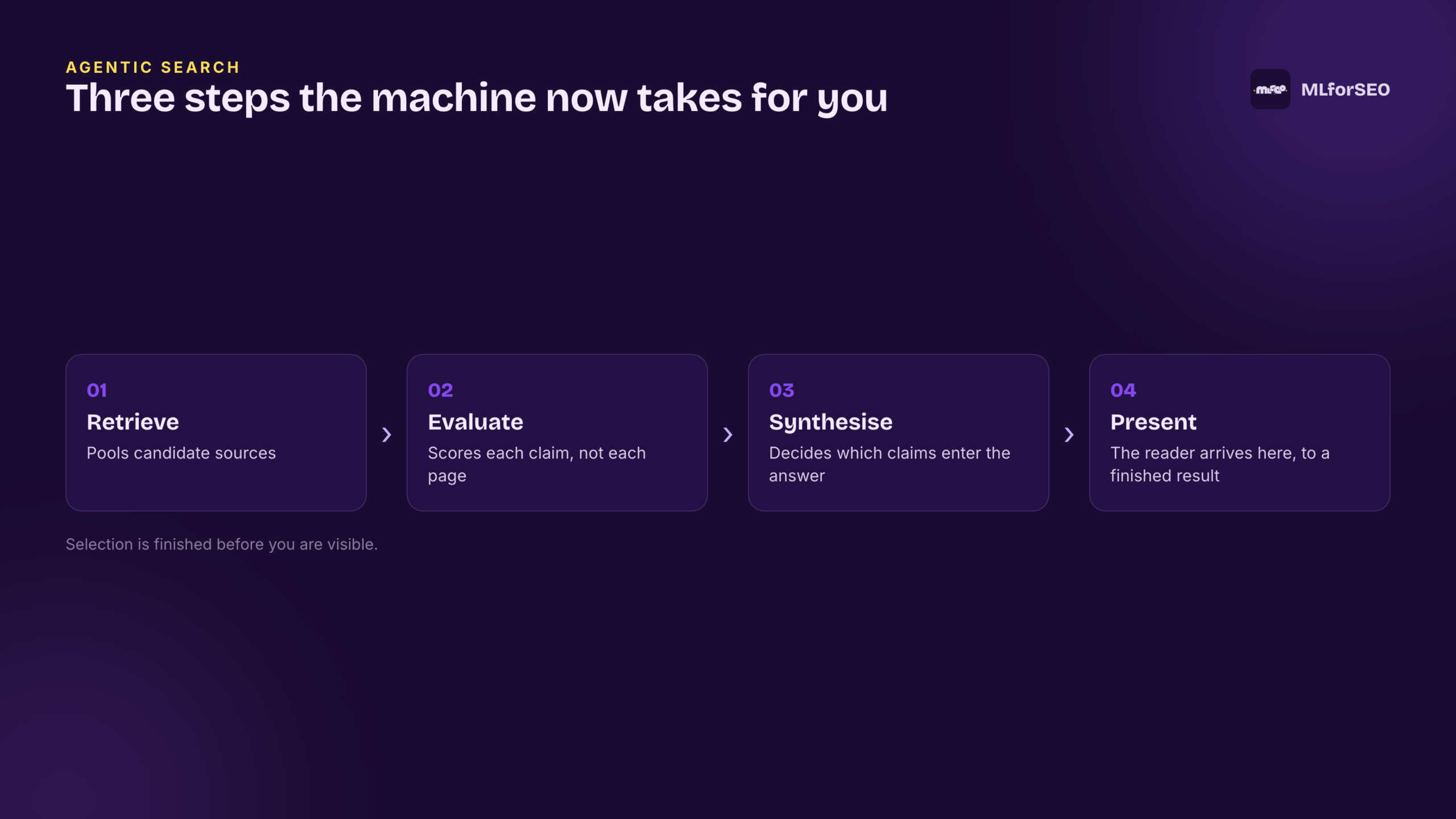
Look at where you sit in that pipeline. The system is at work through the whole of it, and the reader arrives only at the end, to a result that is already assembled. There is no SERP for them to browse. There is no click event. There is no second chance for your page to make its case, because the case was already heard and decided in the retrieval and evaluation stages. This is what people mean, without quite realising it, when they say AI search feels like a black box: the deciding happens upstream of everything they are used to measuring.
Indexed is the precondition. Selected is the outcome.
Here is the reframing I ask everyone to make first, before any tactic. In the old model, being indexed and ranking well was the outcome: you ranked, the human saw you, value followed. In the agentic model, being indexed is only the precondition. It buys you a ticket into the pool of candidates the system might read. It does not buy you a place in the answer. Selection is a separate decision, made on separate criteria, and it happens after retrieval and before visibility.
This is why a page can rank first and contribute nothing. Consider three combinations I see constantly. You rank first, the system retrieves you, and then it synthesises from other sources because your claims are less specific than theirs: high visibility, zero use. Or you sit outside the top ten, but embedding-based retrieval surfaces one precise claim only you have made, and you get cited: low visibility, high use. Or you rank in the top three and are still excluded, because your claim contradicts the other sources or is too vague to extract cleanly. Visibility, in other words, is the floor. It is not the ceiling.
Notice that none of these three failures is a ranking failure. In two of them you are ranking well and still losing. The instrument that tells you your rank cannot tell you which of these three situations you are in, and that is not a small inconvenience. It is the whole problem.
Why your rank tracker is answering a different question
When you use rank tracking to assess your performance in agentic search, you are using a thermometer to measure air pressure. The thermometer is not broken. It measures something real, and it measures it accurately. It is simply the wrong instrument for the question you are now asking. Ranking measures visibility to humans. It does not measure selection by systems, and it does not measure inclusion in the synthesis. That is not a measurement gap that better rank tracking will close. It is a measurement category error.
I labour this because the category error is expensive. It sends people to optimise the thing they can see, which is position, while the thing that actually determines whether they are cited is a claim-level decision they are not looking at. If you want the full argument on measurement, and on what to track instead, I made that its own piece: why your rank tracker can’t see AI search“>your rank tracker is lying to you about AI search goes through why the numbers already sitting in your analytics tell you more than your rank tracker ever will. For now the point is narrower. Do not diagnose an AI search problem with a ranking tool. You will get a confident answer to a question you did not ask.
Value has quietly decoupled from traffic
There is a further consequence, and it is the one that takes the longest to accept, so I will state it plainly. Usefulness and traffic have decoupled. In the old model, usefulness meant visibility plus engagement: you got seen, you got the click, you got time on the page, and you captured the value on your own site. In the agentic model, usefulness means selection plus synthesis: the system selects your information, cites you, and comes to prefer you as a source, and this can happen entirely without sending you a visit.
Picture a pricing figure of yours cited across ten thousand AI-generated responses, your brand named as the source each time, and not one of those interactions producing a session in your analytics. By every traditional metric that is a failure: no traffic, no click-through, no time on page. By the logic of agent-mediated search it is a success: you are the named, trusted source for a claim, at scale. This is not a problem to be solved. It is a structural feature of how these systems work. Value is now created inside the generated response, not on your website.
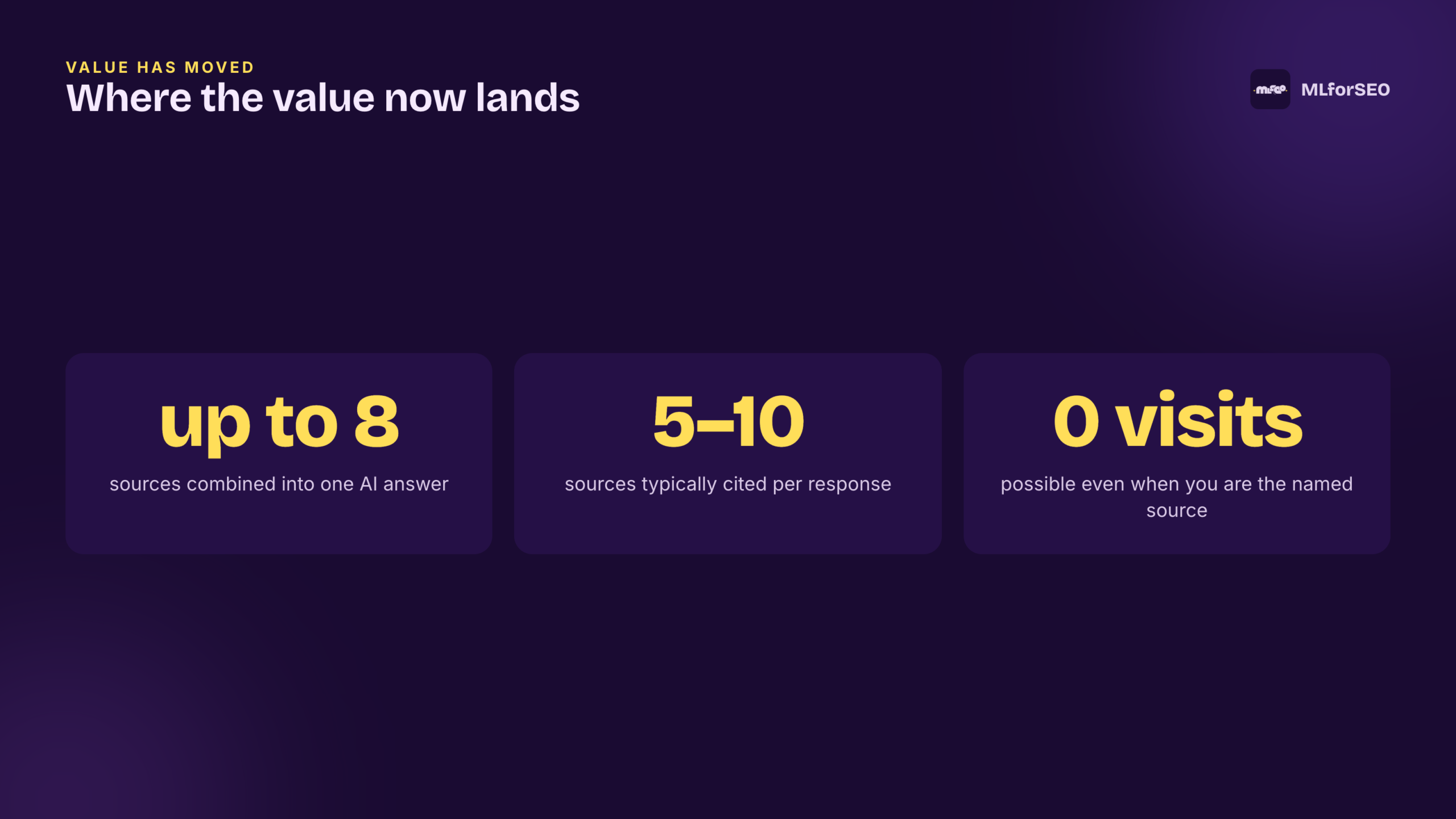
So the definition of a useful page has to change with it. A page with a thousand sessions of people who immediately left is worth less than ten accurate citations in high-confidence agent responses. Ten thousand anonymous page views generate less brand signal than being consistently identified as the named source for one specific claim. If your scoreboard still only counts visits, it will tell you that you are losing at exactly the moments you are winning.
What selection actually rewards
If ranking is not the lever, what is? The short version, and it is genuinely a version because the full treatment is a course, is that selection is decided on the quality of individual claims, not the authority of the whole page. Three properties raise the probability that a claim is chosen: precision, uniqueness, and verifiability. Not length. Not comprehensiveness. Not keyword density. A claim a human can only interpret through the surrounding context is a claim a system may fail to extract at all.
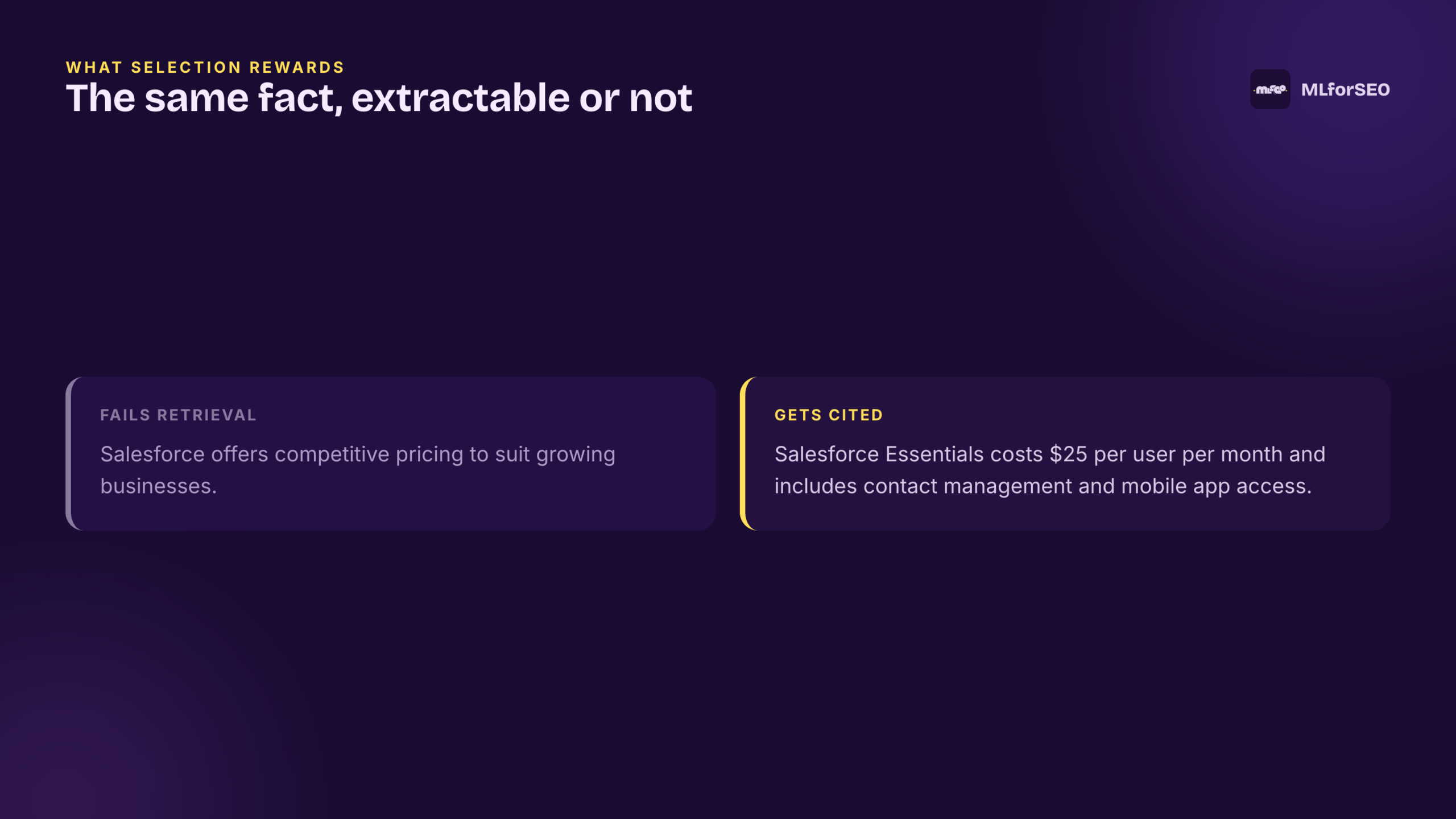
The difference between those two sentences is not a matter of writing polish. One survives extraction as a clean, verifiable fact: a subject, an action, an object, a specific value. The other dissolves the moment it is separated from the paragraph around it, and separation is exactly what these systems do. Vagueness here is not neutral. It is a disqualifier. That single reframing, from writing to be read to writing to be extracted, is where the practical work begins.
So which stage is actually dropping you?
Here is where I want to leave you, because it is the honest edge of a top-of-funnel piece. Knowing that selection happens before visibility is the mindset shift. It is necessary and it is not sufficient. The operational question is which decision, specifically, is excluding you. Every agentic system runs through four stages, which are query understanding, retrieval, evaluation, and synthesis, and your content can survive three of them and die in the fourth. Diagnosing the wrong stage is how people spend a quarter fixing crawlability when their real failure was a vague claim the generator refused to extract.
Learning to read which stage drops your content is the work of the AI Search Optimisation & Agentic SEO course. It is where the mindset shift turns into a repeatable diagnosis: a way to look at a page, locate the exact stage where it falls out of the funnel, and fix that stage rather than guessing. If you would rather begin on your own first, the course includes a downloadable 30-day action plan that walks you through a first content audit and a citation baseline across ChatGPT, Perplexity, and Claude. Start there, and bring your questions to the MLforSEO community. But start from the right sentence: your AI search problem is almost never a ranking problem. It is a selection problem, and selection is a decision you can learn to influence.
Free templates from the course
▾ 30-Day Agent Search Optimization Action PlanMLforSEO Academy
Take your skills further — pick your path
AI Search Optimisation & Agentic SEO
by Beatrice Gamba
How agentic systems retrieve, evaluate and select — and how to become the source they cite.
View course →AI Search, LLMs, Entity SEO & Knowledge Graph Strategies
by Beatrice Gamba
Build the entity authority and knowledge-graph presence that makes AI recognise and trust your brand.
View course →Semantic ML-enabled Keyword Research
by Lazarina Stoy
Query understanding, search intent and semantic clustering for how people and AI really search.
View course →Introduction to Machine Learning for SEO
by Lazarina Stoy
Ship practical ML workflows — classification, clustering, entity extraction — no CS degree required.
View course →