 By Beatrice Gamba· August 3, 2026
Your positions can be green while AI never cites you. That is not a coverage gap in your tools. It is a category error, and the signal you need is already in your analytics.
Open your rank tracker. If you have been doing this a while, it is probably green. Your positions are holding, maybe even improving, and by the only scoreboard the SEO industry built, you are fine. Now open ChatGPT and ask it the question your best page is built to answer. Watch it recommend three competitors and not you. Both of these things are true at once, and if that does not unsettle you, it should, because it means your instrument and your reality have come apart.
Rankings and traffic have become the wrong scorecard for AI search. Not an incomplete scorecard. The wrong one. I want to be precise about why, because the usual reaction is to assume the tools will catch up and start reporting AI positions any week now. They will not, and the reason they will not is structural, not a matter of time.
This is a category error, not a coverage gap
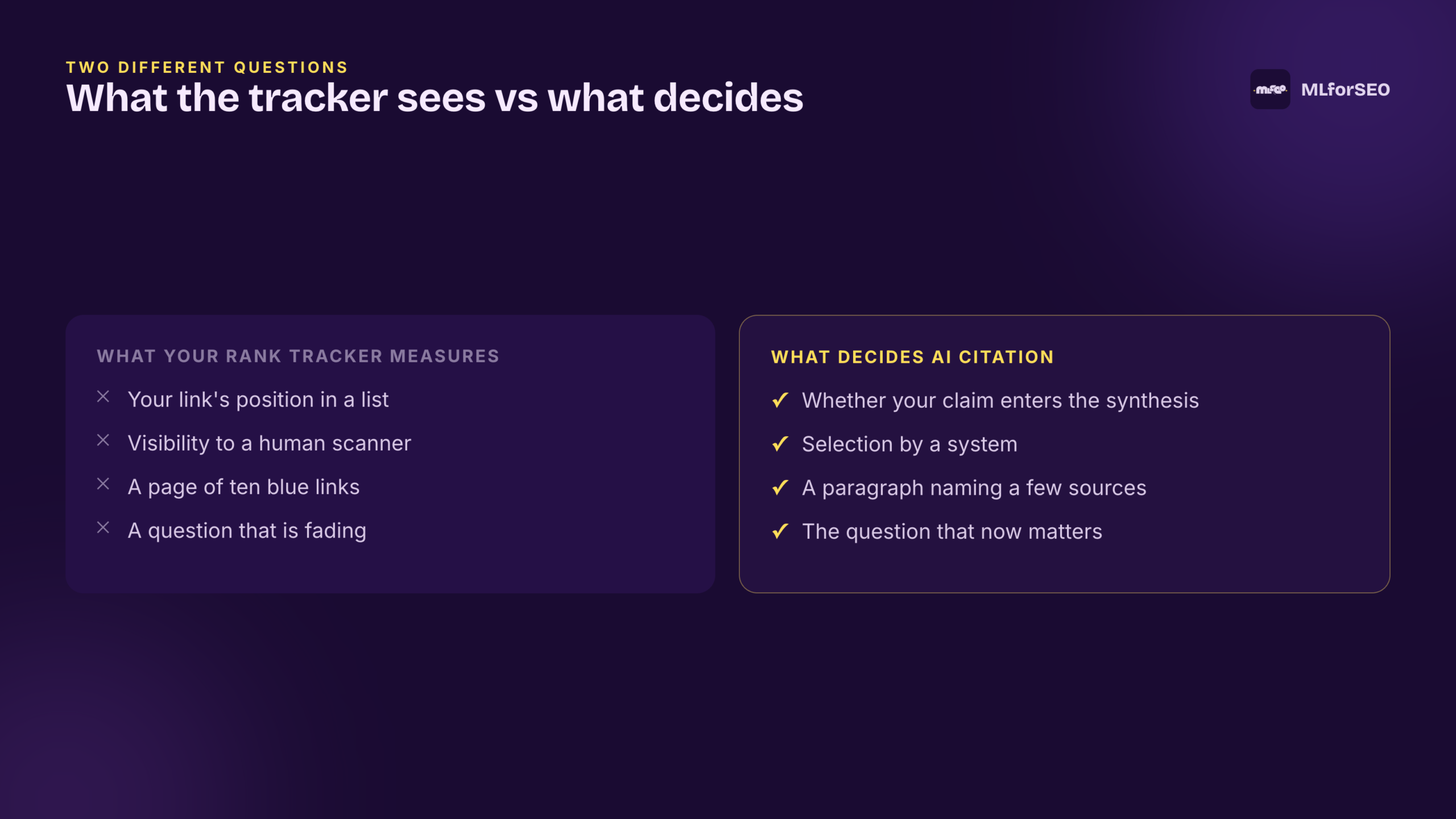
When you use rank tracking to assess your performance in agentic search, you are using a thermometer to measure air pressure. The thermometer works. It is accurate. It is simply built to answer a different question. Ranking measures visibility to humans, which is where your link sits on a page a person scans. It does not measure selection by a system, and it does not measure whether your claim was included in a synthesised answer. Those are different physical quantities. No amount of refining the thermometer turns it into a barometer. This is not a measurement gap. It is a measurement category error.
I have argued the underlying shift at length in indexed is not selected“>indexed is not selected: being retrievable is not being chosen, and the choosing happens before a reader ever sees the answer. If ranking measured selection, this piece would not need to exist. It doesn’t, so it does.
Why a rank tracker structurally cannot see selection
Think about what a rank tracker actually does. It issues a query, it reads the results page, it records where your URL appears in an ordered list. Every part of that depends on there being an ordered list of links for a human to choose from. Agentic systems remove the list. There is no position four to occupy when the output is a paragraph that synthesises claims from five to ten sources and names two of them. The unit your tracker was built to locate, which is your link in a ranked sequence, is simply not present in the thing you are trying to measure.
And selection fails in ways a ranking tool has no column for. There is zero-click influence, where the decision is made entirely inside an AI conversation and you rank nowhere that matters. There is synthesis without attribution, where your claim is absorbed as general knowledge and no link is shown at all. And there is delayed attribution, where someone learns about you inside an AI answer on Tuesday and types your address on Friday. Your tracker sees none of these. Worse: the third one does get recorded, just filed under the wrong cause.
The traffic is already in your analytics, wearing a disguise
Here is the part that changes how people look at their own data. The most valuable traffic AI sends you is already in your analytics, categorised as direct. Roughly seventy percent of AI-influenced traffic arrives with no referrer attached, so it lands in the direct bucket alongside people typing your address from memory. It is not missing. It is mislabelled. When someone reads about you in ChatGPT on their phone and then comes to your site, there is frequently no referrer header passed at all, and direct is where anonymous arrivals go.
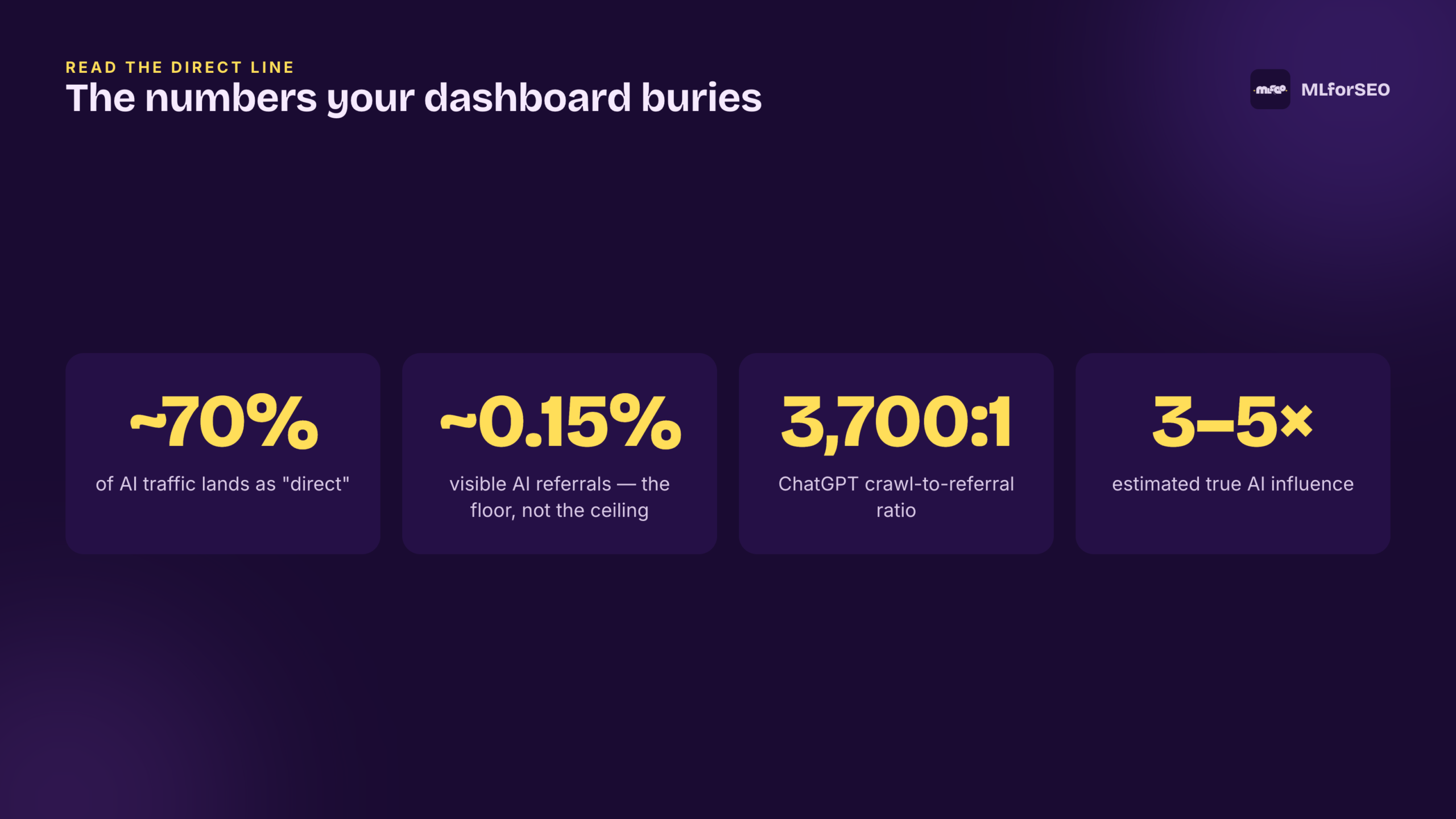
Sit with those numbers, because they reframe the whole exercise. Visible AI referrals show up at around zero point one five percent of all traffic. That is the figure people quote to argue AI search does not matter yet. But it is the floor, not the ceiling. It is only the fraction that happens to pass a clean referrer. True AI influence is estimated at three to five times what you can measure directly. And the crawling tells its own story: ChatGPT’s crawl-to-referral ratio runs at roughly three thousand seven hundred to one, meaning it reads your site around three thousand times for every visitor it sends you. Your analytics is showing you the floor, not the ceiling.
So when a client tells me AI is less than a percent of traffic and they will deal with it later, I ask them to stop reading the referral line and start reading the direct line. The signal is there. It is just not where the tools trained you to look for it.
And it is worth reading, because this is not low-value traffic hiding in the direct bucket. The visitors AI does send arrive further down the decision than an organic click. Someone who read a considered AI answer about your product and then came to you is closer to buying than someone who landed from a broad search. In the properties I have seen, AI-referred traffic converts at roughly a ten percent transactional rate against about two percent for non-AI, and it has been growing by more than five hundred percent year over year. So the channel you are underreading is also, per visit, one of the more valuable ones. Dismissing it because the referral line is small is the exact inversion of what the numbers are telling you.
Citation rate is the KPI that replaces position
If position is the wrong number, what is the right one? The single most useful metric to move to first is citation rate: across a fixed set of representative questions your customers actually ask, how often are you named in the AI answer? It is the agentic-search equivalent of rankings, and it behaves like an authority signal because it is one. Being consistently named as the source for a specific claim is what builds brand presence inside these systems. As a rough calibration, unoptimised content tends to sit at a five to fifteen percent citation rate; deliberate work moves it toward forty to sixty.
And a count is not the whole story: citation frequency is a count, citation quality is a judgment. Being named once as the best-fit primary recommendation is worth more than being listed five times in passing, and being cited for the wrong use case can be worse than not being cited at all, because it brings you the wrong users. Scoring that quality properly has its own rubric, and that rubric lives in the course rather than in this paragraph. But you can begin with the simple count and already be measuring something truer than your rank tracker reports.
Leading indicators, so you stop reacting late
One more idea and then I will hand you something to do. Most teams measure only lagging indicators, which are traffic, conversions, and the citations themselves, which means every problem reaches them a month or two after it started. By the time you see the traffic drop in analytics, the upstream cause happened weeks, sometimes a few months, earlier. There are earlier signals. Entity-confidence changes precede citation-rate changes by four to eight weeks. A crawl spike precedes retrieval by two to four weeks; it is a leading indicator, not a lagging one. Measure only the bottom of the chain and you are always reacting. Watch the top of it and you can get ahead.
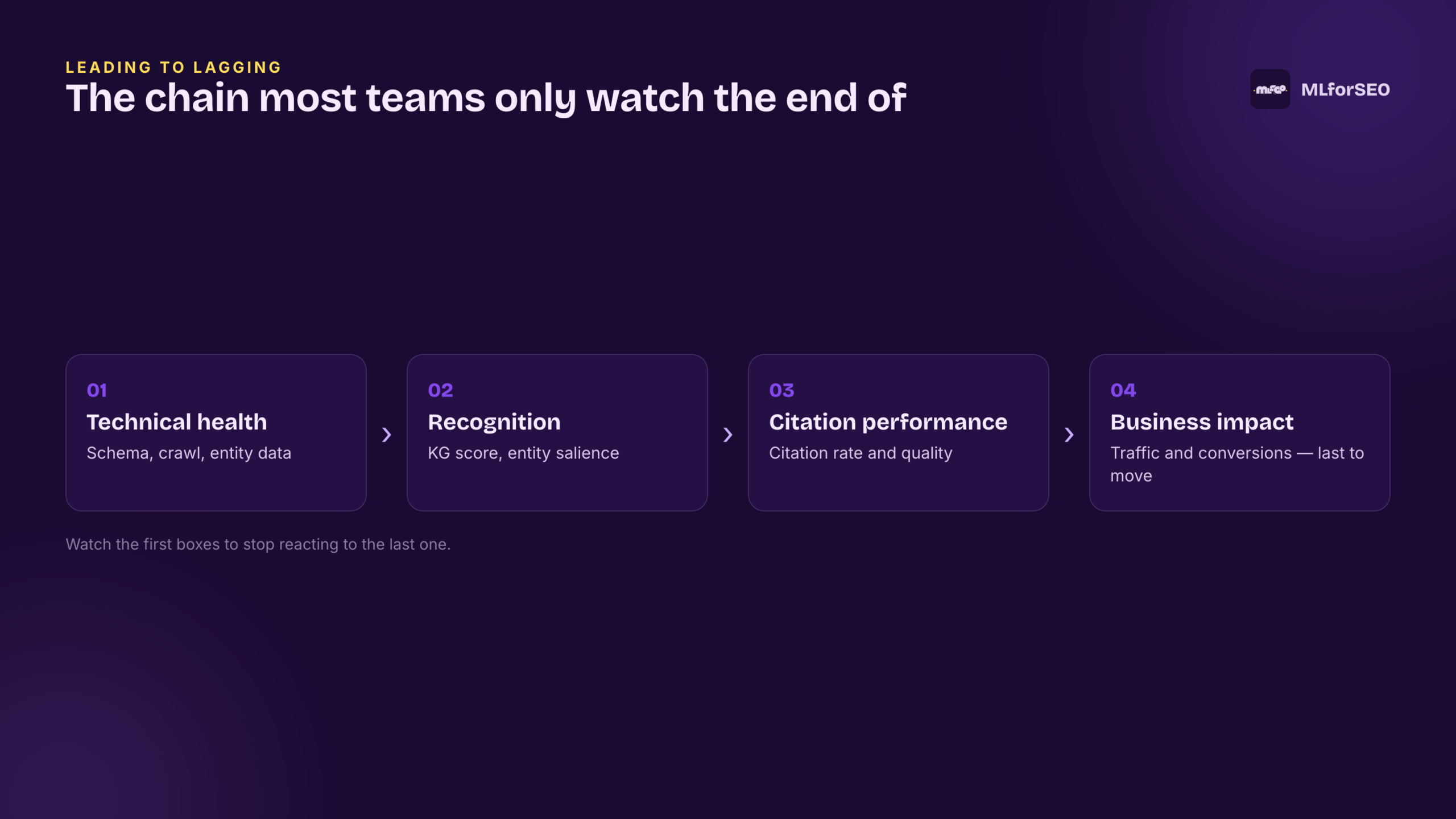
The point of the chain is not the specific tiers, it is the direction of causation. Technical health drives recognition, recognition drives citation, citation drives business impact. If you only watch the last box, you learn about every problem after it has already cost you. The full stack, meaning which signals to read weekly, monthly, and quarterly, and how to score each one, is the measurement system I teach in the AI Search Optimisation & Agentic SEO course. What I want you to leave with today is smaller and immediately usable.
Two things you can check today
You do not need a paid tool for either. First, calculate your direct-versus-branded-search delta. Pull the trend of your direct traffic and put it next to the trend of your branded search in Search Console. If direct is climbing much faster than branded, say direct up eighteen percent month over month while branded search is up three, that fifteen-point gap is very likely dark AI traffic with no referrer to declare itself. Branded search is a decent proxy for genuine unprompted demand; when direct sprints ahead of it, something is sending you people who never passed through a referrer, and today that something is usually an AI answer.
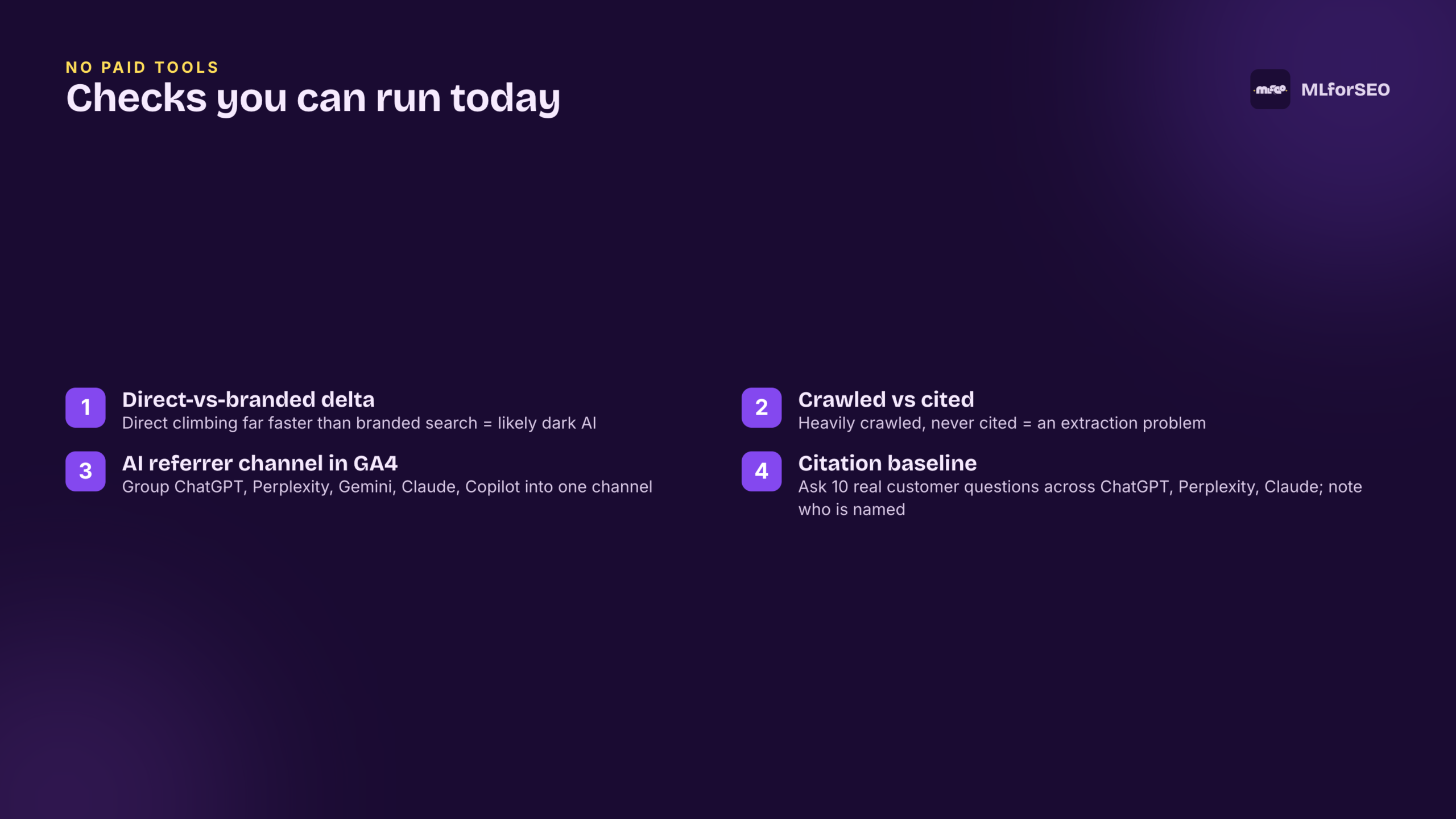
Second, if you can reach your server logs, compare the pages AI bots crawl most against the pages you are actually cited for. A resource being crawled eight hundred times a week and cited zero times is not a visibility problem. It is an extraction problem, and it tells you exactly where to look next. Neither of these is the full measurement system, and neither pretends to be. They are the two checks that most quickly prove to you that the rank tracker has been answering the wrong question all along.
Because that is really the argument. Your rank tracker is not lying out of malice. It is answering, accurately, a question that has stopped being the important one. The important question is whether these systems consider you, select you, and cite you, and that is measurable, just not with the instrument on your dashboard. A structured way to track it, a citation-rate tracking spreadsheet to run it on a consistent schedule, and the seven proxy signals that sit underneath it are what the course builds. Start with the two checks above, then come and compare notes in the MLforSEO community. I would like to see what your direct line has been hiding.
Free templates from the course
▾ LLM Citation Tracking: 4-Step Guide▾ 7 Alternative Signals of AI InfluenceMLforSEO Academy
Take your skills further — pick your path
AI Search Optimisation & Agentic SEO
by Beatrice Gamba
How agentic systems retrieve, evaluate and select — and how to become the source they cite.
View course →AI Search, LLMs, Entity SEO & Knowledge Graph Strategies
by Beatrice Gamba
Build the entity authority and knowledge-graph presence that makes AI recognise and trust your brand.
View course →Semantic ML-enabled Keyword Research
by Lazarina Stoy
Query understanding, search intent and semantic clustering for how people and AI really search.
View course →Introduction to Machine Learning for SEO
by Lazarina Stoy
Ship practical ML workflows — classification, clustering, entity extraction — no CS degree required.
View course →