 By Beatrice Gamba· August 5, 2026
A page can rank, read well, and still be useless to an AI answer engine. The reason is usually at the sentence level, and it is not neutral.
There is a kind of sentence that sounds professional, reads smoothly, and is completely useless to a machine. “Our platform offers flexible pricing to suit businesses of every size.” A human skims past it without complaint. An AI answer engine cannot do anything with it at all. There is no value to extract, nothing to verify, nothing specific to cite. So the sentence is not weak. It is eliminated.
This is the point that takes the longest to land, so let me state it plainly. Vagueness is not neutral. In agentic search it is a disqualifier. When the system is choosing which claims to synthesise into an answer, a claim it cannot pin down is not a slightly worse candidate that ranks a little lower. It is simply not selected. And most marketing copy is vague by design, because it was engineered to be evocative rather than precise. Those are not the same goal, and one of them now costs you citations.
This piece is about the sentence, not the page. It follows the funnel in the five-stage retrieval funnel and the chunk-level structure in the chunk, not the page, and it goes one level deeper, to the individual claim that either survives the machine’s evaluation or does not. There is a simple test, and there is a set of rewrite rules, and you can apply both today.
Three properties every claim needs
A claim that gets selected tends to have three properties at once. It is extract-friendly, it is verifiable, and it is specific. Let’s dive into each with a concrete pair, because the difference is easier to see than to describe.
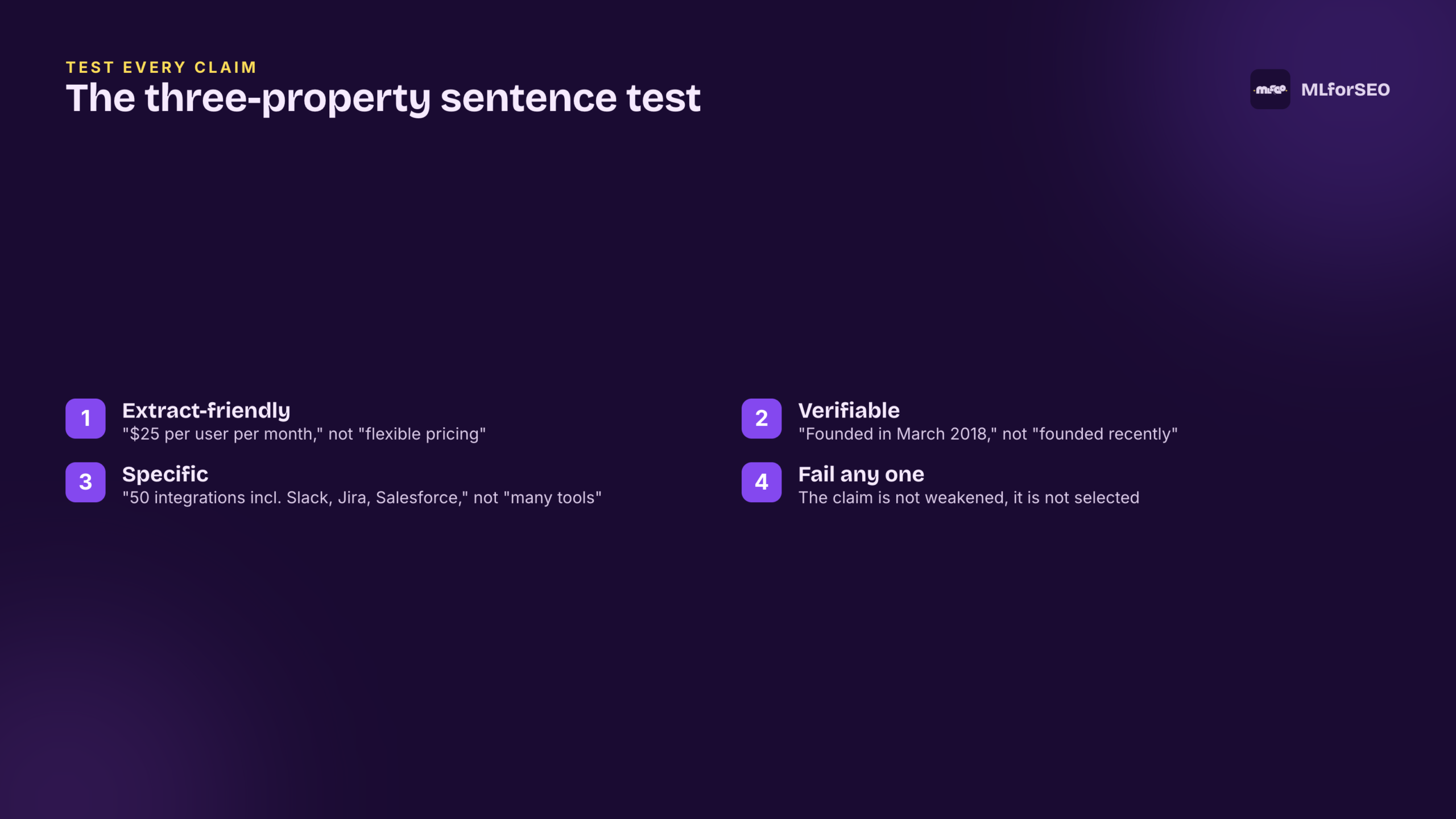
Extract-friendly means the value is stated as a fact the system can lift out cleanly. “Costs twenty-five dollars per user per month” is extract-friendly. “Flexible pricing options” is not, because there is nothing to lift. Verifiable means the claim can be checked against another source. “Founded in March 2018” is verifiable, because a system can cross-reference that date against Crunchbase, LinkedIn or Wikipedia. “Founded recently” is not, because there is nothing to confirm. Specific means the claim resolves to exact detail. “Fifty integrations including Slack, Jira and Salesforce” is specific. “Integrates with many popular tools” is not, because “many” and “popular” name nothing.
Notice that these three are not writing preferences. They map onto what the system actually does. It extracts, so the claim must be extractable. It cross-checks against external sources, so the claim must be verifiable. It matches meaning precisely, so the claim must be specific. A sentence that fails any one of the three gives the machine less to work with, and less, at this level, often means nothing.
Why marketing language fails on purpose
It is worth being honest about where the vague sentences come from, because they are not accidents. Marketing language is particularly problematic here because it is specifically engineered to be evocative rather than precise. “World-class solution,” “industry-leading performance,” “best-in-class capabilities.” These phrases are built to make a human feel something and to avoid committing to a claim a competitor could contest. That is a reasonable goal for a billboard. It is a disqualifying property for a claim that an agent is trying to verify.
I use my own biography as the example in the course, because it fails in an instructive way. It scores well on one property and badly on the others: it names real entities, so it is extract-friendly, but it has no dates or quantified facts, so it is not verifiable, and it leans on phrases like “cutting-edge technology” and “passionate about,” so it is not specific. Which does not mean the bio is badly written. It means it was written for a human reader, and it needs different sentences to survive a machine one.
And this is why the fix is not “write less like a marketer” in some vague, stylistic sense. The problem is precise. A human reads “trusted by growing teams everywhere” and infers scale, safety, momentum. A system reads the same phrase and finds no entity, no number, no scope, so it stores nothing and cites nothing. The evocative sentence was doing real work for one reader and zero work for the other. You are not choosing between persuasive and precise. You are making sure the persuasive sentence also carries a claim underneath it.
Marketing language is engineered to be evocative rather than precise. In agentic search, that is a disqualifying property.
The four rewrite rules
The good news is that fixing this is mechanical. You do not need inspiration, you need four rules, and they apply universally, to every claim that matters.
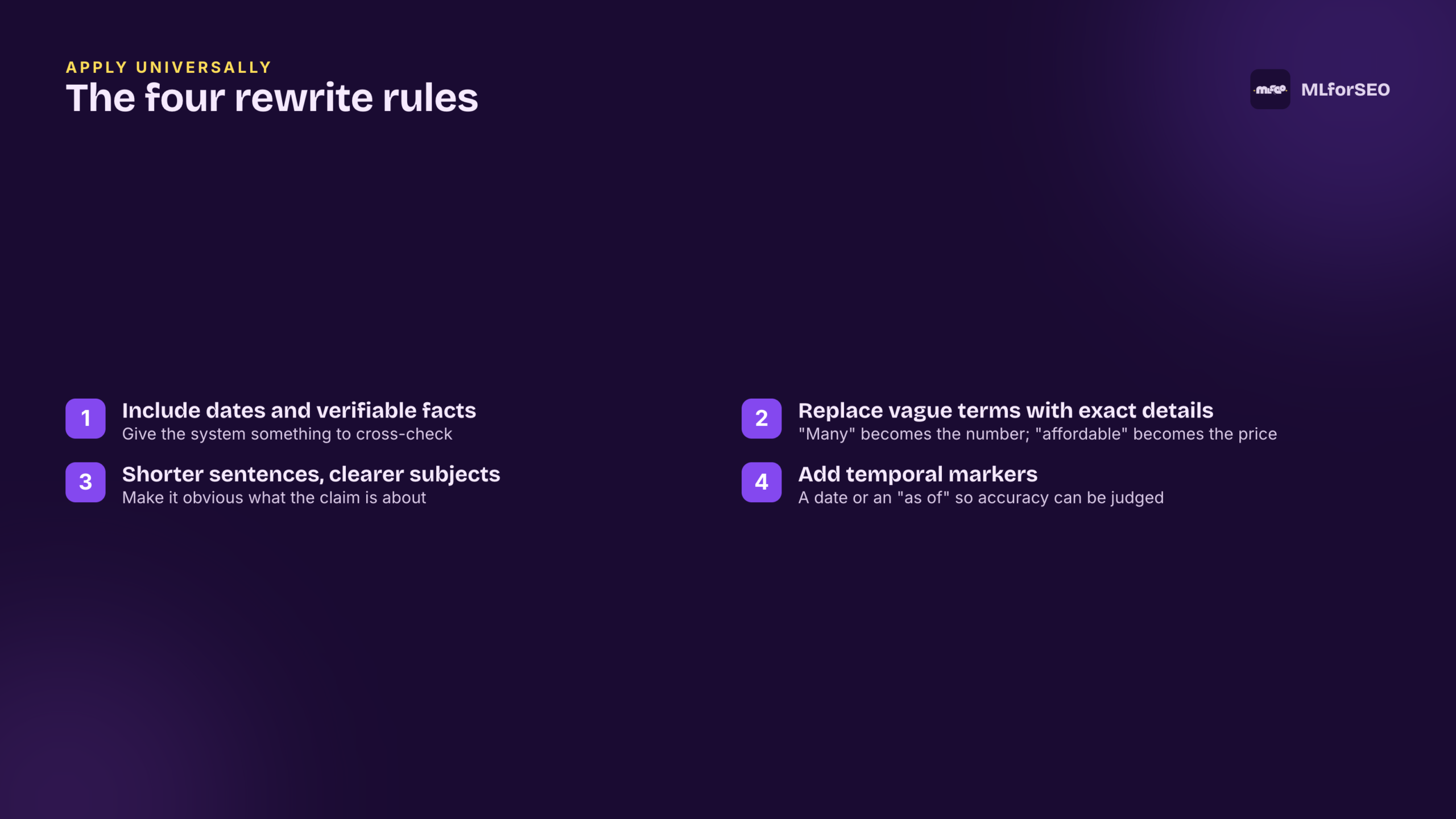
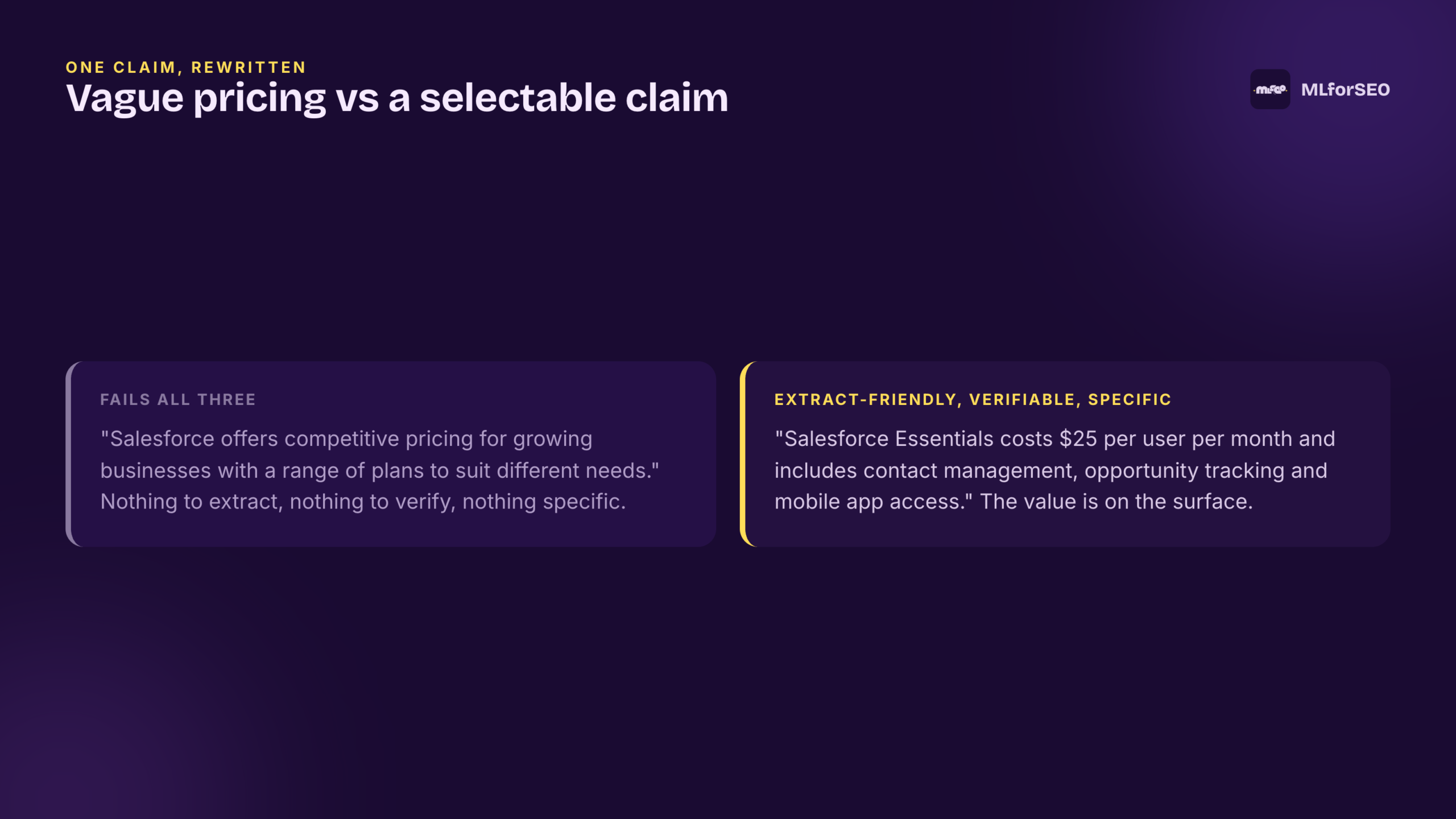
First, always include dates and verifiable facts. Second, replace vague terms with exact details: “many integrations” becomes “fifty integrations,” “affordable” becomes the actual number. Third, use shorter sentences with clearer subjects, so the machine can tell what the claim is even about. Fourth, add temporal markers, a date or an “as of,” so the system can assess how current the claim is. Run any evocative sentence through those four and you get a sentence the machine can select. Run “we offer competitive pricing for growing businesses” through them and you get “Salesforce Essentials costs twenty-five dollars per user per month and includes contact management, opportunity tracking and mobile app access.” One of those is extractable. The other, of course, is not.
Density is the ratio, not the word count
There is a measure that sits underneath all of this, and it reframes what a “good” page even is. Information density is the ratio of distinct verifiable claims to total words. Not the word count. The ratio. A four-hundred-word document with five specific verifiable claims beats a two-thousand-word document padded with framing, restated introductions and transitional filler, because the padded version dilutes its own signal and raises the cost of extracting anything useful from it.
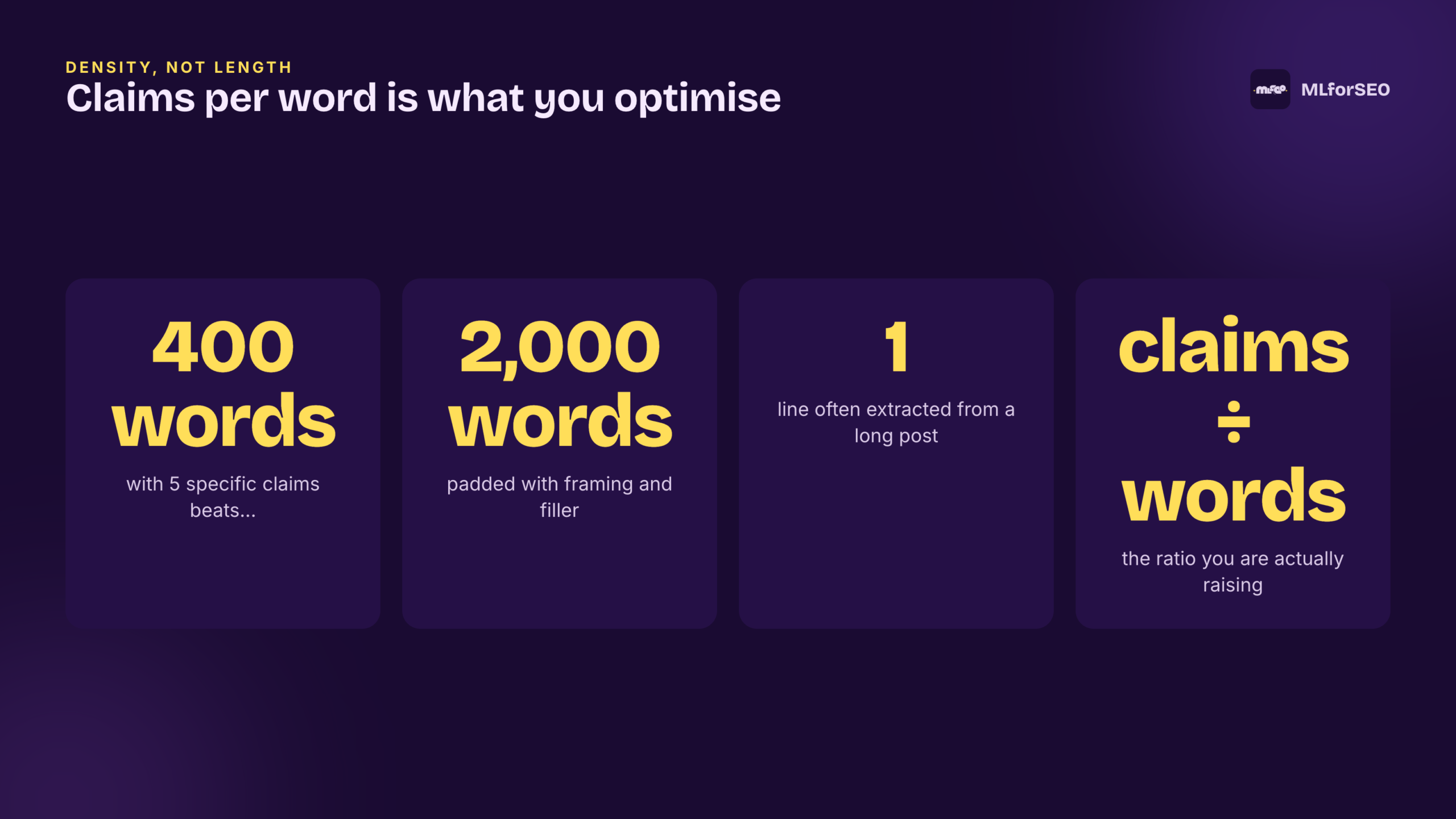
Put bluntly, fifteen hundred words of padding is worth less than three hundred words of precise technical content. This is why the instinct to “add more” so often backfires in AI search. When a system pulls from a two-thousand-word SaaS post, it may extract exactly one line, the “five to seven percent monthly churn in the SMB segment,” and ignore the rest. Everything around that line was cost, not contribution. Density is what you are actually optimising, and you raise it by cutting the query-restating intros and the repeated conclusions, not by writing more of them.
There is a quiet discipline that follows from this. Every sentence in a section either carries a distinct verifiable claim or it does not, and the ones that do not are pulling your ratio down. That is not an argument for terse, joyless pages. It is an argument for knowing which of your sentences are load-bearing. The framing sentences can stay, of course, but they should be surrounding a claim, not standing in for one. When most of your paragraph is warming up to a point it never quite states, the machine gets nothing to extract and moves on to a competitor who stated it in the first line.
A worked pass over one sentence
Let’s take one sentence all the way through, because the test is only useful if you can feel it working. Start with: “Salesforce offers competitive pricing for growing businesses with a range of plans to suit different needs.” Run the three-property test. Extract-friendly? No, there is no value to lift. Verifiable? No, there is nothing to check. Specific? No, “range” and “different needs” resolve to nothing. It fails all three, so as a claim it is invisible.
Now apply the four rules. Add the fact and the number, replace the vague terms with the exact plan and price, shorten the subject, add the scope. You arrive at something like: “Salesforce Essentials costs twenty-five dollars per user per month and includes contact management, opportunity tracking and mobile app access.” That version is extract-friendly, verifiable and specific. The information was always available to you. The first sentence just refused to state it. The fix is direct.
The reason this matters more than it looks is what happens next in the pipeline. As I explain in the five-stage retrieval funnel, before a system writes an answer it cross-checks claims against external sources. A verifiable claim, “founded in March 2018,” can be confirmed against Crunchbase, LinkedIn and Wikipedia, and if they agree it is trusted. A vague claim, “founded recently,” gives the cross-check nothing to grip, so it cannot rise in confidence no matter how authoritative your domain is. Specificity is not a matter of tone. It is what makes a claim eligible for the verification step at all, and claims that are not eligible are not selected.
Where this goes next
None of this asks you to write worse, or to strip the personality out of your pages. It asks you to make sure that the claims that matter, the ones you actually want cited, carry their value on the surface where a machine can reach it. Keep the human writing. Add the extractable claim. The two are not in conflict, they simply serve two different readers, and one of those readers now decides whether you appear in the answer at all.
The way to make this a habit rather than a one-off audit is to run it as a short structured programme. In the course I hand over a 30-day action plan that walks you from a content audit of your ten most important pages, through fixing the entities behind them, into rewriting vague claims into specific ones, and ends by testing your citation rate across ChatGPT, Perplexity and Claude so you have a real baseline. Vagueness is where most of the loss hides, and it is one of the most fixable things you have. The next step from here is the structure those sentences live in, which is the chunk, not the page.
MLforSEO Academy
Take your skills further — pick your path
AI Search Optimisation & Agentic SEO
by Beatrice Gamba
How agentic systems retrieve, evaluate and select — and how to become the source they cite.
View course →AI Search, LLMs, Entity SEO & Knowledge Graph Strategies
by Beatrice Gamba
Build the entity authority and knowledge-graph presence that makes AI recognise and trust your brand.
View course →Semantic ML-enabled Keyword Research
by Lazarina Stoy
Query understanding, search intent and semantic clustering for how people and AI really search.
View course →Introduction to Machine Learning for SEO
by Lazarina Stoy
Ship practical ML workflows — classification, clustering, entity extraction — no CS degree required.
View course →