 By Beatrice Gamba· August 21, 2026
The AI referral line in your analytics is not small because AI is not sending traffic. It is small because most of that traffic arrives with its label stripped off. Let’s go and find it.
A client tells me, most weeks, some version of the same thing. “We looked at the AI referral line. It is under one percent of traffic. We will deal with it when it gets bigger.” The number they are quoting is real. It is also the single most misleading figure in your analytics right now, because it is measuring the wrong thing with quiet confidence. Let’s dive into why, and then let’s go and find the traffic that line is hiding from you.
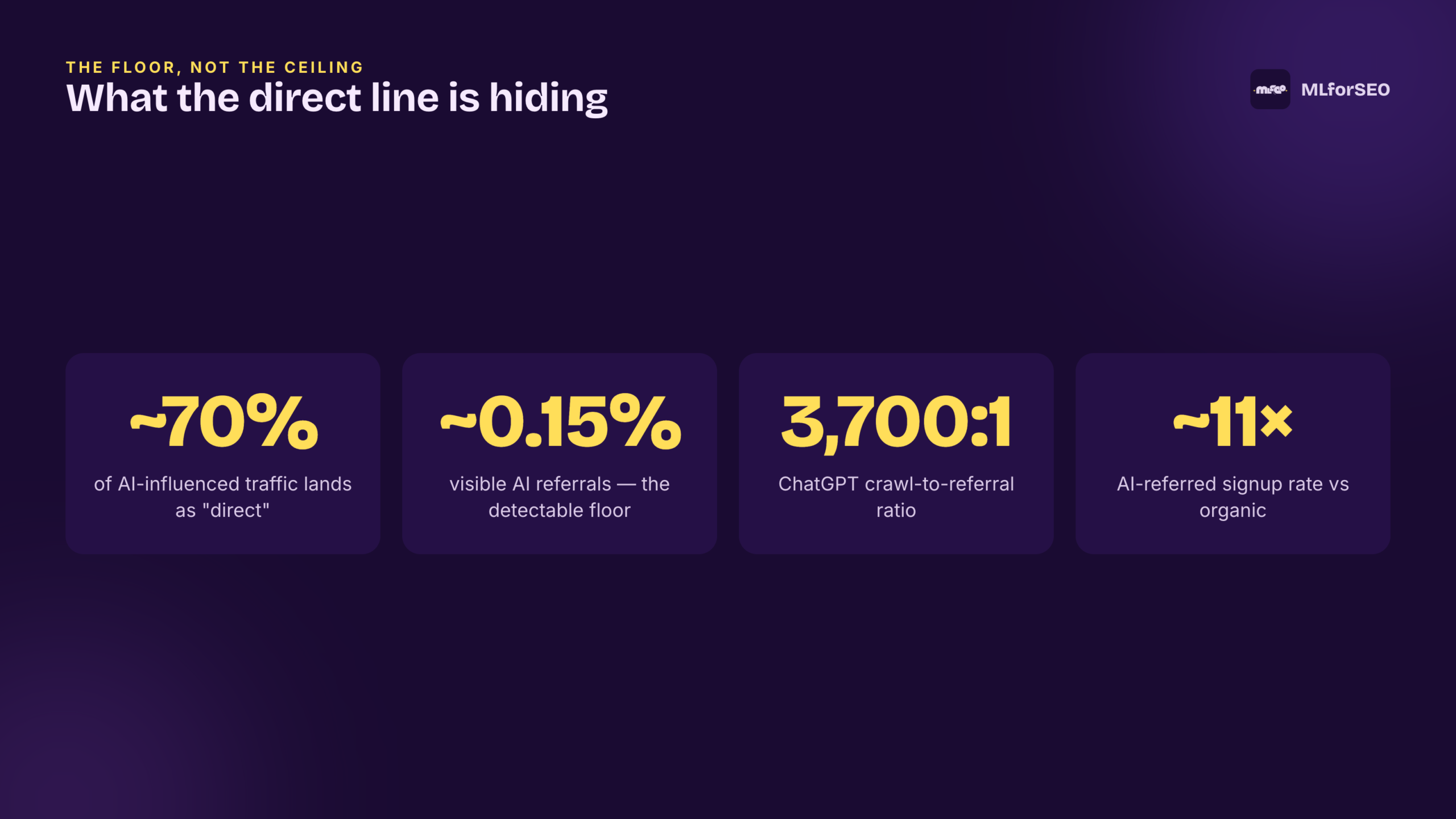
Here is the mechanism. When someone reads about you inside ChatGPT on their phone, or inside an AI Overview, and then arrives at your site, there is frequently no referrer header passed. Analytics has to put anonymous arrivals somewhere, and the somewhere is called direct — the same bucket as people typing your address from memory or opening a bookmark. So the most valuable traffic AI sends you is already in your analytics, categorised as direct. It is not missing. It is mislabelled. Roughly seventy percent of AI-influenced traffic lands there, with no source attached, sitting in plain sight under the wrong name.
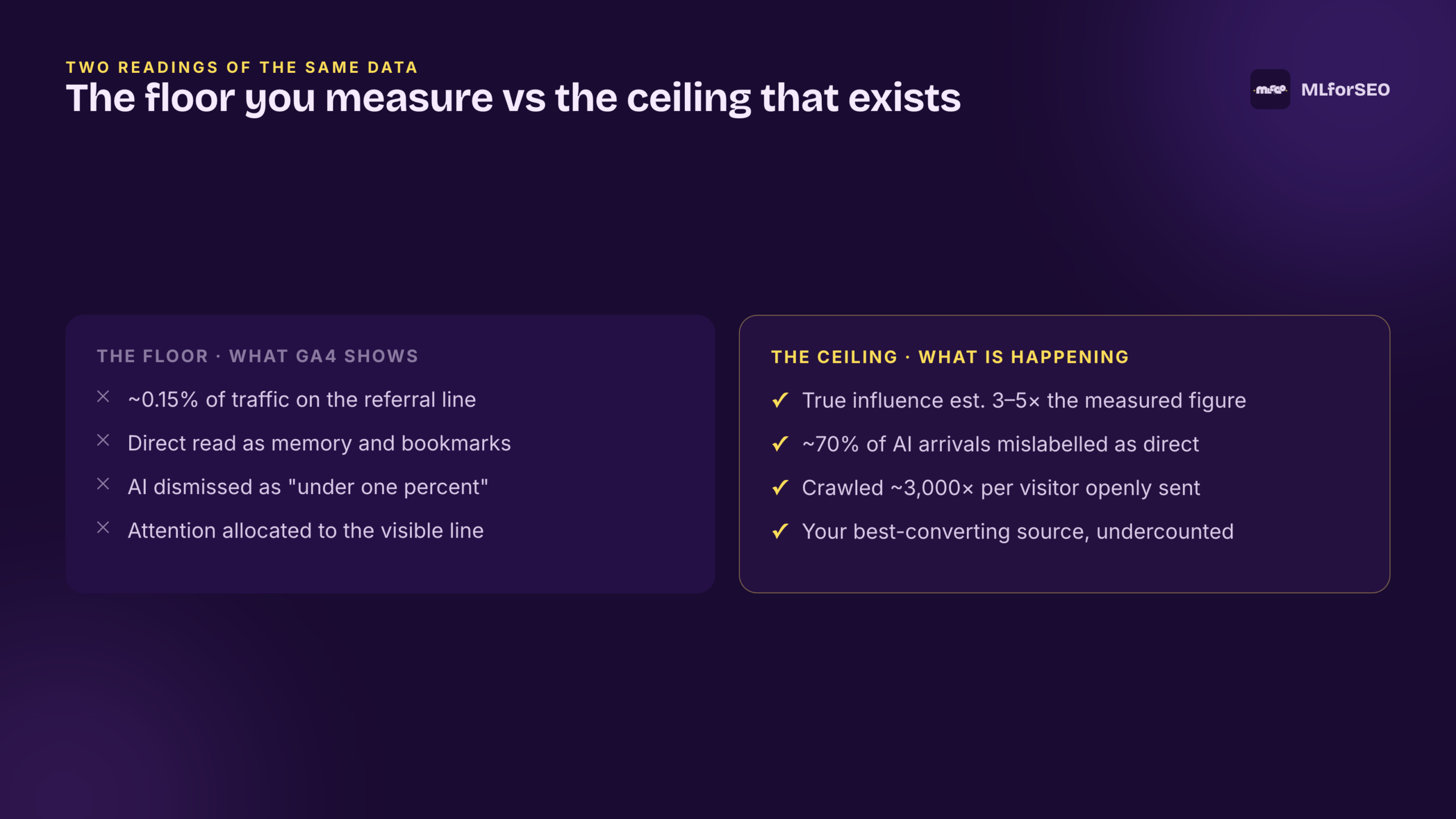
This is what I call dark AI traffic: visible in aggregate, invisible by source. And the reason it matters is not tidiness. It is that the visible AI-referral channel — the line the client was reading — is the detectable floor, not the ceiling. GA4 is showing you the floor. Everything real is happening above it, and the gap between the two is large enough to change how you spend your next quarter.
Three ways your AI influence goes dark
Standard metrics miss AI influence in three specific ways, and it is worth naming them separately because they call for different responses. Once you can see the three, you stop treating a flat referral line as evidence of a flat impact.
- Zero-click influence. The decision is made entirely inside the AI conversation. The user reads a synthesised answer, forms a view, and never clicks anything. You may have shaped the decision and you rank nowhere that a tool can see.
- Synthesis without attribution. Your material is absorbed into the answer as general knowledge, with no link and no name. Your claim did the work; the citation went to nobody. This is the hardest to detect and often the most common.
- Delayed attribution. Someone discovers you inside an AI answer on Tuesday, thinks about it, and types your URL on Friday. That visit is logged as direct, days after and one step removed from the thing that actually caused it.
Notice that only the third of these leaves any residue in your analytics at all, and even that residue is filed under the wrong cause. This is why you cannot argue about AI’s impact from the referral line alone. Two of the three influence paths never touch it, and the third touches it wearing a disguise.
Not every platform goes dark to the same degree
It helps to stop treating “AI traffic” as one undifferentiated thing, because the platforms sit at very different points on a trackability spectrum, and knowing where each one falls is the first step to a measurement approach that is not guesswork. At the trackable end, Perplexity passes a consistent referrer, so its visits arrive labelled and you can actually see them. In the middle sits ChatGPT desktop, which is partially trackable: it began appending a UTM parameter in June 2025, so recent desktop visits are attributable while everything before that date is simply gone. At the dark end are ChatGPT on mobile, AI Overviews inside Google, and the oldest channel of all — someone copying an answer and pasting your name into a new tab. Those pass nothing, and no amount of tooling recovers a referrer that was never sent.
So the darkness is not uniform, and that is oddly reassuring: it means part of your job is measurement design rather than resignation. You capture what Perplexity and post-June ChatGPT desktop hand you cleanly, and for the genuinely dark channels you switch to inference — the direct-versus-branded delta below is exactly that kind of inference. The mistake is to let the dark portion convince you the whole picture is unknowable. It is partly directly measurable and partly inferable, and almost none of it is truly invisible once you decide to look.
The floor, the ceiling, and the distance between them
Let’s put real figures on the gap, because they are more dramatic than the caution most teams are applying. Visible AI referrals show up at around zero point one five percent of all traffic. That is the number people cite to argue AI search is not worth attention yet. But true AI influence is estimated at three to five times what you can measure directly, and the crawling data makes the mismatch vivid: ChatGPT’s crawl-to-referral ratio runs at roughly three thousand seven hundred to one, meaning it reads your site around three thousand times for every visitor it openly sends. Something is consuming your content at industrial scale and passing almost none of that consumption back to you as a labelled visit.
And the trend is not flat. Across tracked properties, AI referral traffic grew more than five hundred percent year over year into 2025 — off a small base, yes, but that is exactly the shape of a channel you want to be measuring before it is obvious, not after. When it is obvious to everyone, the cheap advantage is gone.
The traffic you cannot see is the traffic that converts
Here is the part that turns this from a measurement curiosity into a commercial argument. The AI-influenced traffic you are undercounting is not marginal, low-intent traffic. It is the opposite. AI-referred visitors convert at roughly eleven times the signup rate of organic — around a ten percent transactional rate against about two percent for non-AI traffic. The intuition behind that holds up: a person arriving from an AI answer has usually already had their options compared, their objections addressed, and their shortlist narrowed by the assistant before they ever reach you. They arrive pre-qualified.
So the situation is precisely the wrong way round from how it feels on the dashboard. The channel that looks smallest is the one carrying your highest-intent visitors, and it looks smallest because its best traffic is the traffic most likely to have its label stripped. If you are allocating attention by the size of the referral line, you are systematically underinvesting in your best-converting source. That is the real cost of leaving this dark.
Stop reacting a month late: leading vs lagging signals
There is one more reason the direct line is a poor instrument, and it is about timing. Traffic, conversions, and citations are lagging indicators — by the time you see a drop, the upstream cause happened weeks, sometimes a couple of months, earlier. As I put it in a related piece on measurement, why your rank tracker can’t see AI search, if you only watch the bottom of the chain you are always reacting to problems that have already cost you. There are earlier signals, and they are readable.
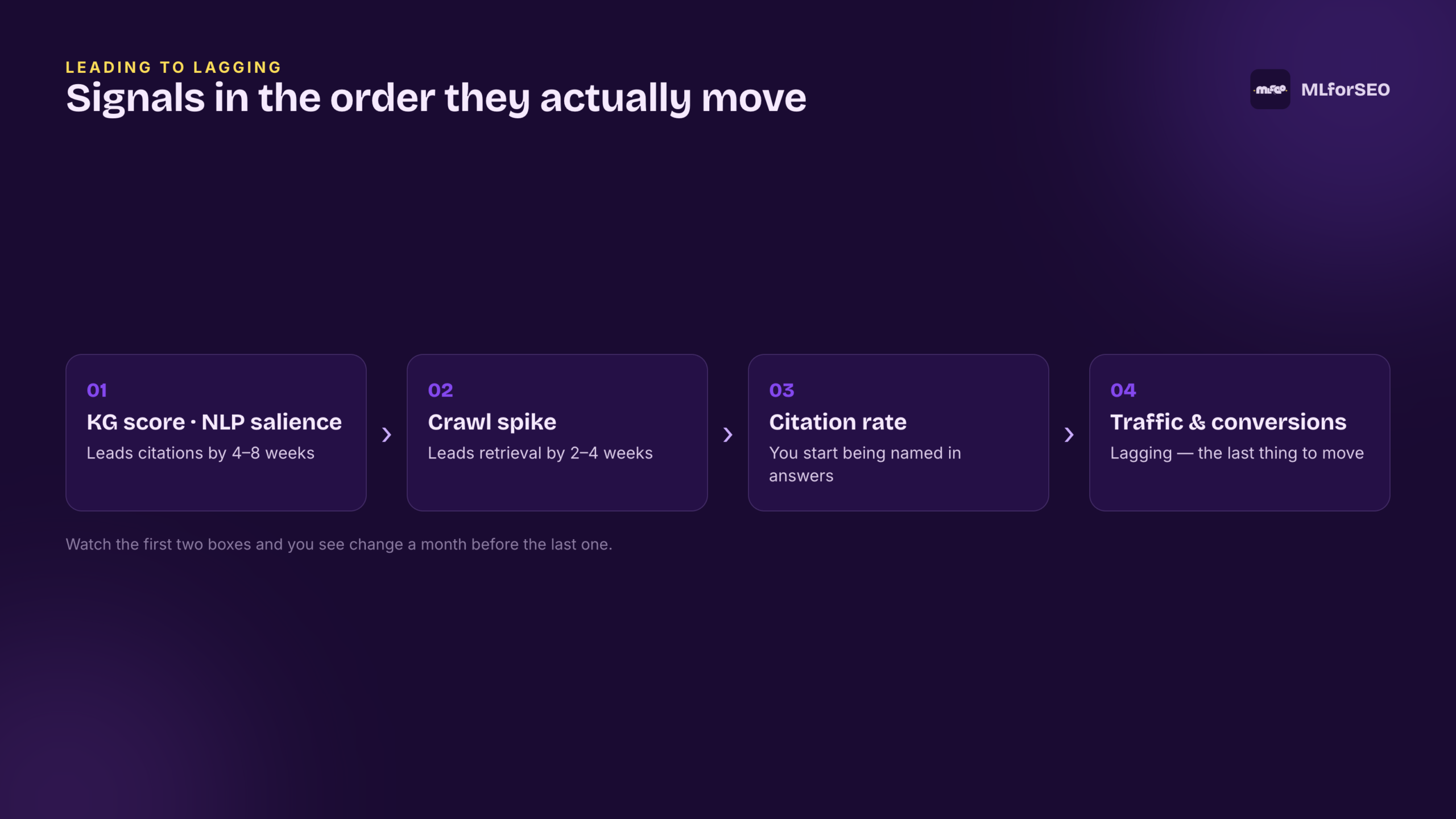
Entity-confidence changes — your Knowledge Graph result score, your NLP entity salience — precede citation-rate changes by four to eight weeks. A crawl spike precedes retrieval by two to four weeks; it is a leading indicator, not a lagging one. This is genuinely useful: it means you can see a citation gain or loss coming a month or two before it shows up as traffic, and act while acting is still cheap. Watching only direct and referral is like steering a ship by its wake.
What to do this week, with no paid tools
None of this requires a purchase, and you can start surfacing your dark AI traffic in an afternoon. Four moves, in order, and each one gives you a number you did not have yesterday.
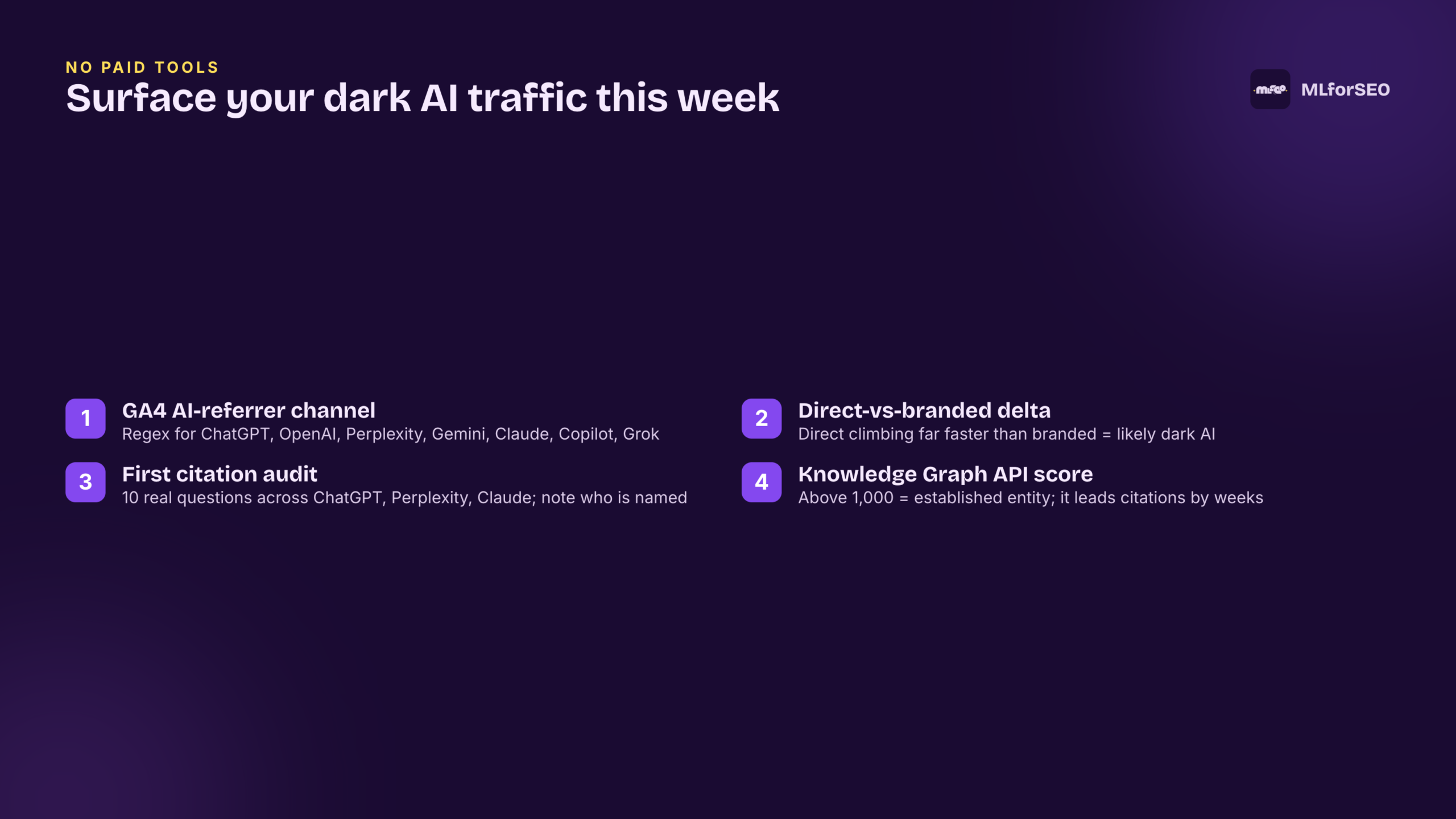
One: build an AI-referrer channel in GA4. Create a custom channel group with a regex that catches the known assistants in the referral source — ChatGPT, OpenAI, Perplexity, Gemini, Claude, Copilot, Grok. This pulls the visible fraction out of the general soup and gives you a real, if partial, baseline to watch. Note the ceiling on this: ChatGPT desktop only began appending utm_source=chatgpt.com in June 2025, so anything before that is unrecoverable, and ChatGPT accounts for the large majority of AI referral traffic, so your regex should not miss it.
Two: compute your direct-versus-branded-search delta. Put the trend of your direct traffic next to the trend of your branded search in Search Console. Branded search is a decent proxy for genuine unprompted demand for your name. If direct is climbing much faster than branded — direct up eighteen percent month over month while branded is up three, say — that fifteen-point gap is very likely dark AI arrivals with no referrer to declare themselves. When direct sprints ahead of branded, someone is sending you people who never passed through a labelled source.
Three: run your first small citation audit. Take ten real questions your customers actually ask, put each one to ChatGPT, Perplexity, and Claude, and simply record whether you are named. That is your baseline citation rate, and unoptimised content usually sits somewhere between five and fifteen percent. You do not need the full scoring apparatus to start — you need to know, honestly, how often the machine mentions you at all. The count comes first; the judgment of how well you were cited comes later.
Four: check your Knowledge Graph API result score. Query your primary entity in Google’s Knowledge Graph Search API and read the result score. Above one thousand signals an established entity; well below it signals that these systems are not yet confident who you are. Because this score is a leading indicator, it tells you today about citations that will or won’t arrive in a month or two — which makes it one of the most forward-looking free numbers available to you.
Where this goes next
So the argument in one line: the AI referral line is not small because AI’s impact is small. It is small because most of that impact arrives with its label removed, and the highest-intent slice is the most likely to arrive that way. The four checks above will not give you a perfect number — nobody has a perfect number yet — but they will replace a badly wrong assumption with a roughly right one, and that alone changes where you spend.
What they are not is the whole system. Turning these four starting checks into a repeatable practice — the seven proxy signals I track, the zero-to-three rubric for scoring citation quality rather than just counting it, and the four-tier scorecard that runs on a weekly, monthly, and quarterly cadence — is the measurement stack I build with you inside the AI Search Optimisation and Agentic SEO course. And measurement only matters because the audience changed underneath it: if you have not yet sat with why a machine reads your schema instead of your prose, your audience is no longer only human is the place to start. Run the four checks first, though. I would genuinely like to know what your direct line has been hiding.
Free templates from the course
▾ 7 Alternative Signals of AI Influence▾ LLM Citation Tracking: 4-Step GuideMLforSEO Academy
Take your skills further — pick your path
AI Search Optimisation & Agentic SEO
by Beatrice Gamba
How agentic systems retrieve, evaluate and select — and how to become the source they cite.
View course →AI Search, LLMs, Entity SEO & Knowledge Graph Strategies
by Beatrice Gamba
Build the entity authority and knowledge-graph presence that makes AI recognise and trust your brand.
View course →Semantic ML-enabled Keyword Research
by Lazarina Stoy
Query understanding, search intent and semantic clustering for how people and AI really search.
View course →Introduction to Machine Learning for SEO
by Lazarina Stoy
Ship practical ML workflows — classification, clustering, entity extraction — no CS degree required.
View course →